Full line rate and smallest size MACsec solution for 10M ports with MII interface
Home > Security IP > Secure Networking IP > MACsec-IP-360
10Base-T1S is a standard for a 10Mbit/s single-pair Ethernet over an unshielded, single-twisted pair that was introduced with the IEEE 802.3cg-2019 specification. It brings Ethernet technology into the low-cost, edge applications space, enabling connection of “edge nodes” (remote sensors, actuators, light controls, etc.) to a “head node” (host MCU, switch or gateway) using a multi-drop bus up to 25 meters in length.
The T1S physical wires are located at remote locations, like peripheral zones, and are easily accessible for potential physical intervention, where the attacker may not only read the data, but also inject its own. Therefore, protecting T1S traffic is vitally important, and IEEE802.1AE MACsec has been chosen as an industry-wide network security protocol for this purpose.
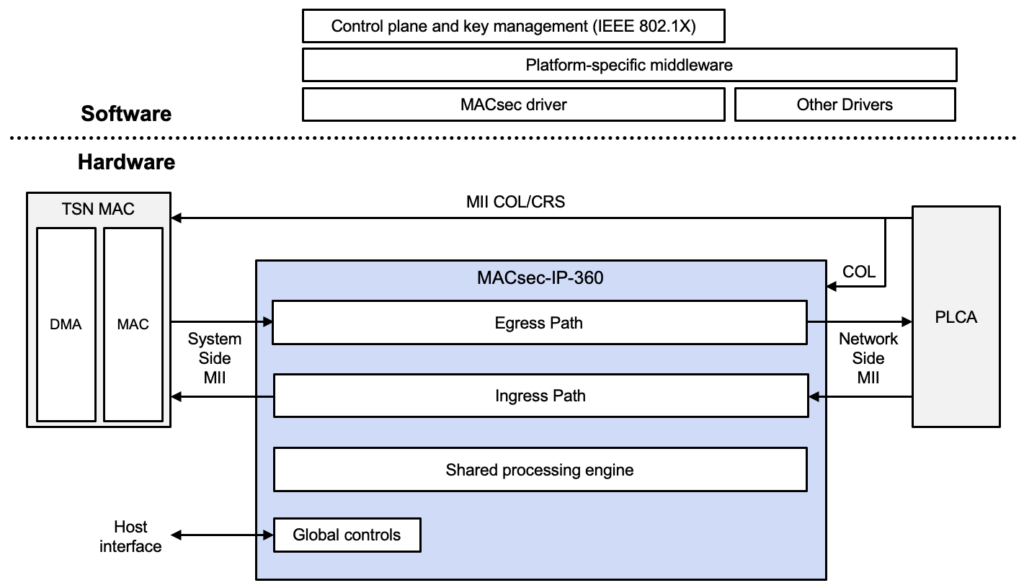
MACsec solution for integration between MAC and PCS/PLCA modules at the MII side of an Ethernet subsystem.
Fully-compliant MACsec solution supporting 10M full and half-duplex rates and supports VLAN-in-clear case.
Full IEEE 802.1AE-2018 and Open Alliance Automotive MACsec profile support.
The MACsec-IP-360 engine provides complete MACsec processing for a port. It contains programmable matching rules for the uncontrolled and controlled (MACsec) processing. It supports multiple SecY (CA).
All features and ciphers of the standard MACsec are supported. The processing results are reflected in the MACsec statistics and additional non-standard counters. The MACsec-IP-360 engine operates as a fixed delay component at the MII side, preserving accuracy of PTP timestamping and TSN scheduling created by the TSN MAC subsystem. Its operation is transparent for non-packet related information that is sent over the MII bus.
10BASE-T1S is a 10 Mb/s single-pair Ethernet technology that enables multiple devices, including sensors, actuators, and lighting controls, to communicate with a host MCU over a shared unshielded twisted-pair bus. The T1S physical wires are often located in remote locations, like peripheral zones, and are easily accessible for potential physical intervention, where the attacker may not only read the data, but also inject its own. Therefore, protecting T1S traffic is vitally important, and MACsec has been chosen as the industry-wide network security protocol.
Packet Interface
SA and classification scaling
Control Interface
Protocol Support
NIST CAVP Compliance for FIPS 140-3 Validation
Packages
Complete Documentation
Tools and Scripts
Verification Support
Integration Support
The MACsec, IPsec and SSL/TLS/DTLS protocols are the primary means of securing data in motion (communicated between connected devices). These protocols can be anchored in hardware or implemented in software as part of an end-to-end security architecture. This white paper provides fundamental information on each of these protocols including their interrelationships and use cases.