
[Last updated on April 8, 2026] MACsec (Media Access Control Security) is an Ethernet security standard that encrypts and authenticates data in motion at Layer 2 of the OSI model, protecting traffic as it moves between directly connected devices.
To achieve end‑to‑end security, data must be secured throughout its entire lifecycle: when it is stored, when it is actively processed, and when it is transmitted between devices. Hardware root of trust anchored in silicon provides foundation for securing data at rest, while inline memory encryption protects data in use. For data in motion, however, security must be enforced at the point where information first leaves the device, before it traverses a network that may not be fully trusted.
This is where MACsec plays a critical role. By anchoring security in hardware at the Ethernet layer, MACsec ensures that all network traffic is encrypted and authenticated the moment it goes on the wire. This approach protects against eavesdropping, tampering, and impersonation without relying on higher‑layer software or application changes.
In this blog, we’ll explore what MACsec is, how it works, how it compares to higher-layer security approaches, and why it is essential for modern Ethernet-based systems.
Table of Contents:
-
- What is the OSI Model and How Does it Relate to Network Security?
- What Is MACsec and Why Does It Matter?
- How Does MACsec Work at the Ethernet Layer?
- How Does MACsec Authentication and Key Management Work?
- MACsec vs. IPsec and TLS: What’s the Difference?
- What Are the Performance, Latency, and Power Considerations for MACsec?
- Where is MACsec Used Today?
- Rambus MACsec IP Solutions
- Summary: Why MACsec Matters for Modern Ethernet Security
- Frequently Asked Questions about MACsec
What is the OSI Model and How Does it Relate to Network Security?
The OSI model explains how MACsec, IPsec, and TLS secure data at different layers of the network communication.
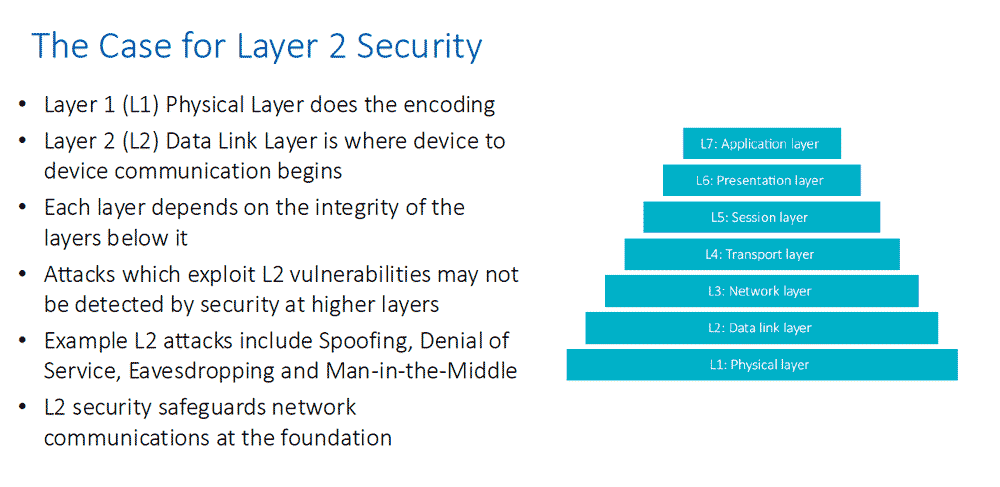
The OSI model is a seven‑layer framework for network communications, with each layer describing how data moves through a network. Each layer can also introduce its own form of security. In this section, we focus on three of those layers and the technologies commonly used to protect data in motion at each one: MACsec, IPsec, and TLS.
How MACsec, IPsec and TLS Map to the OSI Model
At Layer 2 of the OSI model, MACsec protects data as it travels between devices on the same local network, such as switch‑to‑switch, switch‑to‑host, or host‑to‑host connections. A simple way to think about MACsec is that it protects the cable itself. If someone gains access to the physical network, MACsec ensures the data on the wire is encrypted and cannot be read or altered. Because Layer 2 is the last point where data exists in clear form before leaving a device, securing traffic here stops attacks like sniffing, spoofing, and unauthorized monitoring early, without relying on higher‑level software behaving correctly. Layer 2 security provides a strong foundation for network protection.
Internet Protocol Security (IPsec) operates at Layer 3, the network layer. Rather than securing a single physical link, IPsec protects data as it moves between networks, including traffic that traverses the public internet. This makes IPsec well suited for use cases such as site‑to‑site and remote access VPNs, where data must be protected across longer distances and multiple network hops.
Transport Layer Security (TLS) sits near the top of the stack, typically at Layer 4 and above, and focuses on securing individual application communications. A familiar example is the “https” prefix in a web browser. TLS encrypts specific conversations, such as a browser accessing a website or an application calling an API, ensuring the data remains confidential, the server is authenticated, and the communication cannot be tampered with.
Together, these technologies demonstrate how security can be applied at different layers of the network stack, with MACsec protecting the link, IPsec protecting network paths, and TLS protecting application‑level communication.
What Is MACsec and Why Does It Matter?
Defined by the IEEE 802.1AE standard, MACsec provides encryption and authentication for Ethernet traffic at the data link layer of the OSI model. Its purpose is to protect data as it travels across local and metropolitan area networks by ensuring that Ethernet frames can only be read and modified by authorized devices.
Under IEEE 802.1AE, Ethernet frames are encrypted and integrity-checked before they are transmitted over a physical link, which prevents eavesdropping, data tampering, and replay attacks. Because this protection happens at the MAC layer, it is independent of higher-layer protocols such as IP, TCP, or application-level encryption, and it works transparently without requiring changes to applications or network configurations. This makes MACsec especially valuable for environments where physical access to network links cannot be fully trusted, such as shared data centers, campus networks, and inter-rack connections.
In short, MACsec is a Layer 2 security standard that encrypts and authenticates Ethernet frames, ensuring that only trusted devices can access data in transit on local and metropolitan networks.
How Does MACsec Work at the Ethernet Layer?
MACsec works by securing Ethernet frames themselves, before they ever become IP packets or application data. To understand how it operates, it helps to think about what normally happens at the Ethernet layer and how MACsec modifies that process.
Under normal Ethernet operation, a device (like a server or switch) builds an Ethernet frame containing a destination MAC address, a source MAC address, payload data, and a frame check sequence. That frame is then put directly onto the wire, where any device with access to the physical network could potentially observe or copy it.
With MACsec, an additional security step is inserted inside the Ethernet layer, between frame creation and transmission on the physical link. Before the frame is sent, MACsec treats it as protected data that must be authenticated and optionally encrypted.
When two MACsec-capable devices are connected, they first establish trust. This is usually done using IEEE 802.1X for authentication and key agreement, although pre-shared keys can also be used. During this process, the devices agree on cryptographic keys known as Secure Association Keys (SAKs). These keys are unique to the link and can be rotated periodically to limit exposure.
Once keys are established, each Ethernet frame is processed by the MACsec engine. The original Ethernet payload is encrypted using symmetric cryptography (typically AES). MACsec also calculates an integrity check value for the frame, ensuring that the data cannot be altered in transit without detection. A small MACsec header and security tag are added to the frame to indicate that it is protected and to carry information such as packet numbers used to prevent replay attacks.
Importantly, MACsec does not encrypt everything in the Ethernet frame. The source and destination MAC addresses remain visible so switches can still forward traffic correctly. What is protected is the Ethernet payload, along with integrity and authenticity information. From the perspective of higher layers like IP, TCP, and applications, nothing changes; they see the same data as if MACsec were not present.
When the encrypted frame reaches the receiving device, the MACsec engine verifies the integrity check and packet number to confirm the frame has not been tampered with or replayed. If the frame passes validation, it is decrypted and handed up to the normal Ethernet processing path. If validation fails, the frame is silently dropped.
All of this happens at line rate, often using dedicated hardware in network interface cards, switches, or routers. Because the work is done at Layer 2, latency is extremely low, and applications do not need to be modified or even be aware that encryption is occurring.
Conceptually, MACsec turns each Ethernet link into a private, secure tunnel. Instead of assuming the local network is trusted, it assumes the wire itself could be hostile and protects traffic the moment it leaves a device. This makes MACsec especially valuable for securing data center links, campus networks, and any environment where physical or internal network access cannot be fully trusted.
By encrypting Ethernet payloads at line rate before they leave the device, MACsec turns each physical or logical link into a secure, trusted communication channel.
How Does MACsec Authentication and Key Management Work?
MACsec itself is responsible for encrypting and authenticating Ethernet frames, but it does not decide who is allowed to communicate or which keys should be used. That responsibility is handled by IEEE 802.1X and a companion protocol called MACsec Key Agreement, commonly referred to as MKA.
The process begins with IEEE 802.1X authentication, which answers a fundamental question at the Ethernet layer: is this device trusted enough to participate in secure communication? When two devices are connected by an Ethernet link, such as a switch and a server, each device must prove its identity before any protected traffic is allowed to flow.
IEEE 802.1X uses a familiar identity model with three roles: the supplicant, which is the device requesting access; the authenticator, which controls the port and enforces access; and an authentication server, typically a RADIUS server. Using Extensible Authentication Protocol, or EAP, the supplicant and authentication server exchange credentials such as certificates or usernames and passwords. If authentication succeeds, the link is considered authorized.
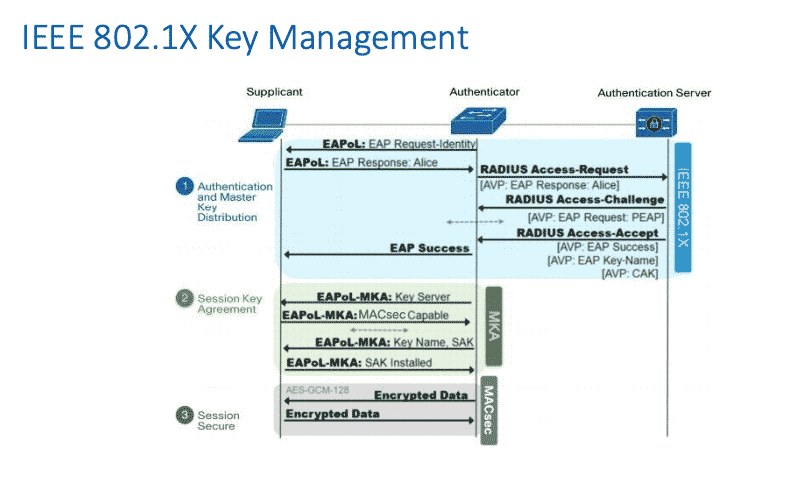
Once authentication is complete, IEEE 802.1X does more than simply open the port. It also establishes a shared secret known as a Master Session Key. This key is cryptographically strong and unique to the authenticated session. At this point, the devices trust each other, but they still do not have the specific encryption keys required for MACsec traffic protection.
This is where MACsec Key Agreement (MKA) comes into play. MKA is defined as part of IEEE 802.1AE and runs directly at the Ethernet layer between authenticated peers. Using the Master Session Key as its foundation, MKA derives one or more Secure Association Keys, or SAKs. These SAKs are the actual keys used by MACsec to encrypt and authenticate Ethernet frames.
MKA serves several important purposes beyond simple key derivation. It securely distributes SAKs to all participants on a protected link or, in the case of point‑to‑multipoint scenarios, to multiple authorized devices. It also assigns each device a role, such as key server or participant, to coordinate key generation and updates. MKA includes mechanisms for key rotation, allowing SAKs to be periodically replaced without interrupting traffic. This limits the amount of data protected by any single key and reduces the impact of potential compromise.
As encrypted traffic begins to flow, each MACsec‑protected frame includes a packet number that is checked by the receiver. MKA ensures both sides agree on packet number handling and anti‑replay rules. If a frame arrives with an unexpected or reused packet number, it is rejected. This prevents attackers from capturing and replaying old Ethernet frames.
Importantly, MKA continues running in the background for the lifetime of the connection. If a device disconnects, fails authentication checks, or violates policy, MKA signals MACsec to stop accepting traffic from that device. If a new device joins, it must complete its own 802.1X authentication before receiving any MACsec keys. This tight coupling ensures that encryption keys are always tied to authenticated identities, not just physical access to a cable or switch port.
From an operational perspective, the combination of IEEE 802.1X and MKA allows MACsec to behave like a zero‑trust system at Layer 2. Every device must authenticate, keys are unique to each link or group, keys are refreshed automatically, and encrypted communication starts immediately at the edge of the network. All of this happens transparently to IP, TCP, and applications, which remain unaware that encryption and identity enforcement are taking place underneath.
IEEE 802.1X and MACsec Key Agreement work together to authenticate devices, derive encryption keys, and continuously manage trust for secure Ethernet communication.
MACsec vs. IPsec and TLS: What’s the Difference?
MACsec, IPsec, and TLS are all technologies used to protect data in motion, but they operate at different layers of the network stack and address different security needs. Rather than competing with one another, they are complementary and are often deployed together as part of a layered security strategy.
The simplest way to distinguish them is by where encryption is applied. MACsec operates at Layer 2, securing Ethernet frames as they move across a physical or logical link. IPsec operates at Layer 3, protecting IP packets as they travel between hosts or networks, including across the public internet. TLS operates at the application level, typically above Layer 4, securing individual sessions such as web traffic, APIs, and application‑to‑application communications.
Because of where each technology sits in the stack, each one protects a different portion of the data path. MACsec encrypts the Ethernet payload on a hop‑by‑hop basis while leaving MAC addresses visible so switching can function normally. IPsec encrypts IP packets end to end or between security gateways, depending on deployment mode. TLS encrypts only the application data itself, leaving lower‑layer headers exposed to the network.
These differences also shape how trust is established. MACsec relies on IEEE 802.1X authentication and MACsec Key Agreement to ensure only authorized devices receive encryption keys at the network edge. IPsec uses Internet Key Exchange with certificates or pre‑shared keys to establish trust between endpoints or gateways. TLS depends on public key infrastructure to authenticate servers and sometimes clients directly at the application layer.
From a performance standpoint, MACsec is optimized for line‑rate, low‑latency operation, often using dedicated hardware in NICs and switches, and is largely invisible to applications. IPsec introduces more overhead due to encapsulation and policy processing, though it may also be hardware accelerated. TLS adds encryption and handshake overhead at the application layer but benefits from widespread CPU optimizations and broad software support.
In practice, each technology is best suited to a specific role. MACsec is ideal for securing internal or local Ethernet links without modifying applications. IPsec is commonly used to protect traffic between sites or across untrusted networks, such as VPN connections. TLS is the dominant choice for securing application‑level communication, especially over the public internet.
MACsec vs. IPsec vs TLS at a Glance
| Aspect | MACsec | IPsec | TLS |
|---|---|---|---|
| Primary purpose | Secure Ethernet links | Secure IP traffic | Secure application sessions |
| OSI layer | Layer 2 (Data Link) | Layer 3 (Network) | Layers 4–7 (Application) |
| What is encrypted | Ethernet payload | IP packets | Application data |
| Scope of protection | Hop by hop, link local | End to end or tunnel based | End to end per application |
| Typical authentication | IEEE 802.1X, MKA | IKE with certificates or PSKs | Certificates and PKI |
| Visibility to applications | Transparent | Transparent | Application aware |
| Performance characteristics | Line rate, very low latency | Moderate overhead | Session setup and crypto overhead |
| Common implementations | NICs, switches, routers | Hosts, gateways, VPN devices | Web servers, apps, APIs |
| Best suited for | Internal Ethernet security | Inter network security | Application level security |
In summary, MACsec protects the link, IPsec protects the route, and TLS protects the application. Used together, they form a layered approach that secures data in motion from the wire to the workload.
What Are The Performance, Latency, and Power Considerations for MACsec?
MACsec is designed to secure Ethernet traffic with minimal impact on performance, especially when implemented in hardware. Modern switches, routers, and NICs typically include dedicated MACsec engines that perform encryption and integrity checks at line rate using symmetric cryptography. In these deployments, MACsec does not reduce throughput, even at high speeds like 25G, 100G, or higher. Performance degradation is mainly a concern with software‑only implementations, where cryptographic processing competes with other workloads and can limit scalability.
From a latency perspective, MACsec adds very little overhead. Because it operates at the Ethernet layer and processes each frame independently, encryption and decryption are done inline as frames enter and exit the interface. In hardware‑accelerated designs, the additional latency is usually measured in tens or hundreds of nanoseconds, far below what applications or even most network monitoring tools can detect. Key rotation events are handled seamlessly by MACsec Key Agreement, allowing keys to change without interrupting traffic or adding noticeable delay.
Power consumption depends heavily on where MACsec is implemented. Hardware MACsec slightly increases silicon area and power use, but the incremental cost per port is typically modest and predictable, making it suitable for large‑scale deployments. In contrast, software‑based MACsec is far less energy‑efficient because general‑purpose CPUs are not optimized for sustained cryptographic workloads, resulting in higher power draw per bit of data protected. At scale, this difference becomes significant.
Overall, MACsec offers a strong security‑to‑cost trade‑off when hardware acceleration is available. It provides near‑zero performance loss, extremely low and deterministic latency, and manageable power overhead, making it well suited for data centers, enterprise networks, and embedded systems. The primary architectural consideration is ensuring MACsec support across network devices, but from a performance, latency, and power standpoint, hardware‑accelerated MACsec is one of the most efficient ways to encrypt data in motion.
When implemented in hardware, MACsec delivers strong security with near‑zero throughput impact, extremely low latency, and predictable power consumption at scale.
Where is MACsec Used Today?
MACsec is used today anywhere organizations want to protect data in motion at the Ethernet layer, especially in environments where internal networks can no longer be assumed to be trusted.
Common MACsec deployment environments include:
- Data centers and cloud infrastructure
- Enterprise campus networks
- Service provider and 5G transport networks
- Automotive and industrial Ethernet systems
In data centers and cloud infrastructure, MACsec is commonly deployed to secure east‑west traffic between servers, switches, and storage systems. Hyperscalers and enterprise data centers use MACsec to encrypt traffic on switch‑to‑switch and switch‑to‑server links without adding noticeable latency or CPU overhead. Because MACsec operates transparently below IP and applications, it allows operators to enforce blanket encryption for all workloads, including legacy protocols that lack native security.
In enterprise campus and corporate networks, MACsec is used to secure access links at the network edge. Switch‑to‑endpoint, switch‑to‑access‑point, and inter‑building fiber links are frequent use cases. When combined with IEEE 802.1X authentication, MACsec ensures that only authenticated devices can send or receive traffic and that all Ethernet frames are encrypted once they leave the device. This is especially valuable for protecting traffic across shared wiring, campus backbones, and leased lines.
MACsec is also widely adopted in telecommunications and service provider networks. Mobile backhaul, fronthaul, and metro Ethernet links use MACsec to protect traffic between radios, aggregation nodes, and core infrastructure. These environments benefit from MACsec’s low latency and deterministic performance, which are critical for 5G and timing‑sensitive workloads.
Finally, MACsec is increasingly found in embedded, automotive, and industrial Ethernet systems. Automotive Ethernet uses MACsec to protect in‑vehicle networks from spoofing and tampering, while industrial control and operational technology environments use it to secure machine‑to‑machine communication without modifying application protocols. In these contexts, hardware‑based MACsec provides strong security while meeting strict real‑time and power constraints.
In short, MACsec is widely deployed across data centers, enterprise networks, service provider infrastructure, and embedded systems wherever Ethernet security, performance, and transparency are critical.
Solutions and next steps
For organizations looking to implement MACsec at scale, hardware-accelerated solutions are essential. Rambus offers a complete family of silicon-proven MACsec silicon IP solutions for applications ranging from automotive/enterprise SOC/PHY to high-performance optical PHY, switch/router and AI interconnect silicon. All Rambus MACsec IP solutions are IEEE 802.1AE-2018 compliant and come with industry-proven Driver Development Kits (DDK).
Rambus MACsec IP enables standards‑compliant, hardware‑accelerated Ethernet security for high‑performance, scalable systems across data center, networking, automotive, and AI applications.
Summary: Why MACsec Matters for Modern Ethernet Security
As Ethernet serves as the backbone of modern computing, securing data in motion is mission critical. MACsec addresses this challenge by delivering line-rate, low-latency, standards-based security directly at the link layer.
By encrypting and authenticating every Ethernet frame, MACsec provides strong protection against eavesdropping, tampering, and unauthorized access without impacting performance or requiring changes to applications and protocols.
For enterprises, data centers, and service providers building next-generation networks, understanding and deploying MACsec is a critical step toward a secure, scalable, and high-performance Ethernet infrastructure.
Frequently Asked Questions About MACsec
Is MACsec end‑to‑end encryption?
No. MACsec is hop‑by‑hop encryption at Layer 2, meaning each Ethernet link is secured independently.
Does MACsec encrypt MAC addresses or Ethernet headers?
No. MACsec leaves source and destination MAC addresses visible so that switching and routing can function normally. It encrypts the Ethernet payload and protects it with integrity and replay protection.
Can MACsec be used together with IPsec or TLS?
Yes. MACsec, IPsec, and TLS are complementary and often used together. MACsec secures the underlying Ethernet link, IPsec protects traffic across networks, and TLS secures application‑level communication.
Does MACsec require application or protocol changes?
No. MACsec operates transparently at Layer 2, so applications, operating systems, and higher‑layer protocols do not need to be modified.
Is MACsec suitable for high‑speed networks?
Yes. When implemented in hardware, MACsec supports line‑rate encryption with extremely low latency, even at speeds of 25G, 100G, and higher.
What standards are associated with MACsec?
MACsec is defined by IEEE 802.1AE, and it is commonly used with IEEE 802.1X and MACsec Key Agreement (MKA) for authentication and key management.
Why MACsec?
MACsec protects data at the Ethernet layer before it reaches higher‑layer security controls, reducing exposure to internal threats and protecting traffic that may not be covered by application‑level encryption.
Need more details? Contact us here and request a meeting with one of our dedicated sales specialists.
More on MACsec:
– Ask the Experts: MACsec at Terabit Line Rates
– Network Security at Terabit-per-second Rates with MACsec, IPsec and UEC
– Secure by Design Series: Inline Memory Encryption & MACsec: Protecting Data in Use and in Motion
– MACsec Fundamentals



Leave a Reply