
The Rambus Registering Clock Driver (RCD) RCD4-GA0 enables DDR5 Registered DIMMs (RDIMMs) operating up to 7200 MT/s. Download the product brief to see the specifications and features.
DDR5 RCD 7200 MT/s Product Brief
Rambus Wins 2023 “Most Respected Emerging Public Semiconductor Company” Award from Global Semiconductor Alliance
SAN JOSE, Calif. – Dec. 11, 2023 – Rambus Inc. (NASDAQ: RMBS), a premier chip and silicon IP provider making data faster and safer, today announced that it is the recipient of this year’s “Most Respected Emerging Public Semiconductor Company” Award in its revenue category from the Global Semiconductor Alliance (GSA).

“It is truly an honor to be recognized amongst our industry with this prestigious award from the GSA, representing another great milestone in our ongoing evolution as a leading semiconductor company,” said Luc Seraphin, president and chief executive officer at Rambus. “This award would not have been possible without the continued dedication and innovation of Rambus employees worldwide and the ongoing support from our customers and partners. Our gratitude goes to the GSA and the entire semiconductor community as we work together to advance the future of technology.”
The GSA is a leading semiconductor and technology industry organization representing over 250 corporate members worldwide. Each year, the GSA recognizes semiconductor companies that have demonstrated excellence through their innovation and performance in the industry at its annual Awards Dinner Celebration. The recipient of “Most Respected Emerging Public Semiconductor Company Achieving $100 Million to $500 Million in Annual Sales” Award is selected by GSA members casting their ballots for the industry’s most respected companies, judged by their vision, technology and market leadership.
Additional Information:
For additional award details, please visit the GSA Website at https://www.gsaglobal.org/2023awd/
Post-quantum Cryptography (PQC): New Algorithms for a New Era
Post-Quantum Cryptography (PQC), also known as Quantum Safe Cryptography (QSC), refers to cryptographic algorithms designed to withstand attacks by quantum computers.
Quantum Safe Cryptography: Protecting Devices and Data in the Quantum Era
[Live on January 10, 2024] Quantum computers will eventually become powerful enough to break current asymmetric encryption, placing important data and assets at risk. In this presentation, Bart Stevens will discuss recent developments in Quantum Safe Cryptography and highlight what you need to know to protect devices and data in the quantum computing era.
QSE-IP-86 Quantum Safe Engine Product Brief
The Rambus Quantum Safe Engine (QSE) IP provides Quantum Safe Cryptography acceleration for ASIC, SoC and FPGA devices. The QSE supports the FIPS 203 ML-KEM and FIPS 204 ML-DSA draft standards. Download the product brief to find out about the QSE features, learn how the QSE can be used for multiple use cases, and review the QSE block diagram.
Rambus Protects Data Center Infrastructure with Quantum Safe Engine IP
Highlights:
- Expands industry-leading family of Quantum Safe IP solutions for data center and government hardware security
- Integrates into root of trust or embedded secure element in advanced SoCs and FPGAs
- Delivers cryptographic acceleration with leading NIST-selected quantum-resistant algorithms
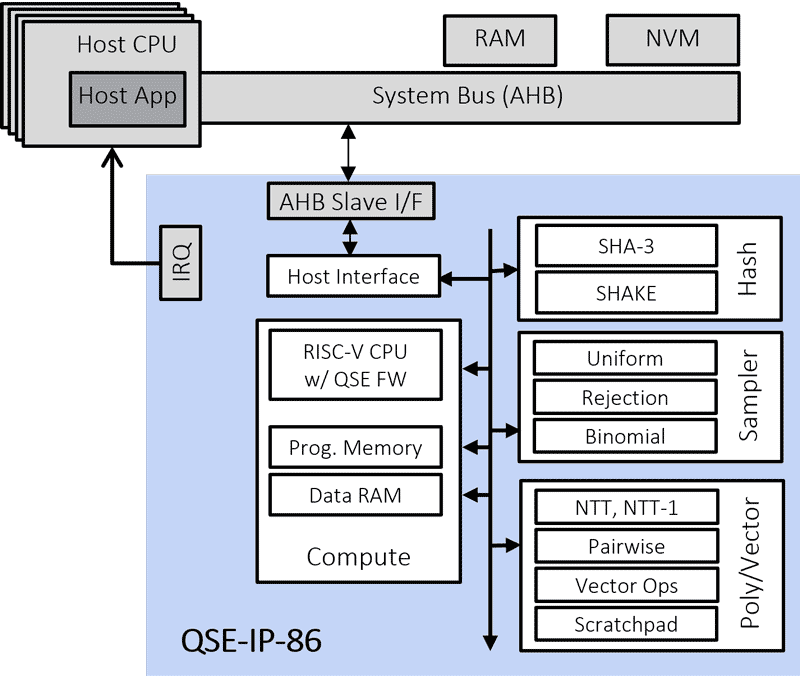
SAN JOSE, Calif. – December 4, 2023 – Rambus Inc. (NASDAQ: RMBS), a premier chip and silicon IP provider making data faster and safer, today announced the availability of a Quantum Safe Engine (QSE) for integration into hardware security elements in ASICs, SoCs and FPGAs. Quantum computers will enable adversaries to break current asymmetric encryption, placing important data and assets at risk. The Rambus QSE IP core uses NIST-selected quantum-resistant algorithms to protect valuable data center and government hardware against attacks emerging in the post quantum computing era.
“From AI, to streaming video, to email, the applications we rely on daily depend on the integrity of data and must be guarded against the growing risk of attacks enabled by quantum computers,” said Neeraj Paliwal, general manager of Silicon IP at Rambus. “The Rambus Quantum Safe Engine is another important addition to our security IP portfolio helping customers transition to Quantum Safe Cryptography starting today.”
“Quantum computers will provide individuals and organizations the exponential speed-up and compute power needed to solve some of today’s most complex problems, including the ability to decrypt current data encryption algorithms,” said Heather West, PhD, research manager of Quantum Computing Research at IDC. “Implementing quantum-resistant cryptography now is key for organizations to protect their past, current and future data from quantum computing enabled attacks.”
The Rambus QSE IP is available as a standalone cryptographic core or integrated in the Rambus Quantum Safe Root of Trust IP as a comprehensive hardware security solution. It supports the National Institute of Standards and Technology (NIST) draft standards for quantum-resistant algorithms (FIPS 203 ML-KEM and FIPS 204 ML-DSA), and provides SHA-3, SHAKE-128 and SHAKE-256 acceleration. For highly secure applications requiring additional protection against differential power analysis (DPA) attacks, a DPA version of the QSE IP is available.
Availability and Additional Information:
The Rambus QSE is available for licensing today. Learn more at https://www.rambus.com/security/quantum-safe-cryptography/qse-ip-86/.