
Chiplets are gaining significant traction as they deliver numerous benefits beyond what can be accomplished with a monolithic SoC in a time of slowing transistor scaling. However, disaggregating SoCs into multiple chiplets increases the attack surface which adversaries can exploit to penetrate safeguards to data and hardware. With chiplets, the risks of hardware-based trojans and exploits such as man-in-the-middle attacks all rise. To realize the many benefits of chiplets, designers should use a design for security approach, and implement security safeguards anchored in hardware.
Search Results for: security
AIと5Gにより高まるIoT機器の脅威 (5G and AI Raise Security Risks for IoT Devices)
5G represents a revolution in mobile technology with performance that will rival that of wireline networks. 5G’s Ultra-reliable Low Latency Communication (uRLLC) links will enable a profusion of artificial intelligence (AI)-powered IoT devices from delivery drones to smart cities. The rapid rise in the number of smart IoT devices, coupled with expanded connectivity, will greatly escalate the growth of data and network traffic.
Embedded Hardware Security Heads to the Edge
The days of building a moat around the castle to keep data secure were long gone before the pandemic led to a surge in remote work. With the enterprise network no longer rooted in a single place, every connection needs to be secured in line with increased server connectivity bandwidth requirements of cloud and edge computing.
Rambus CryptoManager Root of Trust Cores Certified ASIL-B/D Ready for Enhanced Security in Automotive Applications
Highlights:
- Safeguards automotive Vehicle-to-Everything (V2X) communications, Advanced Driver Assistance Systems (ADAS), Electronic Control Unit (ECU) platform management, and infotainment applications
- Provides ISO 26262 Automotive Safety Integrity Level (ASIL)-B and ASIL-D ready security solutions
- Offers comprehensive suite of security features including secure boot, secure firmware updates, authentication, device personalization, secure key and data storage, and secure provisioning
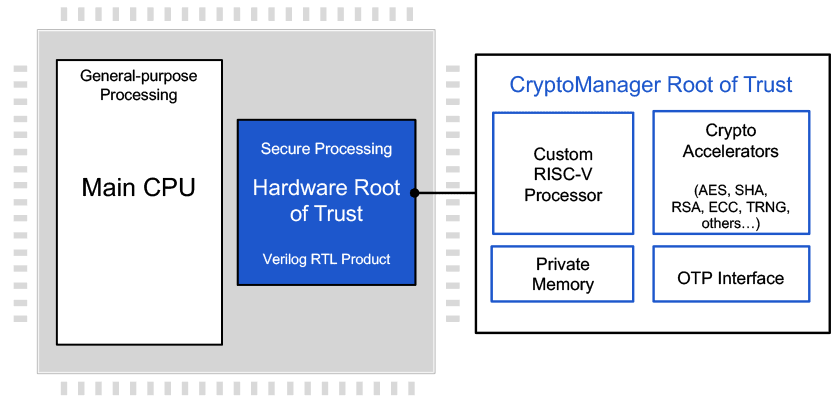
Rambus is pleased to announce our CryptoManager Root of Trust RT-640 and RT-645 cores have been certified ASIL-B and ASIL-D ready, respectively. These automotive-grade secure co-processor IP safeguards SoCs in V2X communications, ADAS, ECU platform management, infotainment and other critical vehicle systems.
“As vehicles become increasingly connected, securing communications and the numerous electronic components that are responsible for critical vehicle systems is a necessity,” said Robyn Westervelt, research director, security and trust for IDC. “ASIL certification of security features such as authentication, attestation cryptographic accelerators are imperative to meet the evolving security needs in the automotive market.”
Easily integrated into chips serving the automotive market, the CryptoManager Root of Trust RT-640 and RT-645 provide a broad suite of security features. These include secure boot, secure firmware updates, secure debug, authentication, attestation, device personalization, key and data provisioning, secure feature and configuration management, cryptographic acceleration, and secure key and data storage. In addition, the RT-640 and RT-645 cores provide design integrity and reliability.
“The increasing sophistication and complexity of automotive electronic systems brings a greater attack surface. This requires robust security solutions to safeguard these vital systems from a growing range of cyber threats,” said Neeraj Paliwal, vice president and general manager of Rambus Security. “With our ASIL-ready CryptoManager secure co-processors, automotive chip makers can be assured of functional safety and have access to a rich set of security features that can be quickly implemented to accelerate the certification of their SoCs.”
With features tailored for the automotive market, the RT-640 and RT-645 can operate as E-safety Vehicle Intrusion Protected Applications (EVITA) full or medium Hardware Security Modules (HSM). Certification for ASIL-B and ASIL-D readiness and “functional safety” was provided by SGS-TÜV Saar GmbH. Copies of the certifications are available on Rambus.com.
Availability
The CryptoManager Root of Trust RT-640 and RT-645 are available for licensing. In addition to a robust Root of Trust framework with functional safety at ASIL-B and -D levels, the RT-640 and RT-645 come with a Secure Application SDK that allows rapid Secure Application development and deployment. Rambus will support its licensees by providing extensive documentation including the ISO26262 FMEDA (Failure Modes Effects and Diagnostics Analysis) sheets and Safety manuals, reducing time to ISO26262 certification and thus time to market.
Additional Information
For additional details about the CryptoManager Root of Trust RT-640 and RT-645, and copies of the ASIL-B/D certifications, please go to https://www.rambus.com/security/root-of-trust/cryptomanager-root-of-trust/rt640/ or visit https://www.rambus.com/security/root-of-trust/cryptomanager-root-of-trust/rt645/.
Hardware Security for AI Accelerators
Dedicated accelerator hardware for artificial intelligence and machine learning (AI/ML) algorithms are increasingly prevalent in data centers and endpoint devices. These accelerators handle valuable data and models, and face a growing threat landscape putting AI/ML assets at risk. Using fundamental cryptographic security techniques performed by a hardware root of trust can safeguard these assets from attack.
Rambus Announces Complete 800G MACsec Solution for Enhanced Data Center and 5G Infrastructure Security
Highlights:
- Integrated hardware-based solution delivers full line-rate MACsec security at 100G to 800G data rates
- Supports multi-channel, multi-rate implementations with flexible bandwidth allocation
- Delivers enhanced data security for cloud, enterprise and carrier network applications as well as network-attached, high-performance computing (HPC) and AI/ML
SUNNYVALE, Calif. – Apr. 29, 2020 – Rambus Inc. (NASDAQ: RMBS), a premier silicon IP and chip provider making data faster and safer, today announced its 800G MACsec (Media Access Control security) solution for next-generation networking infrastructure. The 800G MACsec solution delivers hardware-based, point-to-point security for 800 Gigabit Ethernet links and is a critical element of end-to-end network security. Protecting data in motion, MACsec can identify and prevent security threats such as denial of service, intrusion, man-in-the-middle, passive eavesdropping and masquerading attacks. With growing demand for low-latency communications to support real-time applications such as AI/ML inference, in-line, full-rate secure communication of data traffic with MACsec is imperative. The Rambus 800G MACsec solution addresses this need with a hardware engine delivering MACsec security with no degradation to the speed of data transmission.
“Our world has changed dramatically in just a few months, with a global shift to our homes being the center of work, schooling and entertainment. This has put enormous strain on the global data infrastructure. The evolution to 800 GbE will be a key enabler on the path forward,” said Neeraj Paliwal, vice president and general manager of Rambus Security. “Our 800G MACsec protocol engine leverages a scalable architecture that supports configurations of one to many ports with an aggregate bandwidth of up to 800 Gbps. This flexibility provides the benefit of limiting the silicon cost for security, while safeguarding required data communications.”
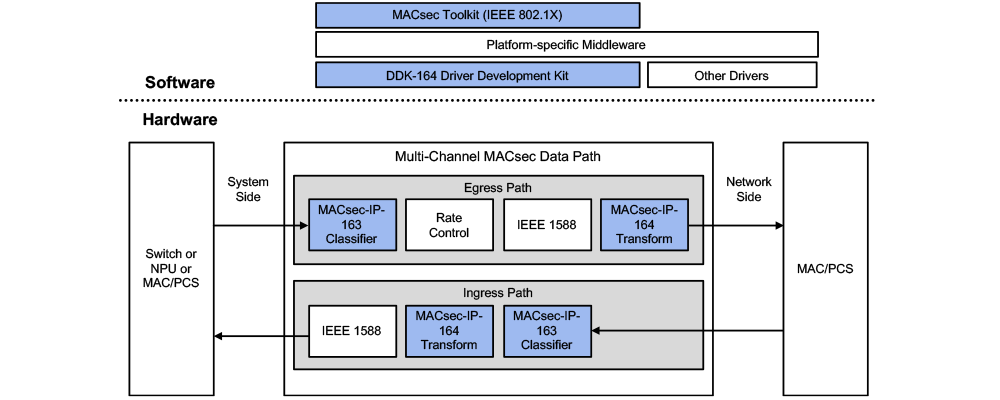
Built with decades of security engineering experience, Rambus MACsec IP solutions have been broadly adopted across the industry spanning multiple generations of the MACsec standard. Thanks to a proven track record of performance, software compatibility and API scalability, the Rambus MACsec-IP-163/164 is the go-to solution of network chip and system companies. To speed the design process, the MACsec engine is delivered with a driver development kit (DDK). For customers building system-level solutions, Rambus offers a MACsec Toolkit that implements the Port-based Network Access Control (PNAC) standard and facilitates development and testing of MACsec-compliant processing.
The Rambus 800G MACsec-IP-163/164 solution comprises a classifier and transform engine for deployment of the MACsec Layer 2 secure communication protocol. Implemented in hardware, this Rambus solution can deliver full line-rate MACsec security from 100G to 800G, making it an ideal choice for 800 GbE and 800GBASE-R. Driven by the continued exponential growth in data traffic, 800 GbE is expected to be broadly deployed across hyperscale data centers, enterprises and carrier networks as well as in network-attached high-performance computing (HPC) and artificial intelligence (AI) / machine learning (ML).
Benefits of Rambus 800G MACsec Solution
- Full line-rate MACsec security from 100G to 800G with any packet and transform mix
- Multi-rate, multi-channel support with flexible bandwidth allocation
- Complies with the IEEE 802.1ae MACsec standard and its successors
- Additional classification and transformation options to support advanced use-cases and deployments
- Supplied with widely-adopted driver development kit (DDK)
- Supports secure data communications across data center, enterprise, carrier networks, network-attached HPC and AI/ML
For more information on the Rambus 800G MACsec solution, please visit https://www.rambus.com/security/protocol-engines/macsec-engines/macsec-ip-163-164/ or read our blog post at https://www.rambus.com/blogs/rambus-launches-800g-macsec-multi-channel-engine/.


