
Scott Best, Senior Director of Anti-Tamper Technology at Rambus, discusses the security challenges associated with AI chips and their growing deployment at the edge. Best highlights the similarities between AI chips and FPGAs, particularly in their vulnerability to attacks on valuable firmware assets, such as neural net models and RTL. He explores the importance of securing firmware from tampering and theft, emphasizing the need for encryption and authenticity verification. Best also delves into the rising threats posed by side-channel attacks like Differential Power Analysis (DPA) and offers novel solutions such as key hash chaining to protect firmware while maintaining boot efficiency. He concludes by discussing emerging risks, including neural net model extraction, and suggests tailored countermeasures to safeguard AI architectures from these attacks.
Search Results for: security
ETAS and Rambus Offer Integrated Software and Hardware Security Solution for Automotive Silicon Designs
Highlights
- Supports need for integrated software and hardware offerings providing faster time to market
- Reduces risk with pre-integrated, pre-validated, pre-certified full HSM stack solution
- Raises the bar for automotive safety and security for the software-defined vehicle
[Last updated: April 25, 2024] The automotive industry is undergoing an exciting transformation towards the software-defined vehicle (SDV) that will enable a new era of customer-centric mobility and create new business opportunities and revenue streams for automotive stakeholders. However, this transformation comes with its own set of challenges that demand revolutionary approaches to navigate the ever-increasing complexity, while at the same time meeting faster time to market (TTM) demands and regulatory safety and security compliance for market access.
One such approach is strategic collaborations within the automotive ecosystem, like the one ETAS and Rambus recently announced to co-develop and provide a bundled cybersecurity solution. We are excited to share more details about this unique, pre-integrated, and pre-validated solution that unites Rambus hardware and ETAS software expertise to create a secure enclave on next-generation automotive silicon designs.
Table of Contents:
Automotive System-on-Chip (SoC) Challenges
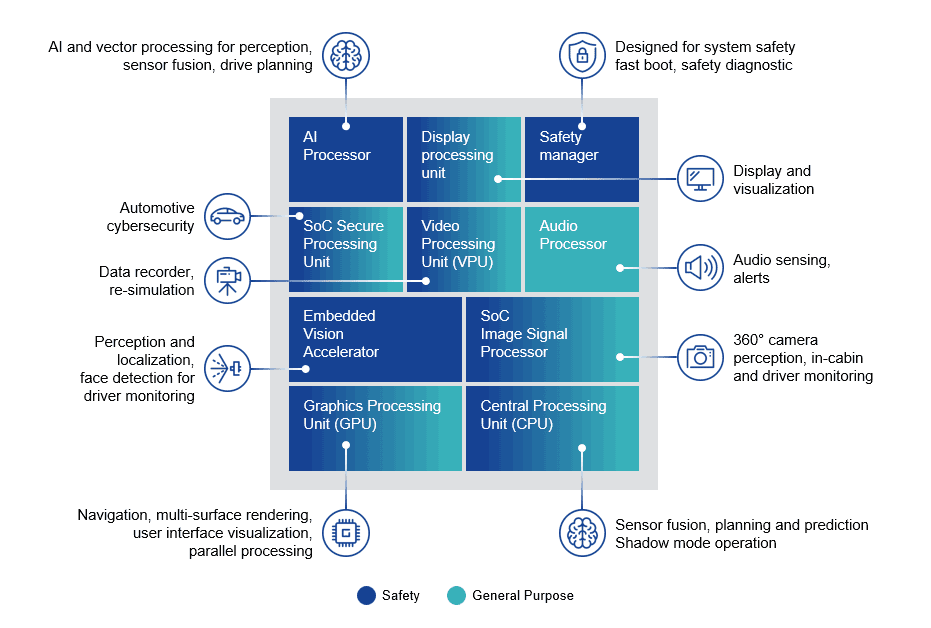
Automotive-grade SoCs have evolved significantly in the last decade from microcontroller-based chips to more advanced and complex microprocessor-based SoCs. This evolution is a response to the never-ending demands for greater computing to fulfill different use cases and enhance customer experiences. The progression in hardware architecture has enabled greatly increased functionality such as Advanced Driver-Assistance Systems (ADAS), automation, E/E vehicle architecture transformation, and much more, to realize the software-defined vehicle (SDV). This technological evolution at the SoC level is opening a new era in the automotive industry, but it also comes with challenges. One of the critical challenges is the diverse and heterogenous architecture of these SoCs with multiple computing islands for different applications. This diversity in the hardware architecture is making security implementations more complex and integration more time consuming for automotive OEMs and Tier 1 system engineering teams.
Hardware Security in the Automotive Industry
Over the last decade, the automotive industry has increasingly relied on Hardware Security Modules (HSM) as the trusted hardware platform for secure tamper-resistant cryptographic operations and key management. HSMs offer various security services and capabilities, including secure communication channels, data integrity protection, message authentication, secure boot processes, and system security policies.
HSMs securely execute authenticated user applications with security mechanisms like tamper detection and protection, secure storage and handling of keys and security assets, and resistance to side-channel attacks. Access to cryptographic accelerator modules, keys, memory ranges, I/O, and other resources is enforced by hardware. Critical operations like encryption, signing, authenticating, key generation, derivation, and storage are performed in hardware without external software access.
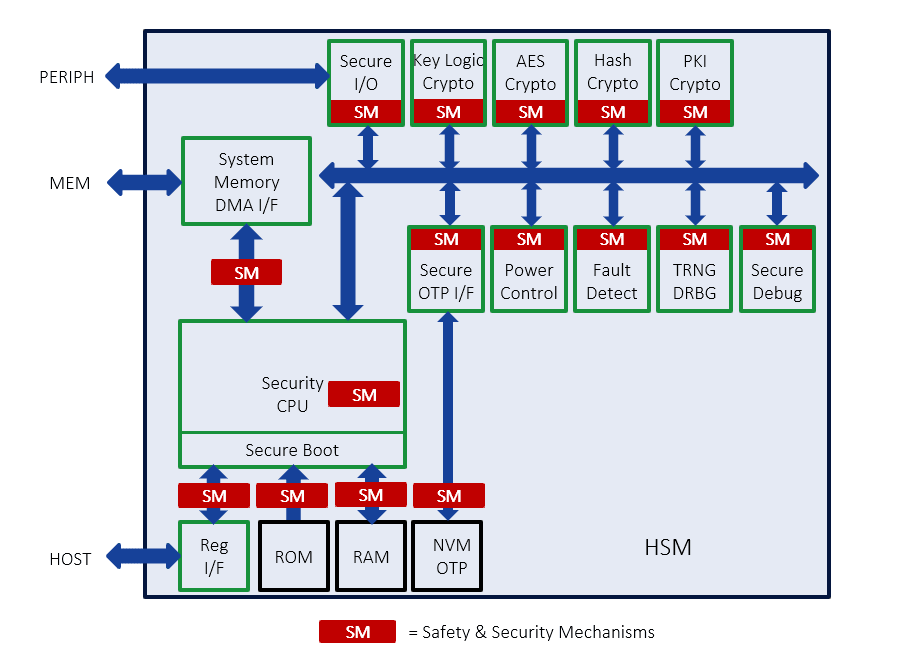
Originally, HSMs were offered as standalone secure element chips or HSM-embedded automotive microcontrollers connected to host system buses. However, the HSM landscape has evolved to meet modern automotive systems’ increased complexity, stricter security requirements, and performance demands. Today, HSMs are siloed hardware blocks (IP) instantiated in automotive SoC ICs. In some SoCs, there are multiple HSM IP blocks to fulfill a variety of security use cases and demands.
This new trend in HSMs reflects the growing importance of cybersecurity in highly connected vehicles, and at the same time, it supports the need for pre-integrated, pre-validated, pre-certified, scalable solutions to help OEMs meet safety and security compliance. Synthesizable automotive-grade HSM silicon IP has emerged as a critical strategy for efficient and effective SoC development.
As with any silicon IP design, the synthesizable automotive-grade HSM IP provides greater flexibility for customization to meet specific performance requirements for critical use cases. The technology-agnostic nature of the HSM silicon IP offers a cost-effective and scalable solution for securing multiple SoCs. Safety and security certified HSM IP enhances the overall reliability and quality of the SoC, minimizing the risk of design and cybersecurity flaws, while ensuring faster compliance at the chip level.
Integrated HSM Hardware and Software Stack – The Solution
To further support OEMs and SoC developers manage design, safety, security, and cost challenges, an integration of the HSM hardware and software stack is required. Specifically, synthesizable HSM hardware IP should come with pre-integrated, pre-validated embedded HSM software (SW). This would enable a technology-node agnostic, full hardware IP-SW stack ready to be integrated into any SoC allowing the security SW integration development to start 18-24 months earlier at the automotive Tier 1 or OEM level. It would also avoid costly and lengthy porting, integration, and validation efforts typically needed for the HSM SW integration with standalone HSM chips or dedicated embedded HSM-based microcontrollers.
Innovative iHSM Solution from ETAS and Rambus
ETAS and Rambus are now offering a new integrated hardware security module (iHSM) product family that combines the Rambus RT-64x Root of Trust IP with the ETAS embedded cybersecurity software solution ESCRYPT CycurSoC.
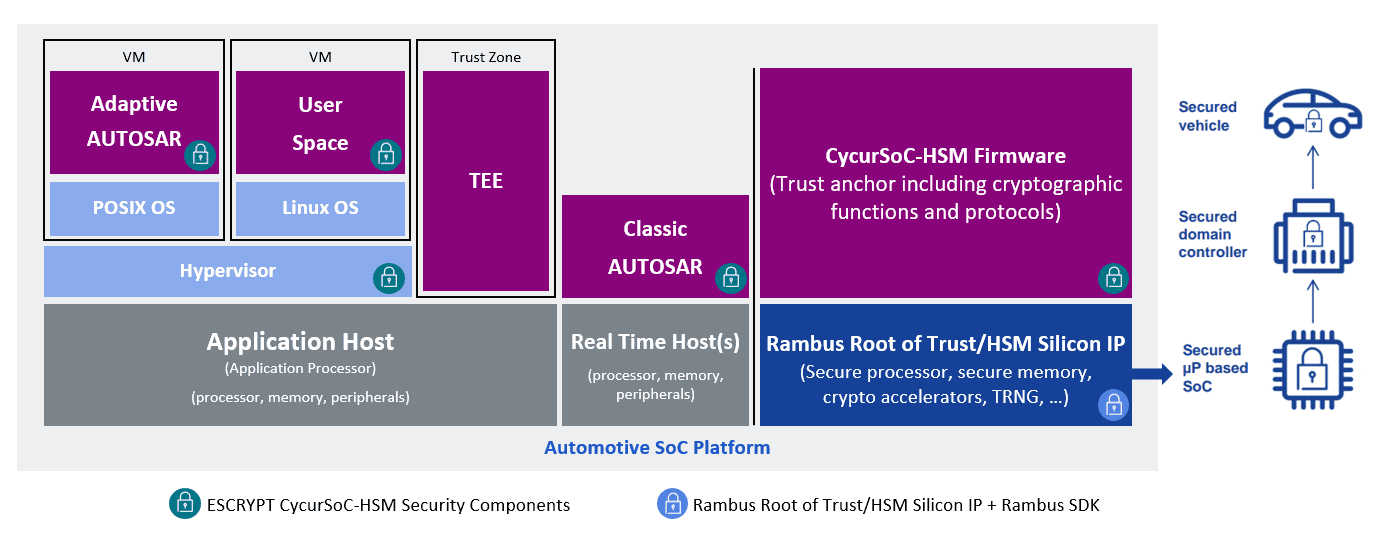
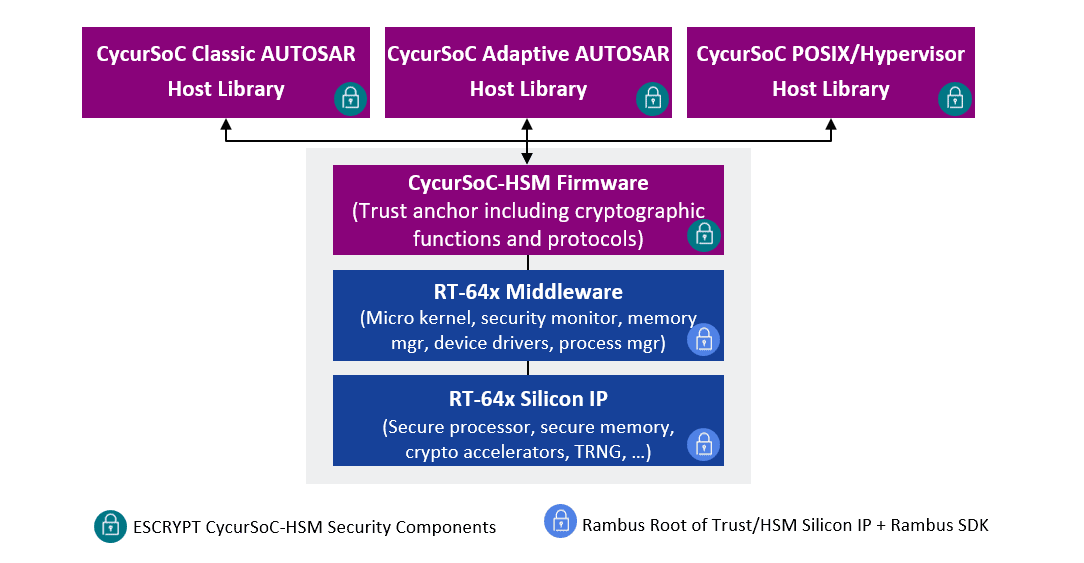
The ETAS-Rambus iHSM-64x solution ports ESCRYPT CycurSoC on the RISC-V-based Rambus RT-64x hardware architecture. Designed for automotive security use cases, the pre-integrated security solution is CMOS node agnostic, highly secure, and optimized for efficiency with minimal impact on available system resources. It supports open and standardized interfaces like SHE+, AUTOSAR Classic, Adaptive, POSIX and Hypervisor to Host applications. The full HSM stack (hardware silicon IP and software) is a pre-validated, drop-in solution critical to creating a security enclave on next-generation automotive silicon designs requiring ISO 26262 ASIL-B and ISO 21434 CSMS compliance.
Pre-integrated, pre-validated, pre-certified HSM SW on synthesizable automotive-grade HSM silicon IP is a welcome new trend and an emerging strategy in the HSM space for safer and more secure mobility. To find out more, check out the latest episode of the ETAS podcast in which guests Adiel Bahrouch from Rambus and Omar Alshabibi from ETAS will explore how ecosystem solutions can reduce implementation complexity and risk while accelerating time to market.

ETAS and Rambus Plan Joint Development of Automotive Cybersecurity Solutions
Cybersecurity is becoming the new measure of quality for the automotive industry as software-enabled autonomous, connected, and electric vehicles all require the highest levels of security. With this in mind, ETAS GmbH, and its solution field cybersecurity (ESCRYPT), and Rambus, the industry’s leading supplier of hardware security IP, have announced a strategic collaboration to co-develop and provide a bundled security offering combining the Rambus RT-640 embedded hardware security module (eHSM) IP integrated with the ETAS SoC security software solution ESCRYPT CycurSoC.
Complexity is the enemy of security, for as complexity increases, the number of vulnerabilities that an adversary can potentially exploit increase exponentially. And the vehicle of tomorrow is becoming highly complex indeed as it undergoes a revolutionary transformation from a relatively simple mechanical system toward a highly interconnected system of compute, mechanical, and connectivity resources including dozens of ADAS/AD sensor technologies and billions of lines of code.
The next-generation vehicle will be a sum of service-oriented software built on a centralized electrical/electronic (E/E) architecture powered by highly advanced computing units. Emerging technologies like chiplet architectures will be harnessed to enable the high-performance SoCs required for advanced automotive systems. But these innovative new technologies will themselves introduce new attack vectors to compromise the safety and security of the vehicle.
Protecting automotive systems requires a defense-in-depth strategy, from silicon IP to software. Through this new collaboration, Rambus and ETAS will offer customers a bundled solution that combines the Rambus next-generation RT-640 eHSM IP with ETAS’s market-leading embedded cybersecurity software solution ESCRYPT CycurSoC. This solution will address the challenges of the ever-advancing automotive SoCs, strengthen overall security, and provide a solid trust foundation for the defense-in-depth strategy from the chip to the cloud. With this solution, customers will realize greater scalability, lower implementation risk, and faster time to market.
“The rapidly expanding cyberthreat environment, and increasingly sophisticated adversaries targeting highly complex and connected vehicles, make strategic collaborations for integrated security solutions mission critical,” says Neeraj Paliwal, general manager of Silicon IP at Rambus. “This collaboration unites hardware and software security expertise and maximizes protection of next-generation SoCs for a safer and more secure future mobility.”
“With advancing software capabilities, the automotive industry is undergoing a rapid transformation to software-defined-vehicle ecosystems,” says Dr. Frederic Stumpf, Cybersecurity Portfolio Manager at ETAS. “This strategic collaboration will bring together best-in-class security solutions that support these advanced software features with robust defense-in-depth protection.”

Stay tuned for more details about the ETAS and Rambus security solution in the months ahead. In the meantime, the Rambus and ETAS teams are taking this new collaboration on the road at CES this week. Please contact us if you’d like to learn more about this powerful combination of software and hardware security for your next SoC design.
Emerging Security Challenges in Highly Interconnected Semiconductor Systems
Cybersecurity: A Top Priority for the Automotive Industry
Rambus Safeguards Accelerated Computing with FPGA-targeted Security IP
Highlights:
- Bring FPGAs with a state-of-the-art offering of security IP products
- Secures the broad range of FPGAs from high-performance accelerators to low-power, lightweight devices
- Supports FPGAs serving applications for the Data Center, Artificial Intelligence / Machine Learning, Edge, IoT, Defense, and more
SAN JOSE, Calif. – Aug. 22, 2023 – Rambus Inc. (NASDAQ: RMBS), a premier chip and silicon IP provider making data faster and safer, today announced a full suite of Security IP solutions for the FPGA market with state-of-the-art cryptographic, side-channel, and Quantum Safe protections. Designed to meet the unique needs of FPGAs, the offering secures the broad range of devices from high-performance accelerators for generative AI, to low-power solutions for IoT devices. Rambus security IP protects FPGAs serving applications in the Data Center, AI/ML, Edge, IoT, Defense, and beyond.
“As customer demand for security continues to accelerate, Rambus is dedicated to providing state-of-the-art security IP for the broad range of applications increasingly enabled by FPGAs,” said Neeraj Paliwal, general manager of Security IP at Rambus. “Our security IP solutions safeguard these FPGA devices now and in the future with Quantum Safe protection from PQC attacks.”
“In the increasingly distributed and accelerator-based computing architectures enabled by Intel FPGAs, it is mission critical to secure data and devices against today’s threats and those that arise with the advent of quantum computing,” said Premal Buch, vice president and general manager of Programmable Solutions at Intel. “We’re pleased to see Rambus offer security IP solutions tailored to FPGAs powering the growing landscape of accelerated computing.”
As part of the industry-leading portfolio, Rambus offers advanced FPGA targeted security IP products including root of trust, 800G MACsec, IPsec, classic and quantum safe public key encryption solutions. Leveraging pioneering work in differential power analysis (DPA) and fault injection attack (FIA) countermeasures, Rambus security IP delivers the highest levels of protection available against both cryptographic and side-channel attacks. With new Quantum Safe security IP products, Rambus futureproofs the protection of FPGAs for the coming Post Quantum Cryptography (PQC) era.
For more information about Rambus Security IP, please visit www.rambus.com/security.


