DishTV India has selected Rambus’ CryptoMedia Security Platform for use in its Pay TV satellite system. According to Martin Scott, senior VP and GM of the Security Division at Rambus, CryptoMedia ensures secure distribution of premium content for cable and satellite operators with a hardware root-of-trust embedded in the set-top-box (STB) chipset.
Search Results for: security
CryptoMedia secures Pay TV content for DishTV India
DishTV India has selected Rambus’ CryptoMedia Security Platform for use in its Pay TV satellite system.
According to Martin Scott, senior VP and GM of the Security Division at Rambus, CryptoMedia ensures secure distribution of premium content for cable and satellite operators with a hardware root-of-trust embedded in the set-top-box (STB) chipset.

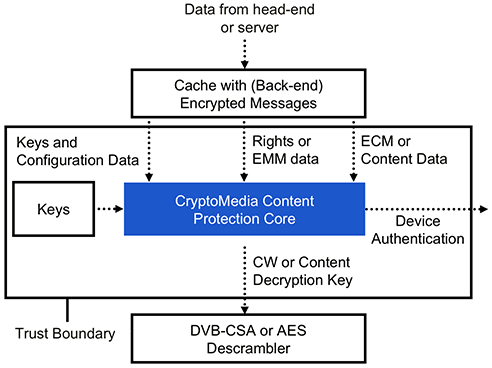
“By using the CryptoMedia Content Protection Core, DishTV India recognizes the value of enabling another level of protection in the set-top box chipset alongside security elements provided by CAS vendors,” said Scott. “Our CryptoMedia Security Platform provides DishTV India with extra protection for the delivery of content, utilizing our expertise in both embedded security and ecosystem enablement.”
As we’ve previously discussed on Rambus Press, CryptoMedia is a complete content storage solution comprising a hardware-based CryptoMedia Delivery Core, player software and trusted key provisioning services for 4K Ultra-high Definition (UHD) and High Dynamic Range (HDR) content.
“Designed to provide strong security and superior system design flexibility for premium content distribution, the CryptoMedia Delivery Core minimizes the risk of security failure and helps simplify product development,” explained Kendra De Berti, Director of Solutions Marketing at Rambus.

“The core is integrated in a broad range of STB and smart TV chipsets and is compatible with the leading CAS and DRM systems to prevent unauthorized access to content and services, including features like pay-per-view and service-tier upgrades.”
In a broader sense, says De Berti, CryptoMedia also offers support for VIDITY-based formats – securely delivering premium content across multiple devices, including smartphones, tablets and smart TVs.
“With a comprehensive suite of components for the entire content protection ecosystem, the platform is ready for the latest industry security requirements and enables VIDITY-compliant chipset makers, as well as storage and player device manufacturers, to bring their products to market faster and easier,” she added. “Robust security is delivered at the hardware and software level with support for content protection specifications and standards including VIDITY and MovieLabs ECP.”
Interested in learning more about CryptoMedia? You can check out our official product page here.
CryptoMedia Content Protection Core

 Contact
 Product Brief




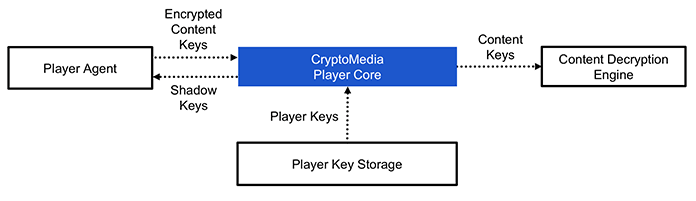
CryptoMedia Player Core
Boeing licenses DPA countermeasures
Rambus and Boeing have inked a licensing agreement for the inclusion of advanced differential power analysis (DPA) countermeasures in Boeing products.
According to Martin Scott, senior vice president and general manager of the Security Division at Rambus, DPA countermeasures enable Boeing to protect against security attacks that are used to reverse engineer or exploit critical technologies built into aircraft and other defense-related products.

“The threat of DPA attacks is on the rise and companies like Boeing need the utmost security solutions to safeguard its customers’ high-value data,” said Scott. “By licensing our DPA countermeasures, Boeing [illustrates] its commitment to building products with the highest level of security.”
As Scott notes, concerns about DPA security attacks originated in the smart card market, although such attacks have since spread into other segments, including aerospace and defense. Fortunately, government and military systems can be protected from cyber adversaries with a hardware-centric security approach, which helps prevent the threat of reverse engineering and exploitation.
As we’ve previously discussed on Rambus Press, DPA is a type of side-channel attack that involves monitoring variations in the electrical power consumption or EM emissions from a target device. These measurements can then be used to derive cryptographic keys and other sensitive information from chips. This is precisely why Rambus’ Cryptography Research division has developed a comprehensive portfolio of application-specific hardware core and software library solutions that can be used to build DPA resistant products. To be sure, robust countermeasures can protect devices and applications used for government and military purposes, along with finance, mass transit and wireless communications.
It should be noted that Rambus also offers a DPA Workstation (DPAWS) platform to customers and partners. Essentially, DPAWS analyzes hardware and software cryptographic implementations for vulnerabilities to power and electromagnetic side-channel attacks. Specifically, DPAWS enables users to quickly assess any vulnerability that an FPGA, ASIC, CPU or microcontroller may have to side-channel analysis.
In addition, DPAWS includes an integrated suite of hardware and data visualization software to aid in the identification and understanding of vulnerabilities in cryptographic chips.
This includes:
- A project library manager that delivers an integrated view of multiple data sets, scripts and analyses.
- A powerful trace display with an intuitive interface for easy analysis.
- Integrated scripting modules for MatLab and Python.
Additional information about Rambus’ DPA Countermeasure solutions and DPA Workstation analysis platform can be found here.
How to Launch Mobile Payments on Android
Mobile payments are becoming the new normal. After many years of debate, predictions and hype, many Android users even have more than one mobile payment option available to them. Google is rolling out Android Pay around the world, Samsung is matching it with Samsung Pay and a range of other services and solutions seem to be launched or expanded on an almost weekly basis.
For banks, though, the competition, market dynamics and options for deployment are more complicated than ever. So, what choices to they need to make and which route, or routes, to market will work best for them?
Banks must act now
One thing that is certain, banks are facing a new kind of threat. Payments have ‘gone mobile’ meaning issuers risk losing control of their traditional customer relationships and even being consigned to a back-end processing role. By failing to take control and act now, banks also risk losing valuable data like usage, location, frequency and drop-out rates, which can be used to enhance and shape the development of existing and future services, and even open up new revenue streams.
BankPay, OEM Pay…or both?
Many banks are already adopting a flexible strategy, combining the launch of their own ‘BankPay’ solution with support for the original equipment manufacturer payment (‘OEM Pay’) platforms. These banks can make the most of the co-branding opportunities and market recognition that the OEM solutions offer, but also maintain control over their own mobile payment services. Having a diverse portfolio of solutions, where at least one platform is directly controlled by the bank itself, is fast becoming the default strategy for banks in this rapidly changing market. Banks must be proactive if they are to successfully execute this strategy.
Deploying tokenization
Mobile payments security is another key pain point for banks. They must decide how to deploy the tokenization technology that enhances the security of the sensitive data used to make transactions. Some banks choose to outsource this activity to the payments schemes, whereas others are hosting with a trusted third party to maintain more control of the implementation. Many banks, however, have made the decision to take full control of their own tokenization activity by becoming their own token service provider (TSP).
Launching mobile payments for Android
When it comes to launching mobile payments, there’s no silver bullet. With so many options, strategic decisions and business model considerations, every deployment is different. For more insight into the approaches banks can take and the options available to them to bring mobile payments to their Android-using customers, download our free eBook: eBook: Launching Mobile Pay for Android.