
This webinar will examine defense-grade RoT architectures designed to meet the rigorous security, resiliency, and assurance requirements of federal environments.
Search Results for: security
専門家に聞く: AIのセキュリティ対策
今回の「専門家に聞く」エピソードのテーマは、今まさに盛んに議論されている「AIのセキュリティ対策」です。ラムバスのセキュリティ製品担当シニアディレクター、Scott Bestに詳しく話を伺いました。
AIシステムのセキュリティ確保の課題に焦点を当て、FPGAシステムとの類似点も取り上げています。AI推論モデルが持つ計り知れない価値と、ハードウェアレベルのセキュリティソリューションが潜在的な攻撃者からAIシステムを守る鍵となる点について議論が行われました。
公開鍵暗号を侵害する可能性のある量子コンピュータの新たな脅威についても触れられました。こうした脅威に対抗するため、ラムバスはAIシリコンを保護するための幅広いセキュリティIPポートフォリオを提供しています。
インタビューでは、AIがAIシステムを攻撃するために使用される可能性について締めくくられ、堅牢なセキュリティ対策の必要性が理解できる内容となっています。
エキスパート
- Scott Best, Senior Director of Security Products, Rambus
重要なポイント
- 推論モデルのセキュリティ保護:AIシステムのセキュリティ保護は、AIモデルの学習に使用されたすべての情報を保持する推論モデルの保護を中心に展開されます。このモデルは敵対者や競合他社の潜在的な標的となる可能性があるため、メモリ内に保存されている状態(保存データ)であっても、チップに読み込まれている状態(使用データ)であっても、セキュリティ保護が不可欠です。
- ハードウェアベースのAIセキュリティ:AIセキュリティはハードウェアレベルで実現する必要があり、安全なソリューションを実装するのはチップメーカーの責任です。これは、データのプライバシーと真正性を確保し、これらのセキュリティ対策がシステムのパフォーマンスを損なわないことを確認することを意味します。
- セキュリティに対する量子脅威:強力な量子コンピュータの出現は、現在の公開鍵暗号に脅威をもたらします。現在構築中で、今後5~10年以上の運用が見込まれるシステムは、データのプライバシーと真正性を確保するために、耐量子暗号の実装を検討する必要があります。
- Rambus セキュリティIP: Rambus は、AI シリコンのハードウェアベースのセキュリティを実現するセキュリティ IP の幅広いポートフォリオに加え、保存データの保護のための Root of Trust IP、使用中のデータの保護のためのインライン メモリ暗号化 IP、量子時代のデバイスとデータを保護する耐量子暗号ソリューションも提供しています。
- AI主導のセキュリティ攻撃:敵対者がAIを攻撃に利用する可能性があり、特に電力解析・サイドチャネル攻撃では、AIが大量のノイズの中から小さな信号を見つけるように訓練される可能性があります。これは、AIシステムにおける堅牢なセキュリティ対策の必要性を浮き彫りにしています。
AIシステムには、学習システムによって生成された推論モデルがあり、その推論モデルはAIチップにロードされ、AIチップがその推論モデルを実行します。これらの推論モデルには、学習システムと関連する学習データを作成した企業にとって長年にわたる価値が含まれています。特定の企業の「秘密のソース」を知りたいと考えている敵対者や競合企業にとって、推論モデルは非常に興味深いものです。
関連コンテンツ:
- 製品: Rambus Security IP
- ブログ: Post-quantum Cryptography (PQC): New Algorithms for a New Era
- ホワイトペーパー: RT-600 Root of Trust Series: A New Generation of Security Anchored in Hardware
Post-quantum Cryptography (PQC): New Algorithms for a New Era
[Updated April 14, 2025] Post-Quantum Cryptography (PQC), also known as Quantum Safe Cryptography (QSC), refers to cryptographic algorithms designed to withstand attacks by quantum computers.
Quantum computers will eventually become powerful enough to break public key-based cryptography, also known as asymmetric cryptography. Public key-based cryptography is used to protect everything from your online communications to your financial transactions.
Quantum computing represents a major security threat and action is needed now to secure applications and infrastructure using Post-Quantum/Quantum Safe Cryptography.
This blog explains everything you need to know about the new algorithms designed to protect against quantum computer attacks.
Table of Contents
- What is quantum computing?
- Why are quantum computers a security threat?
- What is Post-Quantum Cryptography (PQC)?
- Is Quantum Safe Cryptography the same as Post-Quantum Cryptography (PQC)?
- Why do we need to act now if quantum computers are still a way off?
- What progress has been made to develop new PQC algorithms?
- What recommendations does CNSA 2.0 make for transitioning to PQC algorithms?
- How can companies get ready for the Quantum Computing Era?
- What Quantum Safe IP solutions are available from Rambus?
What is quantum computing?
Quantum computing utilizes quantum mechanics to solve certain classes of complex problems faster than is possible on classic computers. Problems that currently take the most powerful supercomputer several years could potentially be solved in days.
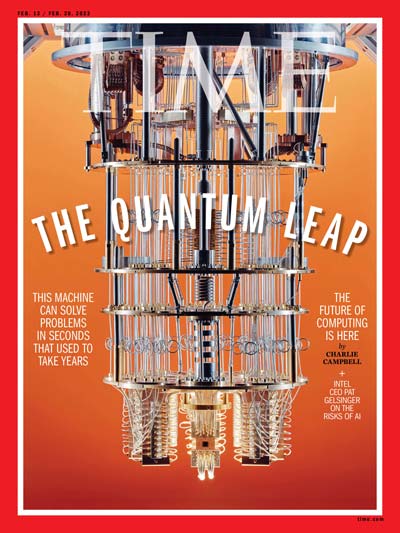
Source: Quantum Could Solve Countless Problems —And Create New Ones | Time, February 2023
As such, quantum computers have the potential to deliver the computational power that could take applications like AI to a whole new level. Powerful quantum computers will become a reality in the not-so-distant future, and while they offer many benefits, they also present a major security threat.
Why are quantum computers a security threat?
Once sufficiently powerful quantum computers exist, traditional asymmetric cryptographic methods for key exchange and digital signatures will be broken. Leveraging Shor’s algorithm, quantum computers will be capable of reducing the security of discrete logarithm-based schemes like Elliptic Curve Cryptography (ECC) and factorization-based schemes like RSA (Rivest-Shamir-Adleman) so much that no reasonable key size would suffice to keep data secure. ECC and RSA are the algorithms used to protect everything from our bank accounts to our medical records.
Governments, researchers, and tech leaders the world over have recognized this quantum threat and the difficulty in securing critical infrastructure against attacks from quantum computers.
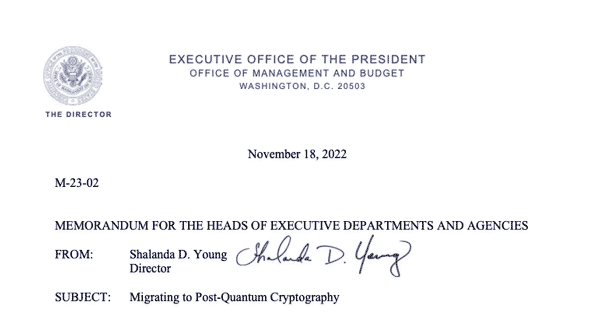
“A quantum computer of sufficient size and sophistication — also known as a cryptanalytically relevant quantum computer (CRQC) — will be capable of breaking much of the public-key cryptography used on digital systems across the United States and around the world.
When it becomes available, a CRQC could jeopardize civilian and military communications, undermine supervisory and control systems for critical infrastructure, and defeat security protocols for most Internet-based financial transactions.”
What is Post-Quantum Cryptography (PQC)?
New digital signatures and key encapsulation mechanisms (KEMs) are needed to protect data and hardware from quantum attacks. Many initiatives have been launched throughout the world to develop and deploy new cryptographic algorithms that can replace RSA and ECC while being highly resistant to both classic and quantum attacks. Post-Quantum Cryptography (PQC) refers to these cryptographic algorithms designed to withstand attacks by quantum computers.
Is Quantum Safe Cryptography the same as Post-Quantum Cryptography (PQC)?
Yes, Quantum Safe Cryptography is another term for Post-Quantum Cryptography. Both refer to cryptographic algorithms designed to withstand attacks by quantum computers. Other terms that you may come across include Quantum Proof Cryptography or Quantum Resistant Cryptography.
Why do we need to act now if quantum computers are still a way off?
While quantum computers powerful enough to break public key encryption may still be a way off, data harvesting is happening now. Malicious actors are already said to be collecting encrypted data and storing it for the time when future quantum computers will be capable of breaking our current encryption methods. This is known as a “harvest now, decrypt later” strategy.
Further because the shelf life of confidential or private information can span years or decades, there is a rapidly growing need to protect such data today to future proof it from quantum attack. Additionally, for many devices such as chips, the development cycle is a long one. Given that it can take years for security testing, certification and then deployment into the existing infrastructure, the earlier the transition to Quantum Safe Cryptography begins, the better.
What progress has been made to develop new PQC algorithms?
The biggest public initiative to develop and standardize new PQC algorithms was launched by The U.S. Department of Commerce’s National Institute of Standards and Technology (NIST). International teams of cryptographers submitted algorithm proposals, reviewed the proposals, broke some, and gained confidence in the security of others.
After multiple rounds of evaluations, on July 5th, 2022, NIST announced the first PQC algorithms selected for standardization. CRYSTALS-Kyber was selected as a Key Encapsulation Mechanism (KEM) and CRYSTALS-Dilithium, FALCON, and SPHINCS+ were selected as digital signature algorithms.
On August 24th, 2023, NIST announced the first three draft standards for general-purpose Quantum Safe Cryptography.
These are draft standards are:
- FIPS 203 ML-KEM: Module-Lattice-Based Key Encapsulation Mechanism Standard, which is based on the previously selected CRYSTALS-Kyber mechanism
- FIPS 204 ML-DSA: Module-Lattice-Based Digital Signature Standard, which is based on the previously selected CRYSTALS-Dilithium signature scheme
- FIPS 205 SLH-DSA: Stateless Hash-Based Digital Signature Standard, which is based on the previously selected SPHINCS+ signature scheme
What recommendations does CNSA 2.0 make for transitioning to PQC algorithms?
The National Security Agency (NSA) published an update to its Commercial National Security Algorithm Suite (CNSA) in September 2022, CNSA 2.0.
National Security Systems (NSS) will need to fully transition to PQC algorithms by 2033 and some use cases will be required to complete the transition as early as 2030. CNSA 2.0 specifies that CRYSTALS-Kyber and CRYSTALS-Dilithium should be used as quantum-resistant algorithms, along with stateful hash-based signature schemes XMSS (eXtended Merkle Signature Scheme) and LMS (Leighton-Micali Signatures).
CNSA 2.0 sets out an ambitious timeline for PQC algorithm adoption – other organizations across the globe are set to follow suit with their own guidelines.
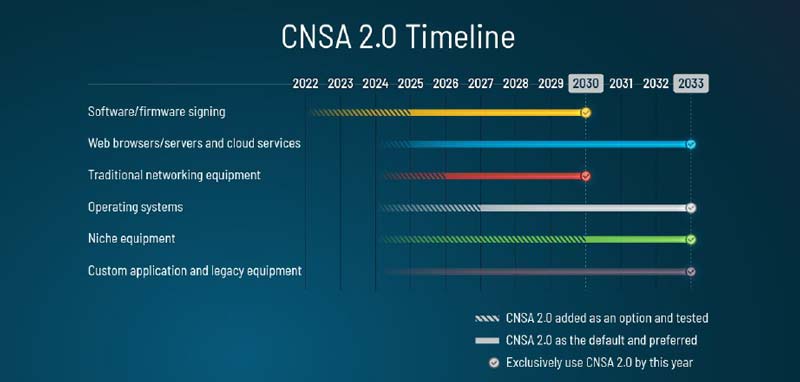
Source: NSA Commercial National Security Algorithm Suite 2.0, September 2022
How can companies get ready for the Quantum Computing Era?
- Understand where vulnerable cryptography like RSA or ECC is deployed in your products.
- Investigate what performance impact a PQC transition will have on your products and what makes sense for your product roadmap.
- Establish what transition timelines your products must observe.
- Speak with your customers and suppliers to ensure that expectations and plans align.
- Understand where vulnerable cryptography like RSA or ECC is deployed in your business infrastructure and business processes.
- Talk to security experts like Rambus to understand how you can begin to transition to Quantum Safe Cryptography
What Quantum Safe IP solutions are available from Rambus?
Rambus Quantum Safe IP solutions offer a hardware-level security solution to protect data and hardware against quantum computer attacks using NIST and CNSA selected algorithms.
Rambus Quantum Safe IP products are compliant with FIPS 203 ML-KEM and FIPS 204 ML-DSA draft standards. Products are firmware programmable to allow for updates with evolving quantum-resistant standards.
The products can be deployed in ASIC, SoC and FPGA implementations for a wide range of applications including data center, AI/ML, defense and other highly secure applications.
Keep Reading:
– Bringing IPsec into the Quantum Safe Era
– Rambus Expands Quantum Safe Solutions with Quantum Safe Engine IP
– Rambus CryptoManager Root of Trust Solutions Tailor Security Capabilities to Specific Customer Needs with New Three-Tier Architecture
Summary
Quantum computing is being pursued across industry, government and academia with tremendous energy and is set to become a reality in the not-so-distant future. For many years, Rambus has been a leading voice in the PQC movement and now offers a portfolio of Quantum Safe IP solutions designed to offer hardware-level security using NIST and CNSA selected algorithms.
Explore more resources:
– Hardware Root of Trust: Everything you need to know
– Protecting Data and Devices Now and in the Quantum Computing Era
– Quantum Safe Cryptography: Protecting Devices and Data in the Quantum Era
Hardware Root of Trust: Everything you need to know
[Last updated on April 8, 2025] A root of trust is the security foundation for an SoC, other semiconductor device or electronic system. However, its meaning differs depending on who you ask. From our perspective, the hardware root of trust contains the keys for cryptographic functions and is usually a part of the secure boot process providing the foundation for the software chain of trust.
In this article:
-
- What is hardware root of trust?
- What are the types of a silicon-based hardware root of trust?
- What are the benefits of a programmable hardware root of trust?
- What features should a programmable hardware root of trust offer?
- What is the Rambus Root of Trust?
- How is the Rambus Root of Trust architected for security?
- What’s new in the latest generation of Rambus Root of Trust IP?
- What is Quantum Safe Cryptography?
- Is there a Root of Trust configured for my application?
- What should I keep in mind when selecting a Root of Trust IP?
What is hardware root of trust?
A hardware root of trust is the foundation on which all secure operations of a computing system depend. It contains the keys used for cryptographic functions and enables a secure boot process. It is inherently trusted and therefore must be secure by design. The most secure implementation of a root of trust is in hardware making it immune from malware attacks. As such, it can be a stand-alone security module or implemented as security module within a processor or system on chip (SoC).
What are the types of a silicon-based hardware root of trust?
A silicon-based hardware root of trust falls into two categories: fixed function and programmable. Essentially, a fixed-function root of trust is firmware controlled. These are typically compact and designed to perform a specific set of functions like data encryption, certificate validation and key management. These compact, firmware-controlled root of trust solutions are particularly well suited for Internet of Things (IoT) devices.
In contrast, a hardware-based programmable root of trust is built around a CPU. Performing all the functions of a firmware-controlled solution, a programmable root of trust can also execute a more complex set of security functions. A programmable root of trust is versatile and upgradable, enabling it to run entirely new cryptographic algorithms and secure applications to meet evolving attack vectors.
What are the benefits of a programmable hardware root of trust?
The cybersecurity threat landscape is dynamic and rapidly evolving. Indeed, attackers are constantly finding new ways to exploit critical vulnerabilities across a wide range of applications and devices. Fortunately, a programmable hardware-based root of trust can be continuously updated to contend with an ever-increasing range of threats.
A programmable hardware-based root of trust is a key component to protect against a number of security threats, including:
- Host processor compromise
- Non-volatile memory (NVM) key extraction
- Tearing and other attacks against NVM writes
- Corruption of non-volatile memory or fuses
- Test and debug interface attacks
- Side-channel and perturbation attacks including Simple Power Analysis (SPA), Differential Power Analysis (DPA) and Fault Injection Attacks (FIA)
- Manufacturing/personalization facility compromise (insider attack)
- Man-in-the-middle and replay attacks
- Probing of external buses
What features should a programmable hardware root of trust offer?
A programmable hardware root of trust should be purpose-built; specifically designed from the ground up to provide a robust level of security. Since the root of trust is a logical target for an attacker, it should be made as secure as possible to safeguard it from compromise. Capabilities should include:
-
-
Siloed Execution:
Ensures that sensitive security functions are only performed within a dedicated security domain that is physically separated from the general-purpose processor. This paradigm allows the primary CPU to be optimized for architectural complexity and performance – with security functionality safely isolated in a physically separated root of trust.
-
Comprehensive Anti-Tamper and Side-Channel Resistance:
Protects against multiple fault injection and side-channel attacks.
-
Layered Security:
Provides multiple layers of robust defense to avoid a single point of failure. Access to cryptographic hardware modules and other sensitive security resources are enforced in hardware, while critical keys are only available to hardware. Software security can be layered on top of a hardware-based root of trust, thereby providing additional flexibility and security.
-
Multiple Root of Trust Instances:
Ensures isolation of resources, keys and security assets. In real-world terms, this means each entity – such as a chip vendor, OEM or service provider – has access to its own ‘virtual’ security core and performs secure functions without having to ‘trust’ other entities. This allows individual entities to possess unique root and derived keys, as well as access only to specified features and resources such as OTP, debug and control bits. Moreover, support for multiple root of trust instances enables the security core to assign or delegate permissions to other entities at any point in the device life cycle, while isolating (in hardware) unique signed apps that are siloed away from other programs.
-
What is the Rambus Root of Trust?
Rambus offers a catalog of robust Root of Trust solutions, ranging from richly featured military-grade co-processors to highly compact firmware-controlled. With a breadth of solutions applicable from the data center to IoT devices, Rambus has a Root of Trust solution for almost every application.
Rambus’ Parvez Shaik explains the importance of addressing supply chain vulnerabilities, the advantages of a hardware root of trust, and the new features of the third-generation CryptoManager Root of Trust products in this episode of Ask the Experts.
Jump to: Root of Trust solutions »
How is the Rambus Root of Trust architected for security?
The CryptoManager RT-6xx Root of Trust family from Rambus is the latest generation of fully programmable FIPS 140-3 compliant hardware security cores offering Quantum Safe security by design for data center and other highly secure applications. The CryptoManager RT-6xx family protects against a wide range of hardware and software attacks through state-of-the-art side channel attack countermeasures and anti-tamper and security techniques.
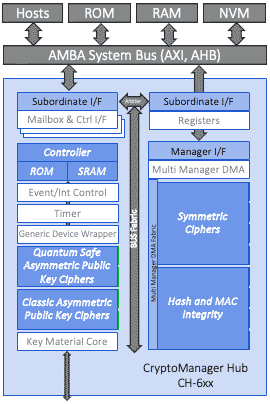
CryptoManager RT-6xx Series Root of Trust Block Diagram
The diagram above illustrates the basic architecture of the Rambus RT-600 series Root of Trust, including:
The CryptoManager RT-6xx Root of Trust is a siloed hardware security IP core for integration into semiconductors, offering secure execution of authenticated user applications, tamper detection and protection, secure storage and handling of keys and security assets, and optional resistance to side-channel attacks. The Root of Trust is easily integrated with industry-standard interfaces and system architectures and includes standard hardware cryptographic cores. Access to crypto modules, keys, memory ranges, I/O, and other resources is enforced in hardware. Critical operations, including key derivation and storage, are performed in hardware with no access by software. The Root of Trust is based on a custom 32-bit processor designed specifically to provide a trusted foundation for secure processing on chip and in the system.
The Root of Trust supports all common host processor architectures including ARM, RISC-V, x86 and others. The multi-threaded secure processor runs customer developed signed code either as a monolithic supervisor or as loadable security applications which include permissions and security-related metadata. It can implement standard security functionality provided by Rambus, or complete customer-specific security applications, including key and data provisioning, security protocols, biometric applications, secure boot, secure firmware update, and many more.
Keep on reading:
Rambus CryptoManager Root of Trust Solutions Tailor Security Capabilities to Specific Customer Needs with New Three-Tier Architecture
What is Quantum Safe Cryptography?
The CryptoManager RT-6xx Root of Trust series is at the forefront of a new category of programmable hardware-based security cores with its new Quantum Safe Cryptography features.
Once sufficiently powerful quantum computers exist, traditional asymmetric cryptographic methods for key exchange and digital signatures will be easily broken. New cryptographic algorithms known as quantum safe cryptography (QSC) or post-quantum cryptography (PQC) are needed to protect against quantum computer attacks.
The latest generation of Rambus Root of Trust IP offers a state-of-the-art programmable security solution to protect hardware and data with NIST and CNSA quantum-resistant algorithms. The Quantum Safe Engine operates with the CRYSTALS-Kyber and CRYSTALS-Dilithium algorithms, as well as the stateful hash-based signature schemes XMSS (eXtended Merkle Signature Scheme) or LMS (Leighton-Micali Signatures).
Learn more about Quantum Safe Cryptography:
– Post-quantum Cryptography (PQC): New Algorithms for a New Era
– Rambus Expands Quantum Safe Solutions with Quantum Safe Engine IP
Is there a Rambus Root of Trust configured for my application?
There are Rambus Root of Trust solutions tailored to address the specific security requirements and certification standards of nearly every application:
-
- The RT-1xx series of Root of Trust solutions are designed for use in power and space-constrained applications as in IoT devices. Featuring a firmware-controlled architecture with dedicated secure memories, the RT-1xx hardware Root of Trust cores provide a variety of cryptographic accelerators including AES, SHA-2, RSA and ECC. There are versions which include SM2, SM3 and SM4 accelerators for the China market.
- The CryptoManager RT-6xx is a fully programmable, FIPS 140-3 compliant, hardware security core offering security-by-design for data center cloud, AI/ML, as well as general purpose semiconductor applications. It protects against a wide range of hardware and software attacks through state-of-the-art anti-tamper and security techniques.
- The CryptoManager RT-7xx is tailored for the automotive market offering ISO 26262 and ISO 21434 compliant hardware security. It supports vehicle-to-vehicle and vehicle-to-infrastructure (V2X), advanced driver-assistance systems (ADAS) and infotainment uses.
- CryptoCell Root of Trust solutions are programmable, FIPS 140-3 certifiable hardware security modules. They are designed to be integrated into Arm TrustZone-based SoCs or FPGAs where power and space are a consideration.
Find out more: See all Rambus Root of Trust IP Solutions »
What should I keep in mind when selecting a Root of Trust IP?
Root of Trust product designs vary greatly in architecture and capabilities. When selecting a Root of Trust solution, it’s important to ask the right questions to ensure the best level of protection for your specific security needs.
Some questions to consider include:
- What is the end use of the chip?
- Who and what are you protecting against?
- What is the risk of a compromised device?
- What certifications are required?
It’s also worth noting that Root of Trust products can be tailored to match an application’s security threat model, use case, industry segment, lifetime, cost, and geography. Some examples of the different criteria that can be selected include the crypto algorithms, security/anti-tamper mechanisms, and provisioning methods used.
Next steps?
If you have any questions about how to select a Root of Trust for your next project, contact us here.
Explore more resources:
– The Ultimate Guide to Secure Silicon: Root of Trust
– Ask the Experts: PUF-based Security
– Implementing State-of-the-Art Digital Protection with Rambus CryptoManager Security IP
Ask the Experts: CryptoManager Root of Trust
Addressing supply chain vulnerabilities and the advantages of Root of Trust on Ask the Experts
On this episode of Ask the Experts, we sat down with Parvez Shaik, a Rambus security expert, about the latest developments in security and the concept of the root of trust. Scroll below to watch this episode and learn about the importance of addressing supply chain vulnerabilities, the advantages of a hardware root of trust, and the new features of the third-generation CryptoManager Root of Trust products.
Key topics answered in this episode:
What is the current threat environment faced by chip and system makers?
Parvez stressed how crucial it is to tackle supply chain vulnerabilities, cybersecurity risks, and regulatory hurdles that manufacturers face. He pointed out that keeping the manufacturing process secure and protecting intellectual property are top priorities. With the security landscape constantly evolving and regulations like the CHIPS and Science Act of 2022 introducing new challenges, manufacturers are dealing with an ever-growing set of threats.
What is a root of trust and its role in security?
Parvez compared Root of Trust to the foundation of a house—it’s the bedrock of security for semiconductor devices. Just like a strong foundation keeps a house standing, a solid Root of Trust ensures secure boot, safeguards cryptographic operations, and protects intellectual property. A hardware Root of Trust acts as a secure vault, storing keys and handling critical cryptographic tasks to keep everything locked down.
What are the advantages of implementing a root of trust in hardware?
Parvez discussed the advantages of implementing root of trust in hardware, including enhanced security, anti-tampering features, and improved performance. He noted that hardware root of trust is embedded into the chip and cannot be tampered with, providing a higher level of security. However, he also mentioned the cost and flexibility limitations of hardware root of trust.
What’s new in the third-generation CryptoManager Root of Trust?
In this third-generation CryptoManager Root of Trust, Parvez emphasized its three-tier architecture, modularity, and compliance with various industry standards. The new features aim to provide customer flexibility, faster time to market, and pre-certification for different security requirements. The three-tier architecture includes the CryptoManager Core, CryptoManager Hub, and the overall CryptoManager Root of Trust, each offering unique features and benefits.
Key Quote
“A hardware root of trust is the foundation or the foundational concept of security for any semiconductor device. It is what its name literally says, “root of trust.” It is basically everything that your complete device security is based on.” – Parvez Shaik


