HBM Controller IP

Delivering ultra high-bandwidth, low-latency memory performance

HBM Memory Controller IP

Rambus High-Bandwidth Memory (HBM) 4E/4, 3E/3 and 2E/2 controller IP provide high-bandwidth, low-latency memory performance for AI/ML, graphics and HPC applications. 

Version Maximum Data Rate (Gb/s) Controller
HBM4E 16 Download the Rambus HBM4 Product Brief Product Brief
HBM4 10 Download the Rambus HBM4 Product Brief Product Brief
HBM3E / HBM3 9.6 Download the Rambus HBM3E/3 Product Brief Product Brief
HBM2E / HBM2 3.6/2.0 Download HBM3 Product Brief Product Brief

HBM4E / HBM4 / HBM3E / HBM3 & HBM2E Controller IP

FeaturesHBM4E
Product Brief
HBM4
Product Brief
HBM3E/3
Product Brief
HBM2E/2
Product Brief
Speed Bins (Gb/s)Up to 16Up to 10Up to 9.6/8.4Up to 3.6/2.0
Channel Densities (Gb)Up to 32Up to 32Up to 32Up to 24
Channels | Pseudo-Channels323216 | 328 | 16
DRAM StacksUp to 16Up to 16Up to 16Up to 12
PHY InterfaceDFI StyleDFI StyleDFI StyleDFI Style
PHY Independent ModeYesYesYesYes
Refresh Management SupportYesYesYes 
Look-Ahead Command Processing for Minimum LatencyYesYesYesYes
Integrated Reorder FunctionalityYesYesYesAdd-on core
Self-refresh and Power-down
Low Power Modes
YesYesYesYes
RAS FeaturesYesYesYesYes
Built-in Activity MonitorYesYesYesYes
DFI CompatibleYesYesYesYes
End-to-end Data ParityYesYesYesYes
Interface to LogicNative or AXINative or AXINative or AXINative or AXI

Ask the Experts: HBM4 Controller IP

In this episode of Ask the Experts, we discuss HBM4 with Nidish Kamath, director of product management for memory interface IP at Rambus. Topics discussed include: how AI is influencing the development of the HBM specification, what we know so far about HBM4, the implementation challenges associated with HBM4, the Rambus HBM4 Controller IP offering, and why customers should choose Rambus for their HBM designs.

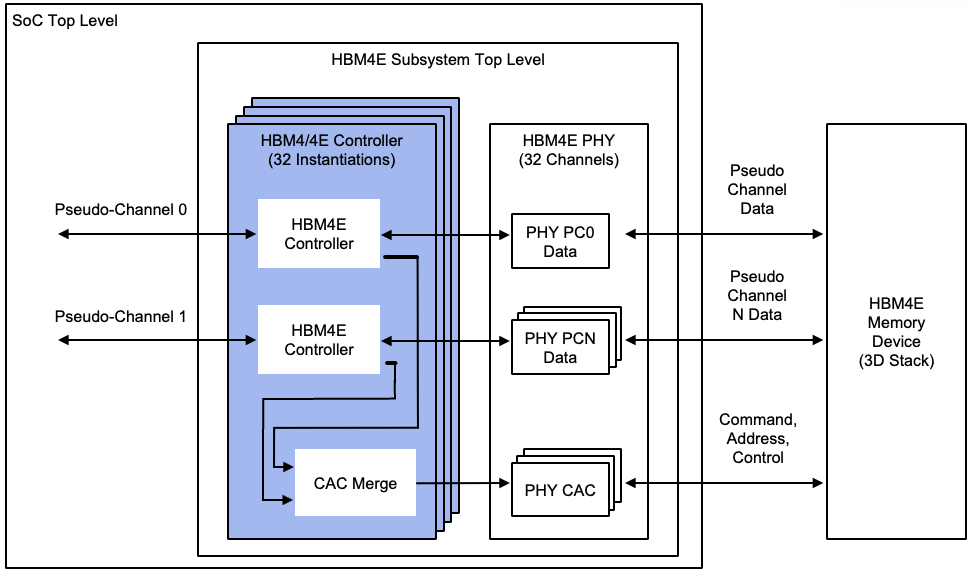
HBM4E Memory Subsystem

HBM is a high-performance memory standard that features reduced power consumption and a small form factor. It combines a 2.5D/3D architecture with a wider interface at a lower clock speed (as compared to GDDR) to deliver higher overall throughput at a higher bandwidth-per-watt efficiency for AI/ML and high-performance computing (HPC) applications. 

HBM4E Memory Subsystem

Rambus HBM memory controllers support data rates up to 16 Gb/s per data pin (HBM4E) and can be paired with 3rd-party or customer PHY solutions.

HBM4E Memory: Break Through to Greater Bandwidth

HBM4E Memory: Break Through to Greater Bandwidth

Delivering unrivaled memory bandwidth in a compact, high-capacity footprint, has made HBM the memory of choice for AI training. HBM4 is the fourth major generation of the HBM standard, with HBM4E offering an extended data rate and the same feature set. The Rambus HBM4E Controller provides industry-leading performance to 16 Gb/s, enabling a memory throughput of over 4 TB/s for training recommender systems, generative AI and other compute-intensive AI workloads.

Frequently Asked Questions about HBM

HBM is a high-performance memory standard that delivers extremely high bandwidth at excellent power efficiency by employing up to a 2048-bit wide interface.

HBM memory offers excellent bandwidth and capacity with superior power efficiency that makes it an ideal solution for AI/ML training workloads.

To achieve its high bandwidth, HBM uses a 2048-bit wide data interface in the latest generation HBM4/4E. This is far more than can be supported on a standard PCB used by traditional (2D) memory solutions. So, HBM employs a silicon interposer where traces can be very finely etched. This structure is called 2.5D. In addition, HBM uses 3D-stacked memory devices, giving HBM a 2.5D/3D architecture.

HBM memory is ideal for data-intensive applications like AI/ML, graphics, and HPC, where large amounts of data need to be processed at very high bandwidth.

HBM3E and GDDR6: Memory Solutions for AI

HBM3E and GDDR6: Memory Solutions for AI

AI/ML changes everything, impacting every industry and touching the lives of everyone. With AI training sets growing at a pace of 10X per year, memory bandwidth is a critical area of focus as we move into the next era of computing and enable this continued growth. AI training and inference have unique feature requirements that can be served by tailored memory solutions. Learn how HBM3E and GDDR6 provide the high performance demanded by the next wave of AI applications.

Rambus logo