Supports low-power, high-performance LPDDR-based memory modules for AI server platforms
Home > Memory Interface Chips > SOCAMM2 Server Chipset
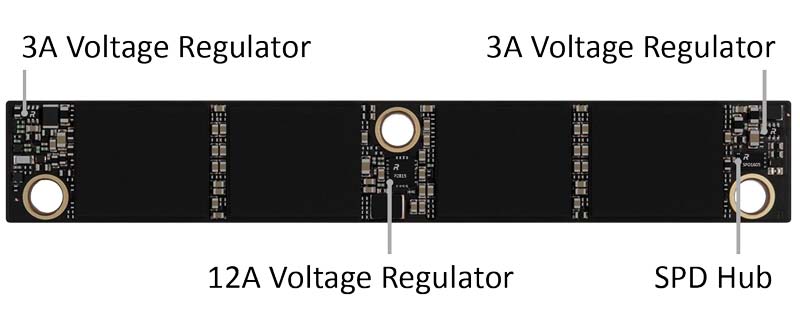
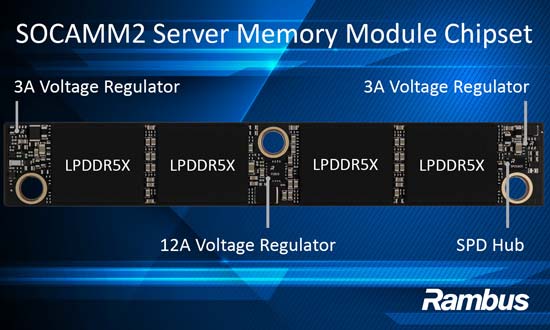
The Rambus LPDDR5X SOCAMM2 (Small Outline Compression Attach Memory Module Gen 2) server chipset includes 12A and 3A Voltage Regulators (VR) and Serial Presence Detect Hub (SPD Hub). These chips enable the SOCAMM2 form factor for servers bringing the power-efficient bandwidth and capacity benefits of LPDDR5X memory with the flexibility and reliability of a module.
Rambus has announced a Power Management IC (PMIC) designed for the upcoming LPDDR6 SOCAMM2. Optimized for the dynamic workloads of future AI systems, the Rambus PMIC and SPD Hub provide efficient and precise module-level power management, including advanced power conversion, sequencing, telemetry and fault protection.
| Description | Part Number | Product Brief | Applications |
|---|---|---|---|
| 12 Amp Voltage Regulator | P2815Gxx | Server LPDDR5X SOCAMM2 | |
| 3 Amp Voltage Regulator | P2813Gxx | Server LPDDR5X SOCAMM2 | |
| SPD Hub with Internal Temperature Sensor | SPD1605Gxx | Server SOCAMM2, RDIMM, MRDIMM |
The Rambus SOCAMM2 Server Chipset enables the operation of LPDDR5X-based SOCAMM2 modules up to a maximum data rate of 9.6 Gb/s. SOCAMM2 overcomes the previous limitation of LPDDR memory in servers wherein the LPDDR DRAM devices had to be soldered down to the motherboard.
The 12A and 3A Voltage Regulators receive high voltage inputs and step down to the voltages to those needed to power the LPDDR DRAM and all the other active components on the module. This architecture supports greater power efficiency and finer grain control of supply currents.
The SPD Hub with integrated temperature sensor enables communication via the I3C bus of important data for system configuration and thermal telemetry.
In this episode of Ask the Experts, we discuss the server module chipset for SOCAMM2 with Piero Bianco, Senior Director of Product Marketing, Memory Interface Chips at Rambus. Topics include: the benefits and challenges of using LPDDR memory in servers; and how the SOCAMM2 module bridges the gap between LPDDR limits and the performance and reliability needs of servers.