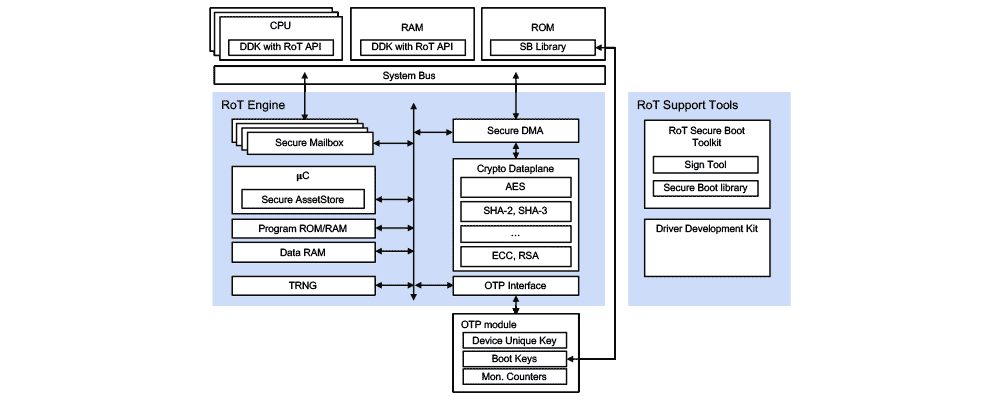
Designed to be integrated in power and space-constrained SoCs or FPGAs, the RT-130 Root of Trust (formerly VaultIP) is a FIPS 140-2 compliant hardware core that guards the most sensitive assets on chips and establishes the foundation for platform security.
Search Results for: security
Root of Trust RT-121 Product Brief
Designed to be integrated in power and space-constrained SoCs or FPGAs, the RT-121 Root of Trust (formerly VaultIP) is a FIPS 140-2 compliant hardware core that guards the most sensitive assets on chips and establishes the foundation for platform security.
Root of Trust RT-120 Product Brief
Designed to be integrated in power and space-constrained SoCs or FPGAs, the RT-120 Root of Trust (formerly VaultIP) is a FIPS 140-2 compliant hardware core that guards the most sensitive assets on chips and establishes the foundation for platform security.
RT-260
Home > You searched for security > Page 85
Designed to be integrated in secure MCUs (microcontrollers), the RT-260 Root of Trust (formerly VaultIP) is a FIPS 140-3 CMVP compliant hardware core that guards the most sensitive assets on chips and establishes the foundation for platform security.
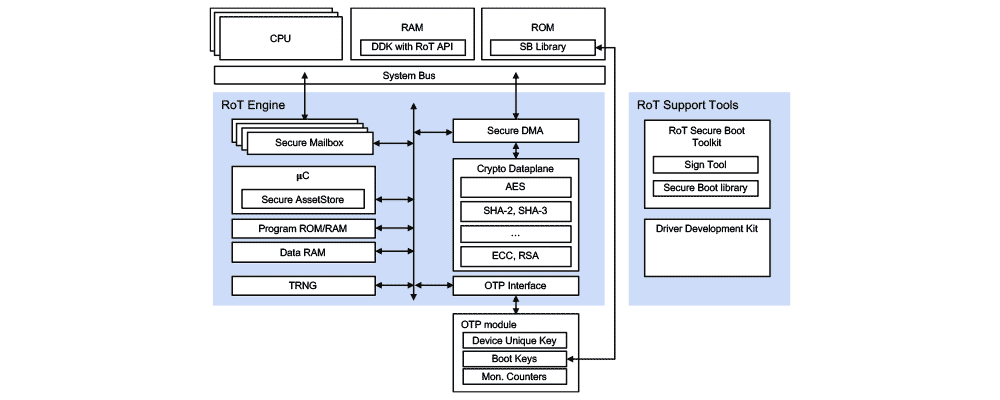
Featuring a firmware-controlled architecture with dedicated secure memories, the RT-260 hardware Root of Trust provides a variety of cryptographic accelerators including DPA protection for AES, RSA, and ECC. Ideal as a secure services and key manager for MCU (microcontroller) devices, the RT-260 Root of Trust offers the best balance of size and performance available on the market.
The RT-260 offers a series of key security use cases ‘out of the box’, including:
- Secure Boot assist to host CPU(s) and protection of key material
- Secure firmware upgrade management for Host CPU
- Lifecycle management support
- Secure Debug support
- Secure device authentication and identity protection
The RT-260 provides a secure asset store:
- Only the RT-260 can manage, use and access the assets
- The O/S and applications cannot access key values
- Applications request asset use by reference
- Enforces policies for access and use of keys and cryptographic functions
- Key generation, derivation, storage and transport
How the Root of Trust Works
The RT-260 Root of Trust is a silicon IP core developed to protect an SoC platform and its operation. It allows the SoC to boot securely and protects sensitive key material and assets. At its heart, its Secure Asset Store allows import, negotiation, and creation of secret and private key material. Safe use of key material is enforced through a flexible key use and access policy. Keys can be securely stored in off-chip NVM. Fully featured, its cryptographic data plane associated to its DMA offloads the main CPU while never exposing secret data to the OS or the applications. It is designed to provide secure, energy efficient and accelerated security functions.
Readily deployable, the RT-260 Root of Trust is offered in off-the-shelf configurations, allowing a choice tailored to the needs of your application. Configurations differ by cryptographic accelerators contained and 3rd-party certification and standard compliance.
The RT-260 is part of the broad Rambus Root of Trust portfolio, which ranges from small, lightweight cores designed to protect IoT endpoints all the way to fully programmable Root of Trust cores designed to protect the most sensitive government/defense chips and automotive deployments requiring ISO-26262 certifications.
Rambus can optionally offer dedicated FIPS 140-3 support packages to its licensees that provide FIPS 140-3 related certification documentation, FIPS test scripts, and dedicated FIPS support.
Solution Offerings
| Feature | Description | Details |
| FIPS 140-3 | CAVP and CMVP Compliant | Includes CAVP certificates for NIST approved algorithms and TRNG |
| DPA Resistance | Simple and differential power analysis resistant cores | RSA, ECC, AES |
| Cipher Algorithm Support | AES (all key sizes) Optional: ChaCha20, ARIA | Modes: CBC, CTR, CCM, CMAC, GCM, XTS ARIA Modes: CBC, CTR, CMAC, CCM, GCM |
| Hash Algorithms | SHA-1, SHA-2 Optional: SHA-3 | SHA-2 224-256-384-512 SHA-3 224-256-384-512 |
| Message Authentication Code Algorithms | HMAC-SHA-1, HMAC-SHA-2 Optional: HMAC-SHA3 | SHA-2 224-256-384-512 SHA-3 224-256-384-512 |
| AEAD Algorithms | AES-GCM, AES-GMAC, AES-CCM Optional: ChaCha20/Poly1305, ARIA-CCM | Modes: GCM, GMAC, CCM |
| Signature Generation and Verification | ECDSA EdDSA RSA up to 3096 bits | NIST P-224, P-256, P-384, P-521 Ed25519 |
| Key Agreement Algorithms | ECDH DH EdDH | NIST P-224, P-256, P-384, P-521 Up to 3096 bits Curve25519 |
| Key Transport Algorithms | ECIES RSA Wrap/Unwrap (RSA-OAEP) AES-WRAP | 128- and 256-bit strength Up to 3096 bits 128- and 256-bit strength |
| True Random Number Generator | NIST SP800-90A/B/C | NIST ENT certificate |
| Crypto Performance | Cipher/Hash Performance (Gbps) @500MHz | Scalable, ~2 Gbps |
| I/O Bus | AMBA Bus Master/Slave | AXI/AHB Master, AXI/AHB/APB Slave |
| OTP Interface | Interface to 3rd-Party OTP | TCM |
- Cloud-connected devices
- IoT (Internet of Things) devices
- Industrial IoT
- Sensors
- Gateways
RT-131
RT-131 Root of Trust
Foundational security in SoCs and FPGAs for Chinese IoT servers, gateways, edge devices and sensors
Home > You searched for security > Page 85
Designed to be integrated in power and space-constrained SoCs or FPGAs, the RT-131 Root of Trust (formerly VaultIP) is a FIPS 140-3 compliant hardware core that guards the most sensitive assets on chips and establishes the foundation for platform security.
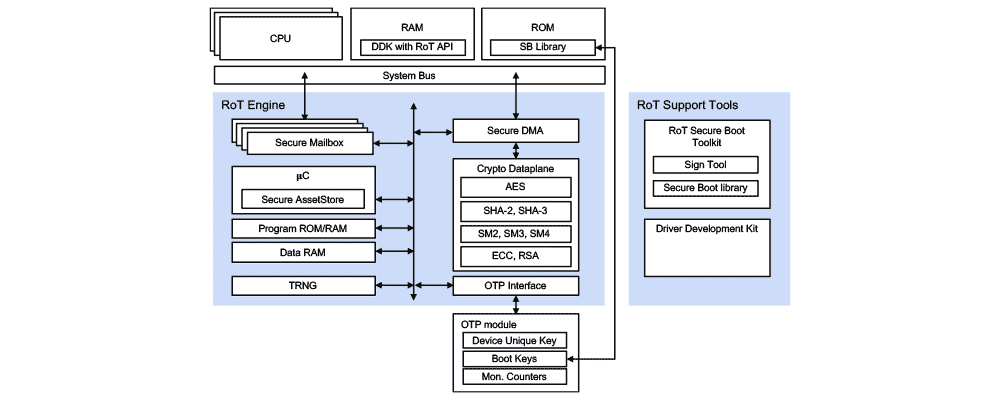
Featuring a firmware-controlled architecture with dedicated secure memories, the RT-131 hardware Root of Trust provides a variety of cryptographic accelerators including AES, SHA-2, OSCCA SM2/SM3/SM4, RSA and ECC. Ideal for power and space-sensitive applications like Chinese IoT server, gateway and edge devices, the RT-131 Root of Trust offers the best balance of size and performance available on the market.
The RT-131 offers a series of key security use cases ‘out of the box’, including:
- Secure Boot assist to host CPU(s) and protection of key material
- Secure firmware upgrade management for Host CPU
- Lifecycle management support
- Secure Debug support
- Secure device authentication and identity protection
The RT-131 provides a secure asset store:
- Only the RT-131 can manage, use and access the assets
- The O/S and applications cannot access key values
- Applications request asset use by reference
- Enforces policies for access and use of keys and cryptographic functions
- Key generation, derivation, storage and transport
How the Root of Trust Works
The RT-131 Root of Trust is a silicon IP core developed to protect an SoC platform and its operation. It allows the SoC to boot securely and protects sensitive key material and assets. At its heart, its Secure Asset Store secretly generates keys and securely stores them. Fully featured, its cryptographic data plane associated to its DMA offloads the main CPU while never exposing secret data to the OS or the applications. It is designed to provide secure, energy efficient and accelerated security functions.
Readily deployable, the RT-131 Root of Trust is offered in off-the-shelf configurations, allowing a choice tailored to the needs of your application. Configurations differ by cryptographic accelerators contained and 3rd-party certification and standard compliance.
The RT-131 is part of the broad Rambus Root of Trust portfolio, which ranges from small, lightweight cores designed to protect IoT endpoints all the way to fully programmable Root of Trust cores designed to protect the most sensitive government/defense chips and automotive deployments requiring ISO-26262 certifications.
Rambus can optionally offer dedicated FIPS 140-3 support packages to its licensees that provide FIPS 140-3 related certification documentation, FIPS test scripts, and dedicated FIPS support.
Solution Offerings
| Feature | Description | Details |
| FIPS 140-3 | CAVP and CMVP Compliant | Includes CAVP certificates for NIST approved algorithms and TRNG |
| Cipher Algorithm Support | AES (all key sizes) SM4 (128-bit key) Optional: ChaCha20, ARIA | Modes: CBC, CTR, CCM, CMAC, GCM, XTS Modes: CBC, CTR, GCM ARIA Modes: CBC, CTR, CMAC, CCM, GCM |
| Hash Algorithms | SHA-1, SHA-2 SM3 Optional: SHA-3 | SHA-2 224-256-384-512 SHA-3 224-256-384-512 |
| Message Authentication Code Algorithms | HMAC-SHA-1, HMAC-SHA-2, HMAC-SM3 Optional: HMAC-SHA3 | SHA-2 224-256-384-512 SHA-3 224-256-384-512 |
| AEAD Algorithms | AES-GCM, AES-GMAC, AES-CCM Optional: ChaCha20/Poly1305, ARIA-CCM | Modes: GCM, GMAC, CCM |
| Signature Generation and Verification | ECDSA EdDSA SM2DSA RSA up to 3096 bits | NIST P-224, P-256, P-384, P-521 Ed25519 |
| Key Agreement Algorithms | ECDH DH EdDH | NIST P-224, P-256, P-384, P-521 Up to 3096 bits Curve25519 |
| Key Transport Algorithms | ECIES RSA Wrap/Unwrap (RSA-OAEP) SM2-WRAP AES-WRAP SM4-WRAP | 128- and 256-bit strength Up to 3096 bits128- and 256-bit strength 128-bit strength |
| True Random Number Generator | NIST SP800-90A/B/C | NIST ENT certificate |
| Crypto Performance | Cipher/Hash Performance (Gbps) @500MHz | Scalable, ~2 Gbps |
| I/O Bus | AMBA Bus Master/Slave | AXI/AHB Master, AXI/AHB/APB Slave |
| OTP Interface | Interface to 3rd-Party OTP | TCM |
- Cloud-connected devices
- IoT (Internet of Things) devices
- Industrial IoT
- Sensors
- Gateways
RT-130
RT-130 Root of Trust
Foundational security in SoCs and FPGAs for IoT servers, gateways, edge devices and sensors
Home > You searched for security > Page 85
Designed to be integrated in power and space-constrained SoCs or FPGAs, the RT-130 Root of Trust (formerly VaultIP) is a SESIP, PSA Certified, and FIPS 140-3 certified hardware core that guards the most sensitive assets on chips and establishes the foundation for platform security.
Featuring a firmware-controlled architecture with dedicated secure memories, the RT-130 hardware Root of Trust provides a variety of cryptographic accelerators including AES, SHA-2, RSA and ECC. Ideal for power and space-sensitive applications like IoT servers, gateways and edge devices, the RT-130 Root of Trust offers the best balance of size and performance available on the market.
The RT-130 offers a series of key security use cases ‘out of the box’, including:
- Secure Boot assist to host CPU(s) and protection of key material
- Secure firmware upgrade management for Host CPU
- Lifecycle management support
- Secure Debug support
- Secure device authentication and identity protection
The RT-130 provides a secure asset store:
- Only the RT-130 can manage, use and access the assets
- The O/S and applications cannot access key values
- Applications request asset use by reference
- Enforces policies for access and use of keys and cryptographic functions
- Key generation, derivation, storage and transport
How the Root of Trust Works
The RT-130 Root of Trust is a silicon IP core developed to protect an SoC platform and its operation. It allows the SoC to boot securely and protects sensitive key material and assets. At its heart, its Secure Asset Store allows import, negotiation, and creation of secret and private key material. Safe use of key material is enforced through a flexible key use and access policy. Keys can be securely stored in off-chip NVM. Fully featured, its cryptographic data plane associated to its DMA offloads the main CPU while never exposing secret data to the OS or the applications. It is designed to provide secure, energy efficient and accelerated security functions.
Readily deployable, the RT-130 Root of Trust is offered in off-the-shelf configurations, allowing a choice tailored to the needs of your application. Configurations differ by cryptographic accelerators contained and 3rd-party certification and standard compliance.
The RT-130 is part of the broad Rambus Root of Trust portfolio, which ranges from small, lightweight cores designed to protect IoT endpoints all the way to fully programmable Root of Trust cores designed to protect the most sensitive government/defense chips and automotive deployments requiring ISO-26262 certifications.
Rambus can optionally offer dedicated certification support packages to its RT-130 licensees that provide related certification documentation, test scripts, and dedicated support to achieve FIPS 140-3, SESIP and PSA certification when embedded in your SoC or ASIC.
“Relying on Rambus for mission-critical security IP allows us to offer customers world leading document solutions and ensure their data is protected”
- Michihiro Okada, Deputy Senior General Manager, Corporate R&D Division at Kyocera
Solution Offerings
| Feature | Description | Details |
| SESIP | Certified Level 2 | SESIP Profile for PSA Certified RoT Component Level 2 version 1.0 REL 02 |
| PSA | Certified Level 2 RoT Component | |
| FIPS 140-3 | CAVP and CMVP Certified | Includes CAVP certificates for NIST approved algorithms and ESV certified TRNG |
| FIPS 140-2 | CAVP and CMVP Certified | Includes CAVP certificates for NIST approved algorithms and ESV certified TRNG |
| Cipher Algorithm support | AES (all key sizes) Optional: ChaCha20, ARIA | Modes: CBC, CTR, CCM, CMAC, GCM, XTS ARIA Modes: CBC, CTR, CMAC, CCM, GCM |
| Hash Algorithms | SHA-1, SHA-2 Optional: SHA-3 | SHA-2 224-256-384-512 SHA-3 224-256-384-512 |
| Message Authentication Code Algorithms | HMAC-SHA-1, HMAC-SHA-2 Optional: HMAC-SHA3 | SHA-2 224-256-384-512 SHA-3 224-256-384-512 |
| AEAD Algorithms | AES-GCM, AES-GMAC, AES-CCM Optional: ChaCha20/Poly1305, ARIA-CCM | Modes: GCM, GMAC, CCM |
| Signature Generation and Verification | ECDSA EdDSA RSA up to 3096 bits | NIST P-224, P-256, P-384, P-521 Ed25519 |
| Key Agreement Algorithms | ECDH DH EdDH | NIST P-224, P-256, P-384, P-521 Up to 3096 bits Curve25519 |
| Key Transport Algorithms | ECIES RSA Wrap/Unwrap (RSA-OAEP) AES-WRAP | 128- and 256-bit strength Up to 3096 bits 128- and 256-bit strength |
| Random Number Generator HW | NIST SP800-90 compliant TRNG | NIST ESV certificate |
| Crypto Performance | Cipher/Hash Performance (Gbps) @500MHz | Scalable, ~2 Gbps |
| I/O Bus | AMBA Bus Master/Slave | AXI/AHB Master, AXI/AHB/APB Slave |
| OTP Interface | Interface to 3rd-Party OTP | TCM |
- Cloud-connected devices
- IoT (Internet of Things) devices
- Industrial IoT
- Sensors
- Gateways
- « Go to Previous Page
- Page 1
- Interim pages omitted …
- Page 83
- Page 84
- Page 85
- Page 86
- Page 87
- Interim pages omitted …
- Page 246
- Go to Next Page »