
Vehicle systems and the semiconductors used within them are some of the most complex electronics seen today. Ensuring these systems are both functionally safe and secure from cyberattacks is mission critical. Join us for this webinar where Thierry Kouthon of Rambus, and Ann Keffer of Siemens will discuss hardware solutions for securing automotive electronics and how functional safety tools from Siemens can help ensure these solutions meet the requirements of ISO 26262.
Search Results for: security
Protecting Devices with Security Anchored in Hardware
[April 14 @ 11am PT] Join Neeraj Paliwal, general manager of the Rambus Security IP business, and John McHale, EVP & Group Editorial Director of Military Embedded Systems, as they discuss how hardware level protection is the key to building the foundation of security for data and electronic systems.
Rambus Accelerates Automotive SoC Design with ASIL-B Certified Embedded Hardware Security Module
Highlights:
- Rambus RT-640 Embedded Hardware Security Module (HSM) provides automotive chip and device makers state-of-the-art digital protection that meets the functional safety standards of ISO 26262 ASIL-B
- Industry-standard certified solution accelerates the process of achieving functional safety for automotive SoCs
- Rambus expands industry-leading security IP portfolio that spans applications from consumer IoT to mission-critical defense electronics
SAN JOSE, Calif. – Mar. 9, 2022 – Rambus Inc. (NASDAQ: RMBS), a premier chip and silicon IP provider making data faster and safer, today announced that the Rambus Root of Trust RT-640 Embedded Hardware Security Module (HSM) has received Automotive Safety Integrity Level B (ASIL-B) certification per the ISO 26262 international standard. Certified ASIL-B compliance is a critical requirement for automotive manufacturers and their suppliers to ensure vehicle systems meet necessary safety levels. As Advanced Driver Assistance Systems (ADAS) become increasingly ubiquitous, it is imperative that vehicle electronic systems and data be protected from cyberattack and system malfunction. By integrating the Rambus RT-640 Embedded HSM, automotive SoC makers are able to accelerate the process of achieving functional safety requirements with proven, certified security IP.
“Increasingly sophisticated automotive systems must be both functionally safe and resilient to cyberattack,” said Neeraj Paliwal, general manager of Security IP at Rambus. “With the Rambus RT-640 Embedded HSM, automotive manufacturers get the best of both worlds: robust cybersecurity anchored in hardware with the assurance of ASIL-B functional safety. We have already achieved multiple design wins for the RT-640 across the globe, and it has tremendous traction in the new centralized automotive architecture across ADAS and sensors such as cameras, lidar and radar.”
Rambus is the leading supplier of security IP with the industry’s broadest portfolio of solutions. With nearly 200 design wins in the past three years, Rambus has proven security IP solutions for every application from consumer IoT to mission-critical defense electronics. With certified solutions such as the RT-640 Embedded HSM, chip and device makers can implement state-of-the-art security, meet industry-specified requirements, and reduce time to market.
Ensuring Functional Safety with ISO 26262 ASIL-B
Specified under ISO 26262, ASIL-B is a risk classification defined for functional safety of road vehicles. ASIL levels are assigned by performing risk analysis of potential hazards by examining various risk parameters such as severity, exposure and controllability of the vehicle operating scenario. In addition to the RT-640 HSM ASIL-B certification, the Rambus hardware and software development organizations have demonstrated to have the qualification, knowledge, and expertise required for the automotive industry and therefore have been certified to operate in accordance with ISO 26262:2018 standard ASIL-B for development and support processes.
While developing ADAS, automotive electronics makers are building complex SoCs, replacing discrete secure processor elements with ISO 26262-certified synthesizable IP and software. The Rambus RT-640 is the first programmable automotive grade Hardware Root of Trust IP solution on the market to reach this certified status. Customers can integrate the RT-640 as-is and focus on their own automotive security application without affecting the RT-640 certificate.
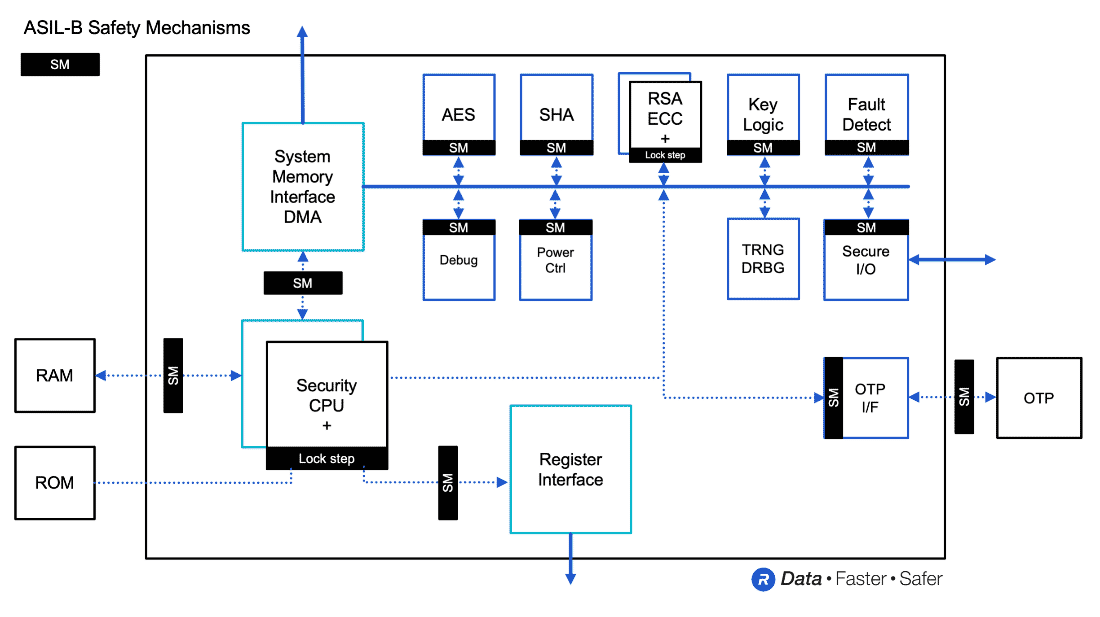
Integrated into an automotive SoC, the ASIL B certified RT-640 silicon IP design provides powerful cryptographic functions, state-of-the-art safety mechanisms and anti-tamper technologies to protect critical automotive electronics and data. This robust cybersecurity solution has been certified by TÜV-SGS 26262 ASIL-B functional safety. The ASIL-B certificate guarantees that all safety mechanisms are implemented and verified correctly, meet and exceed the required safety integrity levels and are supported with the ISO 26262 required evidence.
The certified RT-640 Embedded HSM key features include:
- Fully programmable, purpose-built security processor with hardware enforced security and privilege levels
- High-performance cryptographic accelerators for RSA, ECC, AES, HMAC and SHA-2
- NIST SP 800-90 compliant random bit generator
- Hardware enforced security with state-of-the-art protection from side channel and tampering attacks
- ASIL-B safety mechanisms in the HW and SW implementation
More Information:
For more information on the Rambus RT-640 Embedded HSM, please visit https://www.rambus.com/security/root-of-trust/rt-640/.
Navigating the Intersection of Safety and Security
Vehicle systems and the semiconductors used within them are some of the most complex electronics seen today. In the past, electronics going into vehicle systems implemented flat architectures with isolated functions controlling various components of the power train and vehicle dynamics. However, to support the realization of Level 4 and Level 5 (L4/L5) autonomous driving, a massive restructure is underway. The software-defined vehicle, the automotive Ethernet, vehicle-to-everything (V2X) connectivity, and domain controller units are just some of the new technologies required to realize L4/L5 capabilities. Ensuring all these new systems are both functionally safe and secure from cyberattacks is mission critical.
Addressing automotive security challenges with a hardware root of trust
Ann Steffora Mutschler of Semiconductor Engineering recently wrote an article that takes an in-depth look at automotive security challenges. As Mutschler notes, automakers are “scrambling” to prevent security breaches and data hacks in new vehicles. Concurrently, they are adding new and increasingly autonomous features into vehicles that open the door to new vulnerabilities.
“As with any complex system, nothing is ever completely secure. But even getting a handle on this multilayered issue is a challenge,” she explains. “Vehicle architectures today, and those being developed for future vehicles, are increasingly complex and often beyond the control of any single company.”
This is because vehicle architectures typically involve both hardware and software components, with data generated and processed at multiple levels and locations, such as within a vehicle, between vehicles (V2V), and externally via connected infrastructure.
“Some of that data is critical to the functionality of the vehicle and tightly controlled, but even less-critical data can provide a potential attack vector,” she adds.
Thierry Kouthon, technical product manager at Rambus, concurs.
“We have many challenges with vehicles today because there is an increasing amount of advanced driver assistance systems (ADAS) that require a lot of electronic control units,” Kouthon tells Semiconductor Engineering. “All the functions of the car that in the old days were mechanical or hydraulic are now computerized. Otherwise, you cannot control the car by computer. But this also provides [an attractive] attack surfaces for hackers.”
As Kouthon highlights, infotainment systems are a prime entry point for attacks due to a number of wireless connections to the vehicle. There is also the electrification of vehicles, which multiplies the number of electronic control units (ECUs). And although there are fewer moving parts, there are more electronic components that create a wider attack surface. This is especially true for autonomous vehicles which require even more advanced electronic systems.
Vehicle-to-everything (V2X) adds yet another potential attack vector, as cars and trucks will eventually communicate with traffic lights, other vehicles, and even pedestrian devices. In addition, V2X-enabled cars will communicate with non-V2X-enabled cars—or earlier iterations of the evolving technology.
“[This] means you want to make sure the communication protocols work together. Everything is wireless, and there are two main standards—5G/cellular network-based and DSRC, which is based upon direct radio frequencies between cars,” says Kouthon. “All those are almost interchangeable, and maybe both will work. [However], since you don’t have any physical connection and you are communicating wirelessly with your environment, you [must] make sure that all those messages are authentic.”
According to Kouthon, drivers need to be sure data relayed from traffic lights and stop signs is legitimate—and not spoofed by hostile hackers trying to cause an accident.
“[This] becomes an authentication problem,” Kouthon elaborates. “Authentication means that all the messages are signed with a signature, so the car can verify this message originates from a genuine source, and that it’s not a fake traffic light or rail crossing infrastructure. It needs to be a genuine one that is actually run by the city.”
In addition to potential security issues posed by city infrastructure, vehicle-to-vehicle (V2V) communication is expected to be another complex challenge, making it especially important for manufacturers to agree on a clearly defined set of protocols. This will enable vehicles to seamlessly—and securely—identify and authenticate each other.
“[The issue] of certificate distribution is an old problem that has been very well studied in the context of websites on the internet. [It is] usually pretty complex [because] certificate chains can be very long,” Kouthon explains. “In the case of the car, the challenge is to make sure that the verification sessions are very quick [so a vehicle can] verify up to upwards of 2,000 messages per second.”
Verification, says Kouthon, has implications for automotive infrastructure because it must be rapidly executed.
“[This] also impacts the certificate format, their nature, and it means you cannot design these exactly like websites were designed, where they could authenticate each other,” he adds. “With a website, it’s assumed that the user can wait a couple of seconds, whereas in the car, decisions [must] be made in microseconds.”
As Kouthon emphasizes, anchoring security in hardware is foundational to safeguarding all automotive electronic systems. This can be done by embedding a hardware root of trust in the ICs used in automotive ECUs.
“Rambus offers ISO-26262 ASIL-B and ASIL-D ready hardware root of trust cores tailored for automotive applications. These root of trust cores (RT-640 and RT-645 respectively) protect against a wide range of failures such as permanent, transient and latent faults, and hardware and software attacks with state-of-the-art anti-tamper security techniques,” he concludes.
Revolution in Embedded Security
The growth of computing, graphics, neural processing power, communication bandwidth, and storage capacities have enabled amazing solutions. These innovations have created great value for society, and that value must be protected from exploitation by adversaries. This whitepaper explores many of these major technology changes and how Rambus’ security offerings help in tackling the new embedded security challenges of device and silicon manufacturers.