
Download this white paper to learn how organizations can establish trust across every device in AI infrastructure and modern data centers as heterogeneous processors, accelerators, and controllers become increasingly prevalent. Discover how the open-source Caliptra Root of Trust framework provides a common foundation for device identity, measured boot, and attestation across data center-class systems, and explore the challenges and best practices for transforming an open standard into a production-ready deployment. Learn how enterprises can stay aligned with the Caliptra ecosystem while accelerating implementation, reducing integration risk, and achieving enterprise-grade security for data center and AI infrastructure.
CryptoManager Root of Trust for Use with the Caliptra Specification Product Brief
Download the product brief to learn more about the Rambus CryptoManager Root of Trust for Use with the Caliptra Specification.
Rambus Enhances Enterprise-Grade Security for Data Center and AI SoCs with CryptoManager™ Root of Trust Supporting the Caliptra™ Specification
CryptoManager Root of Trust for use with Caliptra specification provides a production-ready Root of Trust and security orchestration solution that accelerates deployments and enables advanced security for mission-critical data center and AI infrastructure devices
- Provides Root of Trust and security orchestration interoperable with the open-source Caliptra framework
- Accelerates customer deployments with a complete hardware and software integration framework, including dedicated drivers, APIs, and system-level security applications
- Delivers best-in-class side-channel protection, cryptographic agility, integration flexibility, and support for data center and AI SoC designs
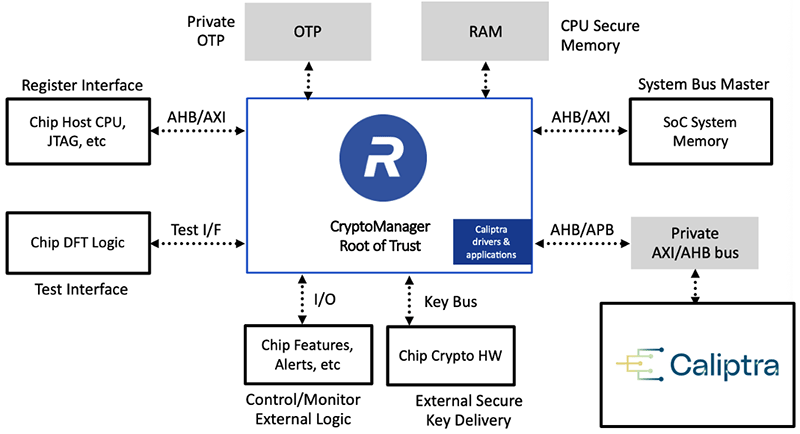
Figure 1: CryptoManager Root of Trust Supporting Caliptra Specification
SAN JOSE, Calif. – Sep. 14, 2026 – Rambus Inc. (NASDAQ: RMBS), a premier chip and silicon IP provider making data faster and safer, today announced its CryptoManager™ Root of Trust supporting the Caliptra™ specification, a production-ready Root of Trust and security orchestration solution designed to deliver enterprise-grade security for mission-critical data center and AI SoCs. Interoperable with the open Caliptra framework, the Rambus solution helps semiconductor designers accelerate deployments with added protection, flexibility and support. CryptoManager Root of Trust delivers platform-wide security awareness with proven side-channel and fault-injection protections and best-in-class cryptographic agility for a low-risk path to volume implementations of highly secure data center and AI infrastructure devices.
Caliptra is an open-source silicon Root of Trust designed for integration into data center-class SoCs. Initiated through the Open Compute Project and now developed within the CHIPS Alliance, it combines hardware, firmware and specifications to provide a common foundation for device identity, measured boot and attestation across CPUs, GPUs, AI accelerators, DPUs, networking devices and other infrastructure components. Its transparent, collaborative model supports greater consistency across devices from different suppliers.
Production-Ready Security for Customer Caliptra Deployments
With the CryptoManager Root of Trust supporting the Caliptra specification, designers can build on the open-source foundation to implement a complete production security subsystem. This addresses integration into the wider platform, provides the software and security orchestration needed for deployment, adds protection against advanced attacks, supports evolving cryptographic requirements, enables additional security certifications and maintains the solution throughout the device lifecycle.
“As the Caliptra ecosystem gains momentum, organizations need a practical path to deploy scalable and supportable security solutions in demanding production environments,” said Simon Blake-Wilson, SVP and general manager of Silicon IP at Rambus. “CryptoManager Root of Trust supporting the Caliptra specification provides the hardware, software, advanced protections and commercial support needed to accelerate deployment of differentiated, enterprise-grade security that is interoperable with the Caliptra framework.”
The CryptoManager Root of Trust supporting the Caliptra specification provides dedicated hardware-level security in an SoC, combining a secure RISC-V processor, protected memory, secure key and data storage, cryptographic accelerators, and secure interfaces. Operating alongside an unmodified open-source Caliptra Project core, it mediates interactions between the Caliptra Project core, the host processor and other SoC components so that security-sensitive operations can remain within a protected boundary while trust is extended across the wider platform.
Through specialized drivers and security applications, CryptoManager Root of Trust provides platform-level awareness enabling security monitoring, policy enforcement, secure lifecycle management, and coordinated protection of critical system resources. The CryptoManager architecture supports classical, post-quantum, and regional cryptographic algorithms, along with advanced protections against side-channel and fault injection attacks, and certification support for security standards such as FIPS 140-3 and SESIP.
By combining enterprise-grade security with simplified integration and certification readiness, the CryptoManager Root of Trust delivers a production-ready security platform for next-generation data center and AI semiconductor devices.
More Information
Learn more about the Rambus CryptoManager Root of Trust supporting the Caliptra specification here.
Forward-Looking Statements
Information set forth in this press release, including statements as to Rambus’ outlook and financial estimates and statements as to the expected timing and effects of Rambus products, constitute forward-looking statements within the meaning of the safe harbor provisions of the Private Securities Litigation Reform Act of 1995.
These statements are based on various assumptions and the current expectations of the management of Rambus and may not be accurate because of risks and uncertainties surrounding these assumptions and expectations. Factors listed below, as well as other factors, may cause actual results to differ significantly from these forward-looking statements. There is no guarantee that any of the events anticipated by these forward-looking statements will occur, or what effect they will have on the operations or financial condition of Rambus. Forward-looking statements included herein are made as of the date hereof, and Rambus undertakes no obligation to publicly update or revise any forward-looking statement unless required to do so by federal securities laws.
Major risks, uncertainties and assumptions include, but are not limited to: any statements regarding anticipated operational and financial results; any statements of expectation or belief; other factors described under “Risk Factors” in Rambus’ Annual Report on Form 10-K and Quarterly Reports on Form 10-Q; and any statements of assumptions underlying any of the foregoing. It is not possible to predict or identify all such factors. Consequently, while the list of factors presented here is considered representative, no such list should be considered to be a complete statement of all potential risks and uncertainties.
Caliptra™ is a trademark of The Linux Foundation and is managed under the CHIPS Alliance project. All rights reserved. Any use of the Caliptra name or logo in this document is purely for descriptive, educational, or reference purposes and does not imply endorsement, sponsorship, or affiliation with The Linux Foundation or CHIPS Alliance.
Enabling Efficient Edge AI Inferencing Through Ecosystem Collaboration
Download this white paper to learn how DEEPX, Rambus, and Samsung Foundry collaborated to create a scalable LPDDR-based memory platform optimized for edge AI inferencing. By aligning AI processor architecture, memory interface IP, and advanced foundry technology early in the design cycle, the companies reduced integration risk, accelerated development, and enabled a platform that scales from today’s LPDDR5-based designs to next-generation LPDDR5X solutions on advanced process nodes. The paper demonstrates how memory subsystem design has become a critical differentiator for edge AI performance and illustrates why ecosystem-level collaboration is emerging as a key driver of innovation for future intelligent systems.
Securing Software-Defined Vehicles with an Arm-Based Root of Trust
[Live on 9/8 at 9am PT] In this webinar, Rambus will explore the changing automotive security landscape and the growing role of hardware Root of Trust technology as the foundation for trusted software execution, secure communications, lifecycle management, and future-ready protection.
Rambus Initiates $100 Million Accelerated Share Repurchase Program
SAN JOSE, Calif., August 5, 2026 – (BUSINESS WIRE) – Rambus Inc. (NASDAQ: RMBS), a premier chip and silicon IP provider making data faster and safer, today announced that it initiated an accelerated share repurchase program with Mizuho Markets Americas LLC, through its agent Mizuho Securities USA LLC (“Dealer”) to repurchase an aggregate of approximately $100 million of its common stock.
“This accelerated share repurchase reflects our confidence in the business and reinforces our commitment to disciplined capital allocation,” said Luc Seraphin, president and chief executive officer at Rambus. “Supported by the strength of our balance sheet and continued cash generation, we remain focused on increasing stockholder value while investing in the long-term growth of the company.”
Under the accelerated share repurchase program, Rambus will pre-pay $100 million to Dealer and receive an initial delivery of approximately 796,000 shares of its common stock. The final number of shares to be repurchased will be determined based on the volume-weighted average price of Rambus common stock during the term of the transaction, less a discount. The program is expected to be completed by the end of the third quarter of 2026.
The accelerated share repurchase program is part of the broader share repurchase program previously authorized by the Rambus Board of Directors.
About Rambus Inc.
Rambus delivers industry-leading chips and silicon IP for the data center and AI infrastructure. With over three decades of advanced semiconductor experience, our products and technologies address the critical bottlenecks between memory and processing to accelerate data-intensive workloads. By enabling greater bandwidth, efficiency and security across next generation computing platforms, we make data faster and safer. For more information, visit rambus.com.
Forward-Looking Statements
This release contains forward-looking statements under the Private Securities Litigation Reform Act of 1995 relating, among other things, to the terms of Rambus’ accelerated share repurchase program, including timing. Such forward-looking statements are based on current expectations, estimates and projections, management’s beliefs and certain assumptions made by Rambus’ management. Actual results may differ materially. The forward-looking statements contained in this press release are subject to risks and uncertainties, including those more fully described in Rambus’ Annual Report on Form 10-K for the fiscal year ended December 31, 2025. The forward-looking statements in this press release are based on information available to Rambus as of the date hereof, and Rambus undertakes no obligation to update forward-looking statements to reflect events or circumstances after the date hereof.
Contact:
Nicole Noutsios
Rambus Investor Relations
(510) 315-1003
[email protected]