
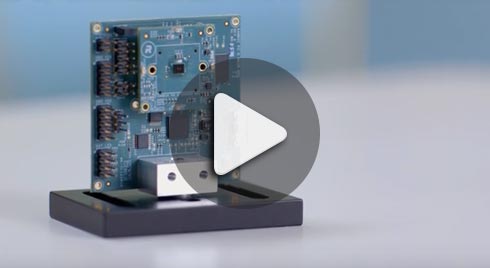
Lensless Smart Sensor (LSS) technology is helping to enable a new generation of low-power sensing by capturing information-rich images with a low-cost phase grating, standard image sensors and sophisticated computational algorithms. To accelerate LSS adoption and further explore additional use cases, Rambus has released its POD 2.0 evaluation system for LSS technology.
Augmented Reality Enabled by LSS

Video: The future of mobile payments
Mobile payments offer a plethora of benefits for consumers, retailers and financial institutions. For consumers, mobile wallets provide a convenient, “tap and go” frictionless commerce experience that seamlessly integrates loyalty cards, boarding passes, ID cards, coupons, event tickets, alerts and notifications. For retailers, mobile wallets offer businesses the ability to engage users with an immersive, in-app experience that starts at the beginning of a retail journey and continues indefinitely with notifications, reminders of upcoming expiration dates, archived digital receipts and a real-time tally of current loyalty bonus points. For banks, digital wallets, which are far more secure than credit or debit cards, has fast become a strategic focus as consumer interest ramps up.
Cash, card or mobile wallet?
A new survey conducted by Moneris finds that 25% of Canadians between the ages of 18-34 prefer paying with a mobile wallet over cash or card.
“Of Canadians aged 18-34, 46% said they would be more likely to use a mobile wallet if it were available for the kind of credit card they used,” Moneris stated in a recent press release. “[Meanwhile], 47% said they would use a mobile wallet if it were available for the kind of phone they used – responses collected prior to the full rollout of Apple Pay.”
Lensless Smart Sensors POD 2.0
Eyeing the future of smart cities
Rambus principal research scientist Patrick Gill recently penned an article for Telecoms Tech about how lensless smart sensors (LSS) can potentially play an important role in building future smart cities. As Gill notes, LSS technology offers a fundamentally new approach to visual sensing by shifting the function of traditional optics to computation, thereby eliminating the need for expensive lenses by replacing them with tiny, inexpensive diffractive gratings.