
AI PCs running agentic workloads are expected to plan, execute, and adapt workflows in real time. These workloads depend on persistent context, concurrent processing, and continuous data movement between the processor and system memory. The result is increased demands on system memory requiring significantly higher bandwidth, greater capacity, and sustained performance under load.
To meet these needs, DDR5 is being pushed to new levels, with data transfer rates now at 6400 mega-transfers per second (MT/s) and scaling to 9600 MT/s. At these speeds, however, traditional client memory architectures face severe signal and power integrity challenges that limit performance and stability.
This is why the industry is transitioning to clocked client memory modules, and why Rambus is supporting this transition with complete client chipsets for clocked modules from DDR5 6400 to DDR5 9600.
The Signal Integrity Challenges at High Data Rates
As DDR5 memory speeds increase, the physics of high-speed signaling becomes increasingly unforgiving. The interface between the CPU and memory operates as a dense parallel bus, with tightly packed traces carrying high frequency signals at very low voltages. As data rates climb, several compounding effects increasingly constrain performance.
Electrical interference and crosstalk become more pronounced as signal lines interact in close proximity, creating a noisy environment that can corrupt data. At the same time, the clock signal used to synchronize all memory operations becomes increasingly difficult to distribute cleanly across the motherboard. Driving the clock directly from the CPU to multiple DRAM modules and devices introduces electrical loading, which degrades signal quality and results in clock jitter, or variation in signal timing.
This timing uncertainty is particularly problematic at higher speeds, where margins are already narrow. Even small deviations in timing can lead to data capture errors and reduced system reliability. The result is a convergence of limitations makes it increasingly difficult to scale DDR5 using conventional unbuffered DIMMs.
Clocked DIMMs: The New Architecture for Client Memory
To overcome these bottlenecks, the industry has adopted clocked memory module architectures, including CUDIMMs and CQDIMMs for desktops and CSODIMMs for notebooks. The defining innovation of these modules is the integration of a Client Clock Driver (CKD) directly onto the DIMM. Rather than distributing a high-speed clock signal from the processor to every DRAM device, the CKD receives the incoming clock, buffers it, and regenerates a clean, precisely timed clock locally on the module.
This architectural shift fundamentally improves signal integrity. By re-driving the clock signal at the point of use, the CKD minimizes electrical interference, reduces jitter, and ensures tighter synchronization across all DRAM devices on the module. It effectively restores timing margin that would otherwise be lost at higher data rates.
Equally important, the CKD introduces adaptability into the memory subsystem. By adjusting output characteristics to match different DIMM topologies, the clock driver enables more flexible system designs while maintaining stable high-speed operation.
Power Integrity: The Other Half of the Equation
Signal integrity and power integrity are fundamentally linked. Any instability in power delivery introduces electrical noise, which directly impacts signal quality and system reliability.
With DDR5, power management responsibilities have shifted from the motherboard onto the memory module itself. This evolution provides more localized control but also introduces new design challenges, especially as performance requirements increase.
High-speed memory operation requires stable voltage delivery across multiple rails, even under rapidly changing workloads. In AI PCs, where workloads can vary dynamically and operate continuously, maintaining consistent power becomes even more critical. At the same time, power must be delivered efficiently to avoid excessive heat, particularly in thermally constrained environments such as thin laptops.
To meet these demands, all DDR5 DIMMs incorporate integrated power management solutions (PMICs) that regulate voltage directly at the module level. By stabilizing power close to the DRAM and clocking circuitry, these solutions reduce noise, improve signal integrity, and enable consistent high-speed operation.
Advanced implementations can further enhance efficiency by dynamically adjusting power usage, disabling unused resources, and protecting sensitive components from transient voltage events. The result is a memory subsystem that is not only faster, but also more resilient and better suited to sustained AI workloads.
A Complete Chipset for DDR5 9600 Performance
Unlocking the full potential of clocked memory modules requires more than individual components, it requires a tightly integrated chipset that addresses clocking, power, and system coordination holistically.
The Rambus DDR5 9600 Client Chipset is designed to deliver exactly that.
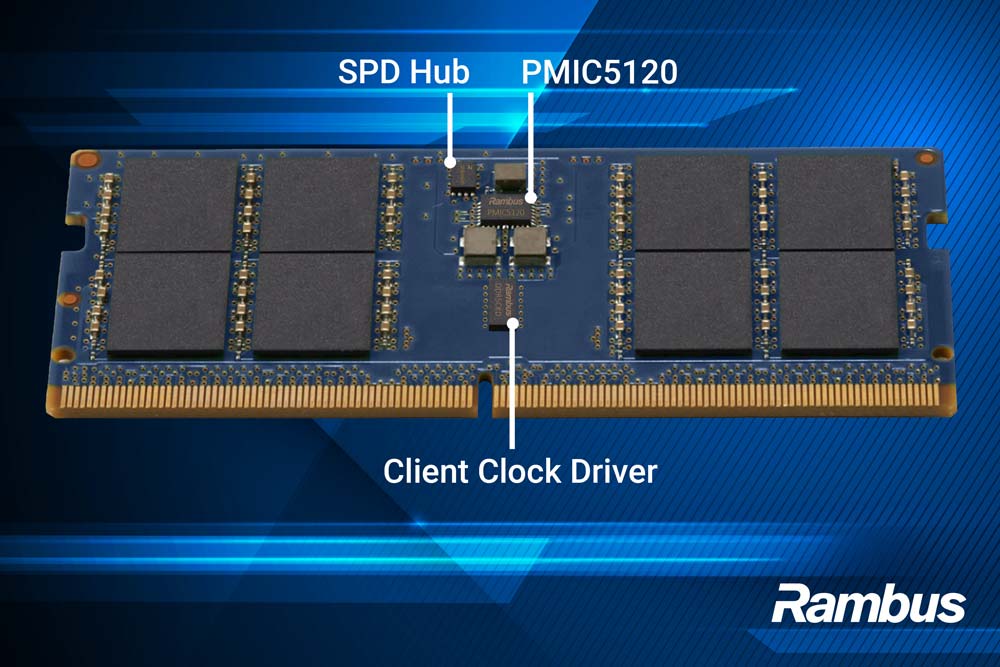
At its core is the Gen2 Client Clock Driver (CKD02), which retimes, conditions, and redistributes the clock signal to the DRAM devices with high precision. By regenerating a clean, low-jitter clock, the CKD02 provides the timing stability required for operation across the 8000 to 9600 MT/s range, enabling the next tier of DDR5 performance.
Complementing the CKD is the PMIC5120 power management IC, which provides efficient, fine-grained voltage regulation directly on the module. By delivering stable power to both the DRAM and clocking circuitry, the PMIC5120 helps reduce electrical noise, improve signal integrity, and support consistent operation under demanding workloads.
The SPD Hub completes the chipset by enabling communication of module identification, configuration, and telemetry. This capability is increasingly important in AI PCs, where system-level optimization depends on accurate, real-time visibility into memory subsystem behavior.
Together, these components form a complete chipset solution that enables high-bandwidth, high-capacity CUDIMM, CQDIMM, and CSODIMM modules, while simplifying system design and accelerating adoption.
You can find more details on the Rambus DDR5 Client Chipsets here.



Leave a Reply