
Over the past five years, the semiconductor industry has faced a number of complex challenges. These include increased development costs, eroded ASPs, market saturation and heightened, yet unsustainable M&A activity. As 2018 begins, the semiconductor industry continues to seek a return to stability and organic growth within the parameters of a new business paradigm that is both viable and collaborative. Within this context, semiconductor companies are acknowledging the potential of new markets and downstream revenue opportunities as they explore a more comprehensive “silicon to services” model that spans the data center to the mobile edge. This includes end-to-end IoT security solutions and PaaS-based services such as in-field feature configuration, advanced analytics, predictive maintenance alerts, self-learning algorithms and intelligent, proactive interaction with customers. In addition to services, the concept of open-source hardware and building silicon from disaggregated, pre-verified chiplets is beginning to gain traction as companies move to slash costs and reduce time-to-market for heterogeneous designs. Specific strategies to unlocking the full potential of semiconductors will undoubtedly vary, which is why it is important for us to explore a future in which the industry, along with various research organizations and government offices, plays an open and collaborative role in helping to sustainably monetize both silicon and services.
Papers
Protecting Electronic Systems from Side-Channel Attacks
Side-channel attacks conducted against electronic systems are relatively simple and inexpensive to execute. An attacker does not need to know specific implementation details of the cryptographic device to perform these attacks and extract keys. As all physical electronic systems routinely leak information, effective side-channel countermeasures such as Rambus’ DPA Resistant Hardware Cores (DPARC) or DPA Software Library (DPASL) should be implemented at the design stage to ensure protection of sensitive keys and data. After the implementation of hardware or software countermeasures, systems should be carefully evaluated with a Test Vector Leakage Assessment (TVLA) platform such as the Rambus DPA Workstation (DPAWS) to confirm the cessation of sensitive side-channel leakage.
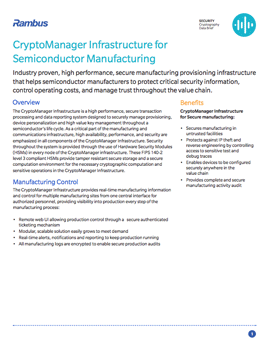
CryptoManager Infrastructure for Semiconductor Manufacturing Data Brief
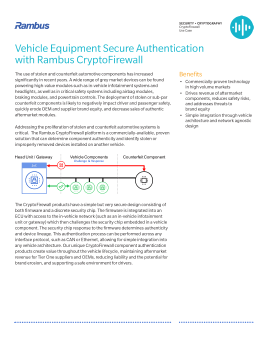
Vehicle Equipment Secure Authentication with Rambus CryptoFirewall
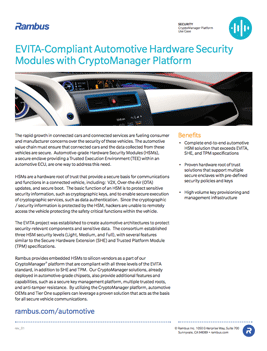
Hardware Security Modules with CryptoManager
Introduction to Side-Channel Attacks
Side-channel attacks conducted against electronic gear are relatively simple and inexpensive to execute. Such attacks include simple power analysis (SPA) and Differential Power Analysis (DPA). An attacker does not need to know specific implementation details of the cryptographic device to perform these attacks and extract keys. As all physical electronic systems routinely leak information, effective side-channel countermeasures should be implemented at the design stage to ensure protection of sensitive keys and data.