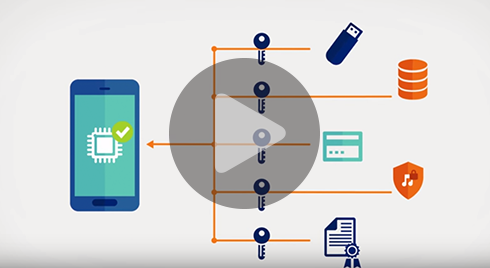
CryptoManager Platform Video

At Rambus, we create cutting-edge semiconductor and IP products, providing industry-leading chips and silicon IP to make data faster and safer.
A new report published by Transparency Market Research confirms the global smart sensor market will hit $21.60 billon by 2019.
“Rapidly increasing sales of various types of consumer electronics and automobiles is the major factor driving demand for smart/intelligent sensors,” TMR analysts stated in their report summary. “In present times, smart/intelligent sensors are [already] an important part of smartphones, tablets, PCs, automobiles and medical equipment with advanced features.”
In addition, smart/intelligent sensors offer significant applications in healthcare, automotive design, collision prevention and oil platforms.
“This is due to the compactness and diverse functionality of smart/intelligent sensors in their present form,” adds the report.
As we’ve previously discussed on Rambus Press, the steady progression of Moore’s Law is helping to accelerate the development and adoption of smart sensor technology.
“The Internet of Things (IoT) has prompted the semiconductor industry to place an emphasis on more efficiently capturing, securing, moving and analyzing an increasing volume of digital data,” explained Steve Woo, VP of Solutions Marketing and distinguished inventor at Rambus.

“Rambus shares the industry’s vision of 50 billion connected devices by 2020, which will also include always-on, always-connected smart sensor endpoints tasked with capturing and delivering a wide range of data. Moore’s Law is a critical factor in making this vision a reality.”
Indeed, says Woo, the size of refractive imagers is currently limited by optics. However, many applications don’t actually require extensive high resolution imaging capabilities provided by a standard lens-based configuration.
“How can we build even smaller imagers? By replacing the traditional camera lens with a diffraction grating, while leveraging advanced algorithms and chip processing capabilities,” he continued. “Now this is where Moore’s Law comes into play, because it continues to help enable the technology necessary for Rambus scientists to create and refine miniature, lensless smart sensors (LSS) that can be as small as the size of a human hair. While Moore’s Law has been a driving force in the computing industry for decades, we’re seeing a growing number of benefits in computation imaging and sensing applications such as LSS.”
According to Woo, Rambus’ low power sipping sensors can perform a wide range of functions, including image change detection, point tracking, range finding, sophisticated gesture recognition, object recognition and image capturing.
“These versatile capabilities make LSS technology suitable for at least five key ‘smart’ verticals, including consumer, cities, transportation, manufacturing and medical,” he added.
Ernest Worthman of Semiconductor Engineering recently noted that future ultra-low-power (ULP) IoT devices require a new paradigm for handling cryptography. “To optimize the power in
Ernest Worthman of Semiconductor Engineering recently noted that future ultra-low-power (ULP) IoT devices require a new paradigm for handling cryptography.
“To optimize the power in a ULP device, cryptography and otherwise, there are two approaches that can be uses; steady-state low-power over time and pulsed operation over time,” he explained. “[However], the main issue surrounding cryptography in ULP devices is the relationship between functionality and power utilization.”

As Worthman points out, traditional cryptographic algorithms are power- and clock-cycle hungry. Essentially, they are the exact opposite of the IoE devices: computationally intensive.
“That is their job – to check everything that can be compromised and that takes power,” he continued. “ULP devices, being computationally constrained, need to make every clock cycle and micro amp count. The two are not mutually compatible.”
According to Worthman, there are a number of approaches to maximizing the limited resources in ULP devices, without foregoing adequate cryptography functionality. For example, the industry could develop smarter decision-making circuitry capable of deciding what needs to run under a cryptographic envelope. Another option would be the coding of lighter weight algorithms and ciphers.
However, as NXP product marketing manager Gordon Cooper told Semiconductor Engineering, the industry cannot simply go to lower power and architecture.
“You have to maintain performance,” he emphasized. “As we go down in process architecture you have that performance for less power, but now you have leakage issues.”
Simon Blake-Wilson, VP of products and marketing at Rambus‘ Cryptography Research Division, points out that leakage often goes along with integration issues. Indeed, at the most advanced nodes, be it security, processor or I/O block with security built in, all need to fit into the surrounding components of a device.
“If you make something that is trivial to integrate with, it will make a huge difference,” said Blake-Wilson. “It’s a good tradeoff of achievable targets, trying to address ease of use for the designers, for the managers of the devices.”
According to Steven Woo, VP of enterprise solutions technology at Rambus, power-related semiconductor security concerns may prompt a general reassessment of how future chips and electronics are designed.
“Security requires power to operate, but the flip side is that power is noisy. When you activate circuits you can monitor that noise,” he told Semiconductor Engineering back in July. “There’s a growing problem with differential power analysis. What it really comes down to is that you’re trying to give confidence for some period of time, so now you have to determine what is a useful lifetime and how long you’re going to guard it.”
As we’ve previously discussed on Rambus Press, physical electronic systems routinely leak information about the internal process of computing. In practical terms, this means attackers can exploit various side-channel techniques to gather data and extract secret cryptographic keys.
As such, the Rambus Cryptography Research division has designed a range of DPA countermeasures that offer a combination of software, hardware and protocol techniques specifically designed to protect tamper-resistant devices from side-channel attacks. These include leak reduction, incorporating randomness, generating amplitude and temporal noise, as well as executing protocol-level countermeasures.
Interested in learning more about how Rambus is helping to secure SoCs, devices and content? You can read more about our DPA countermeasures here, CryptoFireWall Cores here and CryptoManager platform here.
ABI Research analysts have confirmed that several manufacturers are preparing to launch Brain-to-Machine Interface (BMI) products in advance of the end-of-year holiday buying season.
According to ABI Research director Jeff Orr, BMI technology won’t be capable of reading thoughts, nor can it be exploited to program an individual to perform nefarious acts. However, tapping into brain activity as a means of understanding human behavior and even controlling an external activity is now possible.

“Hardcore gamers will be the first consumers to buy brain-to-machine interfaces,” Orr explained. “Combining augmented reality, eye-tracking and BMI headgear will give elite players the upper-hand in real-time multiplayer gaming.”
As Orr notes, clinical research trials of BMI or Brain-to-Computer Interfaces (BCI) tech solutions have also chalked up a number of breakthroughs that combine the latest technology and brain-implanted modules to provide advanced robotic prosthetics, mobility controls and communications capabilities to severely afflicted individuals.
As such, revenue from both commercial and medical BMI products is projected to hit $9.7 million in 2015, increasing to $205 million in 2020. Meanwhile, unit volumes for BMI products in 2015 are on track to top 20,000, ultimately increasing to more than 850,000 shipments in 2020.
Commenting on the above-mentioned report, Rambus VP of User Experience (UX) Eliott Jones told us that the popularity of BMI amongst gamers will act as catalyst for wider consumer adoption of the technology.
“As with stand-alone head-mounted displays (HMDs), wider adoption of BMI technology will benefit multiple verticals, including security, which could create a new paradigm in terms of visualizing and interacting with complex Big Data analytics,” he explained. “It is important to note that effectively extracting meaning from a vast amount of captured raw security-related data requires engaging a broader range of perceptual processing in the brain that goes beyond traditional alpha-numeric information.”
In this case, says Jones, augmented reality, eye-tracking and BMI headgear coupled with a highly intuitive and predictive UI will enable security researchers to absorb information and process it with extreme cognitive efficiency.
“This combination of multi-sensory experience and an intuitive design creates an integrated, meaning driven – rather than information driven – analytic environment which serves to optimize a security platform’s efficiency and ultimately helps define its competitive advantage,” he added.
The FDA and U.S. Department of Homeland Security have issued an official statement concerning cybersecurity vulnerabilities associated with the Symbiq Infusion System.
“Hospira and an independent researcher confirmed that Hospira’s Symbiq Infusion System could be accessed remotely through a hospital’s network. This could allow an unauthorized user to control the device and change the dosage the pump delivers, which could lead to over- or under-infusion of critical patient therapies,” the Food and Drug Administration warned.

Medical Infusion Pump – Stock image
“Hospira has discontinued the manufacture and distribution of the Symbiq Infusion System, due to unrelated issues, and is working with customers to transition to alternative systems. However, due to recent cybersecurity concerns, the FDA strongly encourages health care facilities to begin transitioning to alternative infusion systems as soon as possible.”
Fortunately, both the FDA and Hospira note they are “currently not aware” of any patient adverse events or unauthorized access of a Symbiq Infusion System in a health care setting. Nevertheless, the recent cyber security warning illustrates just how quickly security requirements for the health care ecosystem are evolving and posing a major challenge to the industry.
Indeed, Ernest Worthman of Semiconductor Engineering recently described the health care space as “woefully ill-prepared” for a digital Cyber Age.
“This is a rather dismal assessment, considering that the volume of personal health-related data is an order of magnitude greater than the equivalent data in the financial segment and growing rapidly,” he opined. “Within the past couple of years, millions of personal health care records have been leaked. Yet the health care industry is still behind other critical industries in security spending.”
Worthman also noted that most of today’s medical devices integrate reconfigurable embedded systems – many of which are known to be vulnerable to various cybersecurity breaches.
“As interconnected medical devices proliferate and connect via hospital networks, the Internet, other medical, and smart devices, the risk of cybersecurity breaches that could affect how a medical device functions rises dramatically,” he confirmed.
To be sure, a plethora of dedicated medical devices that were previously offline – such as infusion pumps and implantable heart devices – are now being connected to the rapidly evolving IoT. Some are equipped with standard electronic components, exposing unsecured software functionality.
As we’ve previously discussed on Rambus Press, a software-centric security approach for medical devices inevitably requires frequent updates due to unforeseen vulnerabilities. To avoid potentially dangerous scenarios, medical companies should strive to make building strong hardware-based security a primary design goal, rather than depending on patches after a device has already hit the market.