Contact
 Product Brief
 Security Certifications

At Rambus, we create cutting-edge semiconductor and IP products, providing industry-leading chips and silicon IP to make data faster and safer.
PCI Express, commonly called PCIe, is the high-speed interconnect standard used to move data between key system components inside modern electronic systems. It connects processors, CPUs, GPUs, storage devices, accelerators and networking interfaces, enabling fast and efficient communication across servers, PCs, embedded platforms and cloud infrastructure. Over time, PCIe has become the industry’s default choice for high-bandwidth, low-latency I/O because it continues to scale performance while preserving backward compatibility across generations.
That scalability matters more than ever as AI infrastructure, cloud platforms, storage systems and high-speed networks continue to drive higher data movement requirements. The latest specification, PCIe 7.0, was officially released to PCI-SIG members on June 11, 2025, and doubles the raw data rate of PCIe 6.x from 64.0 GT/s to 128.0 GT/s, delivering up to 512 GB/s of bidirectional bandwidth in a x16 configuration.
PCIe 7.0 is designed for data-intensive applications including AI and machine learning, hyperscale data centers, high-performance computing, high-speed networking, cloud infrastructure, automotive, military and aerospace, and quantum computing. It also continues the architectural transition introduced in PCIe 6.0, including PAM4 signaling and FLIT-based encoding, while improving power efficiency and supporting emerging optical interconnect use cases.
PCI Express is a high-speed serial, point-to-point interconnect standard that enables data transfer between system components. Instead of sharing a common parallel bus like older interfaces, PCIe creates dedicated links between components, which helps improve throughput, reduce contention and support scalable lane widths such as x1, x2, x4, x8 and x16. Modern PCIe controller IP supports these common lane configurations across multiple generations.
PCIe is used throughout modern computing platforms, from enterprise servers and accelerator cards to storage devices, embedded systems and communications infrastructure. Its long-standing strength is that each new generation typically increases available bandwidth while maintaining compatibility with earlier generations. PCIe has served as the de facto high-bandwidth interconnect for more than two decades and continues to evolve to meet growing compute demands.
Modern compute platforms rely on moving massive amounts of data quickly and efficiently. For example:
PCIe sits at the center of these data paths. As performance demands grow, PCIe must scale bandwidth without significantly increasing cost, power consumption or system complexity.
PCIe has historically achieved this through a predictable cadence of doubling bandwidth each generation. PCIe 7.0 continues that pattern by doubling the raw bit rate relative to PCIe 6.x while targeting better power efficiency and broader deployment flexibility, including optical interconnect support.
PCIe has advanced steadily, increasing throughput with each generation:
| PCIe Generation | Max Data Rate | Notable characteristics |
|---|---|---|
| PCIe 2.1 | 5 GT/s | Early high-speed serial PCIe generation |
| PCIe 3.1 | 8 GT/s | Higher bandwidth for mainstream compute and storage. |
| PCIe 4.0 | 16 GT/s | Doubled throughput for faster accelerators, SSDs and networking. |
| PCIe 5.0 | 32 GT/s | Expanded bandwidth for advanced servers and high-speed peripherals. |
| PCIe 6.x | 64 GT/s | Introduced PAM4 signaling, FLIT mode and FEC to continue scaling without simply doubling fundamental frequency in the same way as earlier NRZ generations. |
| PCIe 7.0 | 128 GT/s | Doubles PCIe 6.x bandwidth, keeps PAM4 and FLIT-based encoding, improves power efficiency and supports optical interconnect-related advancements. |
PCIe 6.0 marked a major transition because it introduced PAM4 signaling, FLIT mode and FEC to keep scaling bandwidth without relying on the same signaling approach used in earlier NRZ-based generations. PCIe 7.0 builds on that same architectural foundation at a higher data rate.
The headline improvement in PCIe 7.0 is speed. The specification reaches 128.0 GT/s, double the data rate of PCIe 6.x, and delivers up to 512 GB/s bidirectional throughput in a x16 link. That increase is aimed squarely at systems that need more bandwidth density, such as AI clusters, HPC systems and hyperscale infrastructure.
The video below outlines what’s new in PCIe 7.0:
PCIe 7.0 also continues the use of PAM4 signaling and FLIT-based encoding, building on the major architectural change introduced in PCIe 6.0. PCI-SIG also highlights improved power efficiency, backward compatibility with previous generations, and support for optical interconnect solutions that can extend reach across racks and pods while enabling data mapping across electrical and optical domains.
In practical terms, PCIe 7.0 is not just a faster version of PCIe. It is part of a broader interconnect strategy for environments where bandwidth, scale, reach and efficiency all matter at once. These improvements are specifically designed for bandwidth-intensive applications such as AI, hyperscale infrastructure and high-speed networking.
PAM4 is a signaling technique that uses four voltage levels to encode two bits per symbol, enabling higher data rates without proportionally increasing clock frequency. PCI-SIG identifies PAM4 as a key enabler of both PCIe 6.0 and PCIe 7.0 bandwidth scaling.
PAM4 lets PCIe send more information in each signaling interval than traditional NRZ signaling, which is why it became necessary as the standard moved to 64 GT/s and then 128 GT/s.
Forward Error Correction, or FEC, is a low-latency error correction method used to improve data reliability at very high signaling rates. PCIe 6.0 introduced FEC to address the higher bit error rate associated with PAM4 signaling, and PCIe 7.0 continues using that same approach.
FLIT mode was adopted in part because error correction needs to operate on fixed-size packets, and that the combination of FEC and CRC helps maintain high reliability with low overhead.
FLIT mode organizes PCIe traffic into fixed-size Flow Control Units rather than variable-size packet handling used in older PCIe generations. In PCIe 6.0 and PCIe 7.0, FLIT-based encoding supports efficient transport at very high speeds and works together with FEC and CRC.
FLIT structure remains 256 bytes in both PCIe 6.0 and 7.0, with the same basic layout for Transaction Layer Packets, Data Link Protocol content, CRC and FEC bytes.
PIPE stands for PHY Interface for PCI Express and defines the interface between the PCIe controller and the physical layer implementation. This matters because a standards-aligned PIPE interface helps SoC designers combine controller IP with PIPE-compliant SerDes implementations.
AXI, or Advanced eXtensible Interface, is part of Arm’s AMBA specification and is widely used for high-performance on-chip communication in SoCs. Arm’s AMBA AXI Protocol Specification documents AXI as part of the AMBA family and describes its role in supporting modern on-chip data movement.
In PCIe-based SoCs, AXI is important because it provides an efficient internal interface for connecting processors, memory and accelerators. That makes AXI support especially relevant when integrating PCIe controller IP into complex chip architectures.
PCIe 7.0 is aimed at data-intensive markets. These include hyperscale data centers, high-performance computing, automotive, military and aerospace, plus emerging applications such as AI and machine learning, 800G Ethernet, cloud computing and quantum computing.
Here is how that maps to real-world needs:
PCIe 7.0 vs PCIe 6.0
PCIe 7.0 doubles the raw data rate of PCIe 6.0 from 64 GT/s to 128 GT/s, while continuing to use PAM4 signaling, FLIT-based encoding and FEC. According to PCI-SIG’s PCIe 7.0 webinar Q&A, the FLIT-based encoding and FEC model remain effectively the same between PCIe 6.0 and 7.0, with the bandwidth increase coming from higher clocking.
PCIe 7.0 vs PCIe 5.0
PCIe 7.0 delivers four times the raw data rate of PCIe 5.0, moving from 32 GT/s to 128 GT/s. It also reflects a major architectural change relative to PCIe 5.0 because PCIe 7.0 relies on PAM4 signaling, FLIT-based encoding and FEC rather than the earlier NRZ-based approach used before PCIe 6.0.
A PCIe specification defines the standard, but designers still need implementation IP that can turn that standard into a production-ready subsystem. That is where PCIe controllers come in. Controllers handle protocol compliance, data packet management, link initialization, link initialization and training, error handling and reliability features, and integration with SoC fabrics and memory systems.
For advanced SoCs, controller IP must do more than support the headline data rate. It must also support the right topologies, lane configurations, virtual channels, reliability features, security capabilities and integration interfaces.
As PCIe moves to more advanced signaling and encoding methods, controller design becomes increasingly complex and critical to system performance.
PCI Express is often described as a point-to-point interconnect between a processor and a device, but modern systems rely on a broader set of technologies to fully realize its performance and scalability. Components such as PCIe switches, Direct Memory Access (DMA) engines and USB4 integration extend PCIe beyond simple device connectivity, enabling more flexible architectures and more efficient data movement across increasingly complex systems.
PCIe switch is a connectivity device that enables multiple endpoints to share a single upstream PCIe link. Rather than connecting devices directly to the host processor, a switch allows designers to expand the number of available connections by creating multiple downstream ports from one upstream interface.
This capability is especially important in systems that require high device density. In AI and hyperscale environments, for example, a PCIe switch allows multiple GPUs, accelerators or SSDs to communicate with a host processor without requiring a dedicated PCIe link for each device. The switch manages traffic between endpoints and ensures efficient data flow across the system.
As system architectures continue to evolve toward disaggregation and composability, PCIe switches also play a critical role in enabling more flexible topologies. They allow resources such as storage and compute accelerators to be pooled and dynamically shared, which improves utilization and scalability without significantly increasing system complexity.
With PCIe 6 & 7, PCIe switches are primarily implemented in advanced networking devices like SmartNICs and SuperNICs. These devices sit at the intersection of compute, networking, and acceleration, and they rely on high-performance PCIe fabrics to move massive amounts of data efficiently between CPUs, GPUs, storage devices, and the network.
A SmartNIC, or smart network interface card, goes beyond traditional NIC functionality. Instead of simply moving packets between the server and the network, a SmartNIC offloads infrastructure tasks from the CPU. This can include things like network virtualization, storage processing, security functions, and telemetry. By offloading these tasks, SmartNICs free up CPU cycles for application workloads, which is especially important in cloud and hyperscale environments.
The SuperNIC is essentially an evolution of the SmartNIC concept, but purpose-built for the demands of large-scale AI and accelerated computing environments. While SmartNICs focus on offloading infrastructure services, SuperNICs are designed to support extreme data movement and coordination across clusters of GPUs and accelerators.
In AI systems, SuperNICs are architected to handle orchestrating communication across thousands of GPUs, often in tightly synchronized training workloads. They incorporate advanced networking capabilities, high radix connectivity, and deep integration with accelerator fabrics.
Direct Memory Access, or DMA, is a fundamental mechanism that enables high-speed data transfers between devices and system memory without continuous intervention from the CPU. In PCIe-based systems, DMA engines allow peripherals such as GPUs, network adapters and storage devices to read from and write directly to system memory.
This approach significantly improves system efficiency. Without DMA, the processor would need to manage each data transfer, which would introduce overhead and reduce the amount of compute resources available for applications. By offloading these transfers to DMA engines, systems can maintain high throughput while allowing the CPU to focus on higher-level tasks.
DMA is particularly important in data-intensive workloads such as AI training, high-performance computing and networking. These applications often involve moving large volumes of data at very high speeds, and DMA enables that data movement to occur efficiently in parallel with compute operations.
USB4 represents an important extension of PCIe beyond internal system connectivity. It is a high-speed interface that supports the tunneling of PCIe traffic over a USB Type-C connection, alongside other protocols such as DisplayPort and traditional USB data.
This capability allows PCIe to be used in external applications, not just inside a system. Devices such as external GPUs, high-performance storage solutions and advanced docking stations can leverage PCIe through USB4 to deliver high-bandwidth connectivity outside the chassis.
From an architectural perspective, PCIe continues to serve as the underlying protocol for many high-performance data transfers, even when those transfers occur over a USB4 connection. USB4 effectively acts as a transport layer that carries PCIe traffic, enabling a unified interface for multiple data types while preserving PCIe’s performance characteristics.
Why these components matter for PCIe 7.0
As PCIe 7.0 increases available bandwidth to unprecedented levels, the surrounding ecosystem becomes even more important. Greater bandwidth on its own does not guarantee better system performance unless it can be efficiently distributed, managed and utilized.
PCIe switches help ensure that bandwidth can scale across multiple devices in dense configurations. DMA engines ensure that large volumes of data can be moved without overwhelming the processor. USB4 extends PCIe’s reach beyond the system, enabling new use cases that rely on high-speed external connectivity.
Together, these technologies allow PCIe 7.0 to deliver meaningful system-level benefits across AI, cloud, HPC and next-generation computing platforms, translating raw bandwidth improvements into real-world performance gains.
For teams designing next-generation SoCs, Rambus offers a broad PCIe controller portfolio spanning from PCIe 2.1 through PCIe 7.0, with the latest generation optimized for data rates up to 128 GT/s. Rambus positions these controllers for SoCs, ASICs and FPGAs targeting demanding AI/ML, data center and edge applications, where bandwidth, latency and scalability are critical design factors.
The Rambus PCIe 7.0 Controller is designed as a highly configurable and scalable solution for ASIC implementations, optimized for high bandwidth efficiency at 128 GT/s. The controller supports a wide range of deployment models, including endpoint, root port, switch port and dual-mode configurations. It incorporates advanced PIPE interface options, port bifurcation, and support for multiple virtual channels, allowing designers to tailor architectures for diverse workloads. The controller can be delivered standalone or integrated with a customer’s choice of PIPE-compliant SerDes, enabling flexibility across different process nodes and system requirements.
Rambus also offers a PCIe 7.0 Controller with AXI, which is especially relevant for SoC designers building around AMBA-based internal fabrics. Native support for AMBA AXI interconnect simplifies integration between PCIe and on-chip compute, memory and accelerator subsystems, helping to reduce development complexity while improving data movement efficiency across increasingly heterogeneous designs.
Extending beyond controller IP, Rambus provides a portfolio of PCIe switch and retimer solutions that address the scaling challenges inherent in modern AI infrastructure. PCIe switches play a central role in both scale-up and scale-out architectures, enabling efficient fan-out and connectivity between CPUs, GPUs, accelerators and high-speed storage within a node, as well as across server clusters. Retimers complement these deployments by preserving signal integrity over longer channel reaches and more complex topologies, ensuring reliable high-speed operation at Gen6 and Gen7 data rates. Together, these components enable system designers to build disaggregated and composable architectures required for large-scale AI training and inference, where bandwidth density, low latency and system flexibility are essential.
Beyond raw performance, Rambus emphasizes features that matter in real-world deployments. These include advanced RAS capabilities to improve system reliability and availability, optional Integrity and Data Encryption (IDE) security with AES-GCM encryption, decryption and authentication, and support for key PCIe 6.0/7.0 architectural advancements such as forward error correction (FEC), FLIT-based encoding and L0p low-power mode. These features help ensure that Rambus PCIe solutions are not only high-performance, but also production-ready for the evolving requirements of AI-driven data center and edge systems.
That makes Rambus relevant not just for “supporting PCIe 7.0,” but for helping customers build practical, high-performance interconnect subsystems for data center, edge, AI/ML and HPC designs.
PCI Express remains one of the foundational technologies of modern computing because it provides the bandwidth and flexibility needed to move data across increasingly complex systems. With PCIe 7.0, the industry takes another major step forward by doubling the data rate to 128 GT/s, reaching up to 512 GB/s bidirectional bandwidth in x16 configurations, and continuing the use of PAM4, FLIT-based encoding and FEC to support next-generation workloads.
As AI, cloud, HPC and high-speed networking continue to evolve, PCIe will remain central to system architecture and performance. For design teams moving from specification to implementation, controller IP will continue to play a critical role, and solutions such as Rambus PCIe Controllers can help accelerate the path to robust, standards-aligned PCIe 7.0 designs.
What is PCI Express used for?
PCI Express is used to connect high-speed devices such as GPUs, SSDs, NICs and accelerators to processors and system fabrics inside modern computing platforms.
What is the latest PCIe specification?
The latest PCIe specification is PCIe 7.0, which was officially released to PCI-SIG members on June 11, 2025
How fast is PCIe 7.0?
PCIe 7.0 supports a 128.0 GT/s raw bit rate and up to 512 GB/s of bidirectional bandwidth in a x16 configuration.
What does GT/s mean in PCIe?
GT/s means gigatransfers per second, which refers to the signaling transfer rate of a PCIe link. PCIe generation speeds such as 32 GT/s, 64 GT/s and 128 GT/s are commonly used to describe the maximum link rate for each generation.
Why did PCIe switch to PAM4?
PCIe switched to PAM4 beginning with PCIe 6.0 to continue doubling bandwidth while transmitting more information per symbol than earlier NRZ signaling allowed.
Is PCIe 7.0 backward compatible?
Yes. PCI-SIG states that PCIe 7.0 maintains backward compatibility with previous generations of PCIe technology.
Need more details? Contact us here and request a meeting with one of our dedicated sales specialists.
More on PCI Express:
– Scaling AI Infrastructure with PCIe 7 and CXL 3
– Revolutionizing Power Efficiency in PCIe 6.x: L0p and FLIT Mode in Action
Industry’s fastest DDR5 Client Chipset, with Gen2 Client Clock Driver (CKD02), PMIC5120 and SPD Hub, offers breakthrough performance of up to 9600 MT/s
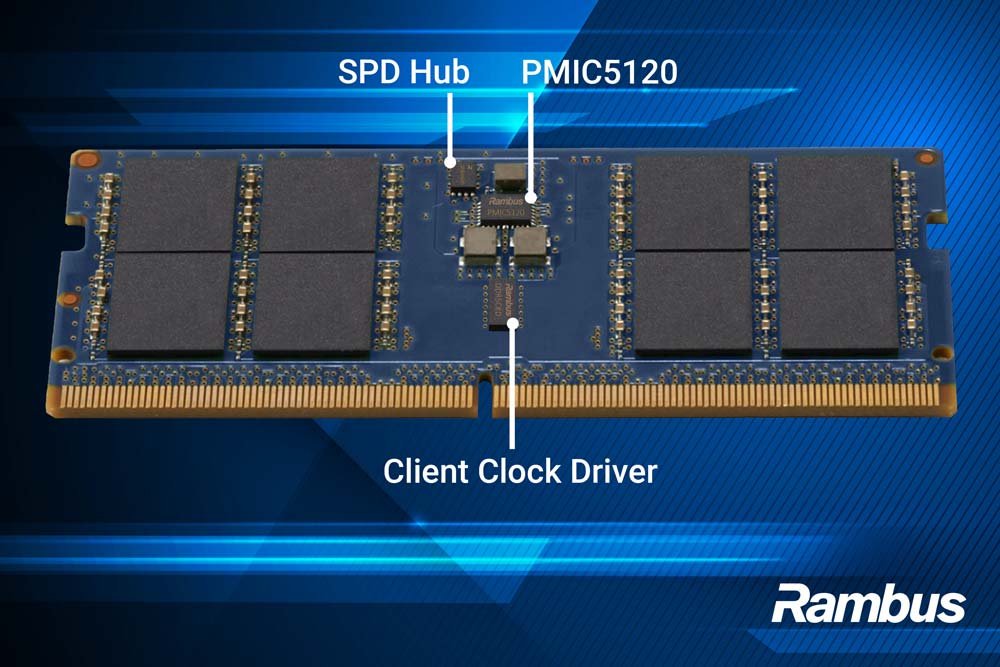
SAN JOSE, Calif. – May 26, 2026 – Rambus Inc. (NASDAQ: RMBS), a premier chip and silicon IP provider making data faster and safer, today announced its complete DDR5 9600 Client Memory Module Chipset for high-performance CUDIMM, CQDIMM and CSODIMM modules in future generation AI PCs. The chipset includes the new Gen2 Client Clock Driver (CKD02), delivering breakthrough performance with support for PC memory module operation of up to 9600 MT/s, Power Management IC (PMIC5120) and Serial Presence Detect Hub (SPD Hub).
With the rise of agentic AI, PCs now plan, execute, and adapt workflows in real time. These workloads require persistent context, concurrent processing, and continuous data movement between the processor and system memory requiring significant increases in both bandwidth and capacity. At the same time, scaling DDR5 memory beyond 6400 MT/s introduces new technical challenges, including signal degradation, clock jitter, and timing instability. To address these challenges, the industry is transitioning to clocked memory modules, including CUDIMM and CQDIMM for desktops and CSODIMM for laptops, which incorporate an on-module client clock driver (CKD) to condition and redistribute the clock signal.
The new Rambus DDR5 9600 Client Chipset provides a complete solution for clocked DDR5 modules operating from 8000 to 9600 MT/s. Designed for performance and scalability, the chipset supports next-generation AI PCs, notebooks, and workstations. By addressing signal integrity, power delivery, and system coordination at the module level, Rambus simplifies the design and deployment of high-performance memory module solutions.
“Agentic workloads are fundamentally more memory-hungry, driving the need for higher memory bandwidth, greater capacity, and improved efficiency in AI-enabled PCs,” said Rami Sethi, SVP and general manager of Memory Interface Chips at Rambus. “Our DDR5 9600 Client Chipset, featuring the Gen2 Client Clock Driver, delivers the performance foundation needed to enable this new era of intelligent, high-performance client systems for AI-driven productivity, next-generation gaming and professional content creation.”
“As AI-driven workloads become increasingly pervasive across client devices, memory subsystem innovation will be key to unlocking their full potential,” said Jeff Janukowicz, research vice president at IDC. “To meet growing performance demands, the industry is transitioning to clocked memory architectures such as CUDIMM and CSODIMM, which are designed to address signal integrity and timing challenges at higher data rates. Complete chipset solutions that deliver stable, high-speed operation will play a critical role in accelerating the adoption of next-generation AI PCs.”
The Rambus DDR5 9600 Client Chipset supporting high-bandwidth, high-capacity, clocked client memory modules and includes:
More Information
Learn more about the Rambus DDR5 9600 Client Memory Module Chipset at: https://www.rambus.com/memory-interface-chips/ddr5-client-dimm-chipset/
About Rambus Inc.
Rambus delivers industry-leading chips and silicon IP for the data center and AI infrastructure. With over three decades of advanced semiconductor experience, our products and technologies address the critical bottlenecks between memory and processing to accelerate data-intensive workloads. By enabling greater bandwidth, efficiency and security across next generation computing platforms, we make data faster and safer. For more information, visit rambus.com.
Forward-looking statements
Information set forth in this press release, including statements as to Rambus’ outlook and financial estimates and statements as to the expected timing and effects of Rambus products, constitute forward-looking statements within the meaning of the safe harbor provisions of the Private Securities Litigation Reform Act of 1995.
These statements are based on various assumptions and the current expectations of the management of Rambus and may not be accurate because of risks and uncertainties surrounding these assumptions and expectations. Factors listed below, as well as other factors, may cause actual results to differ significantly from these forward-looking statements. There is no guarantee that any of the events anticipated by these forward-looking statements will occur, or what effect they will have on the operations or financial condition of Rambus. Forward-looking statements included herein are made as of the date hereof, and Rambus undertakes no obligation to publicly update or revise any forward-looking statement unless required to do so by federal securities laws.
Major risks, uncertainties and assumptions include, but are not limited to: any statements regarding anticipated operational and financial results; any statements of expectation or belief; other factors described under “Risk Factors” in Rambus’ Annual Report on Form 10-K and Quarterly Reports on Form 10-Q; and any statements of assumptions underlying any of the foregoing. It is not possible to predict or identify all such factors. Consequently, while the list of factors presented here is considered representative, no such list should be considered to be a complete statement of all potential risks and uncertainties.
Rambus PCIe® 7.0 Switch IP with Time Division Multiplexing enables efficient, scalable PCIe fabrics that optimize link utilization and reduce system complexity for scale up and scale out of distributed AI clusters and high-performance computing networks
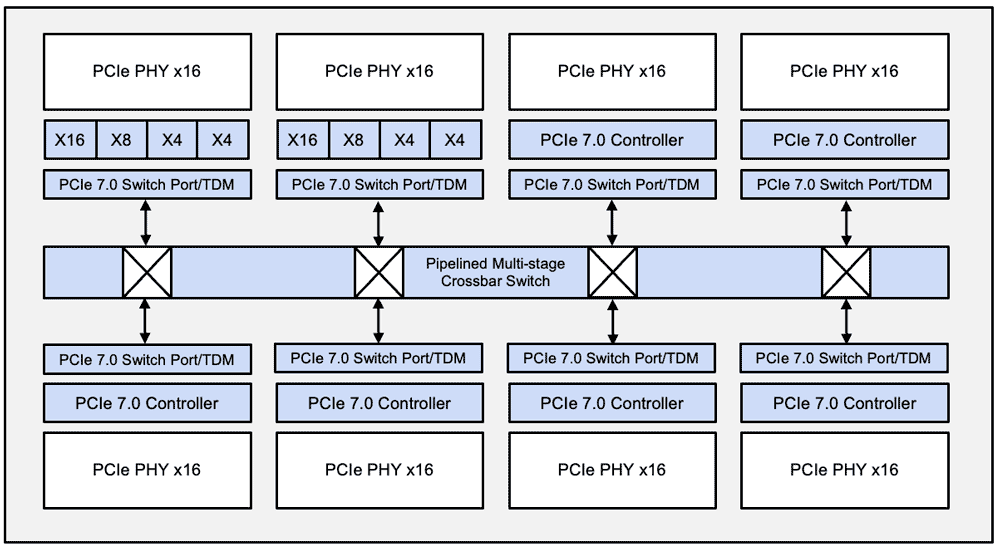
Rambus PCIe 7.0 Switch IP with Time Division Multiplexing
SAN JOSE, Calif. — May 5, 2026 — Rambus Inc. (NASDAQ: RMBS), a premier chip and silicon IP provider making data faster and safer, today announced the Rambus PCIe® 7.0 Switch IP with Time Division Multiplexing (TDM), a new addition to its advanced interconnect IP portfolio designed to address the rapidly escalating bandwidth, latency, and scalability requirements of AI, cloud, and high-performance computing (HPC) systems.
As AI infrastructure grows in scale and architectural complexity, system designers are increasingly challenged to move massive volumes of data efficiently across CPUs, GPUs, accelerators, and NVMe storage. The Rambus PCIe 7.0 Switch IP with TDM is architected to help meet these demands by enabling more flexible and efficient utilization of PCIe links, supporting emerging disaggregated and pooled compute architectures while maintaining low latency and deterministic performance.
Rambus PCIe 7.0 Switch IP with TDM Optimized for Next-Generation AI and Data Center SoCs
Built on the PCIe 7.0 specification, the Rambus newest switch IP is optimized for next‑generation AI and data center SoCs that require extreme bandwidth density, advanced traffic management, and seamless scalability. By incorporating TDM capabilities, the switch enables designers to intelligently schedule and multiplex traffic across shared links, helping maximize fabric utilization while supporting diverse workload profiles, from large‑scale AI training to latency‑sensitive inference and data movement.
“The acceleration of AI is fundamentally reshaping system architectures, and it’s no longer sufficient to simply add more lanes or more endpoints,” said Simon Blake‑Wilson, senior vice president and general manager of Silicon IP at Rambus. “With our PCIe 7.0 Switch IP with TDM, Rambus is giving system architects a new degree of freedom to scale bandwidth efficiently and deterministically, while reducing complexity and improving overall system utilization. This is a critical enabler for scale up and scale out of the next wave of advanced AI clusters and HPC networks.”
“AI infrastructure is increasingly defined by how efficiently data can move between heterogeneous compute and memory resources,” said Jeff Janukowicz, VP, Semiconductors and Enabling Technologies at IDC. “Advanced PCIe switching technologies that improve link utilization and enable flexible traffic orchestration will be key to building scalable, cost‑effective AI platforms as next‑generation interconnect technology evolves.”
Rambus PCIe 7.0 Switch IP with TDM Expands Industry-Leading PCIe IP Portfolio
The Rambus PCIe 7.0 Switch IP with TDM is designed to integrate seamlessly into leading-edge ASIC platforms and complements Rambus’ broader PCIe 7.0 IP portfolio, which includes controllers, retimers, and debug solutions. Together, these IP offerings help customers accelerate time‑to‑market while addressing the demanding performance, power, and reliability requirements of modern AI infrastructure.
The Rambus PCIe 7.0 Switch IP with TDM reinforces the company’s long‑standing leadership in high‑speed interface IP and its commitment to delivering differentiated interconnect technologies that help customers solve the most challenging problems in AI, cloud, and HPC Infrastructure.
More Information:
Learn more about the Rambus PCIe 7.0 Switch IP with TDM and Rambus’ industry-leading family of PCIe solutions at www.rambus.com/interface-ip/pci-express/.
About Rambus Inc.
Rambus delivers industry-leading chips and silicon IP for the data center and AI infrastructure. With over three decades of advanced semiconductor experience, our products and technologies address the critical bottlenecks between memory and processing to accelerate data-intensive workloads. By enabling greater bandwidth, efficiency and security across next generation computing platforms, we make data faster and safer. For more information, visit rambus.com.
Forward-looking statements
Information set forth in this press release, including statements as to Rambus’ outlook and financial estimates and statements as to the expected timing and effects of Rambus products, constitute forward-looking statements within the meaning of the safe harbor provisions of the Private Securities Litigation Reform Act of 1995.
These statements are based on various assumptions and the current expectations of the management of Rambus and may not be accurate because of risks and uncertainties surrounding these assumptions and expectations. Factors listed below, as well as other factors, may cause actual results to differ significantly from these forward-looking statements. There is no guarantee that any of the events anticipated by these forward-looking statements will occur, or what effect they will have on the operations or financial condition of Rambus. Forward-looking statements included herein are made as of the date hereof, and Rambus undertakes no obligation to publicly update or revise any forward-looking statement unless required to do so by federal securities laws.
Major risks, uncertainties and assumptions include, but are not limited to: any statements regarding anticipated operational and financial results; any statements of expectation or belief; other factors described under “Risk Factors” in Rambus’ Annual Report on Form 10-K and Quarterly Reports on Form 10-Q; and any statements of assumptions underlying any of the foregoing. It is not possible to predict or identify all such factors. Consequently, while the list of factors presented here is considered representative, no such list should be considered to be a complete statement of all potential risks and uncertainties.
Press Contact:
Cori Pasinetti
Rambus Corporate Communications
t: (650) 309-6226
[email protected]
Industry-proven finance leader brings deep semiconductor, data center and AI-driven computing ecosystem expertise to support long-term profitable growth
SAN JOSE, Calif., April 29, 2026 — Rambus Inc. (NASDAQ: RMBS) today announced the appointment of Sumeet Gagneja as senior vice president and chief financial officer, effective April 29, 2026. Mr. Gagneja joins Rambus with more than two decades of financial and operational leadership across the semiconductor, data center, and AI-driven computing ecosystem. Mr. Gagneja will oversee the company’s global finance organization, including financial strategy, capital allocation, and investor engagement, reporting to president and chief executive officer Luc Seraphin.
“Sumeet is a highly experienced finance leader with deep knowledge of the semiconductor and data center ecosystem,” said Luc Seraphin, president and chief executive officer of Rambus. “He brings a strong track record of helping companies scale with disciplined execution and a focus on value creation, and will be an outstanding addition to the leadership team as we continue to drive long-term profitable growth.”
Mr. Gagneja most recently served as divisional CFO for AMD’s Data Center segment. Previously, he was CFO of Western Digital’s Flash business and held senior finance leadership roles at Xilinx, Innovium, Maxim Integrated, Avago, and Intel. Across these roles, he supported capital allocation, mergers and acquisitions, operational planning, and investor and analyst engagement, bringing a disciplined and execution-focused approach to scaling complex technology businesses.
“I am excited to join Rambus and support its continued progress,” said Mr. Gagneja. “The company has a strong foundation, a differentiated portfolio, and a clear opportunity to deliver long-term profitable growth. I look forward to working with the leadership team to help drive disciplined execution and create durable value for shareholders.”
Gagneja holds a Master of Business Administration with high distinction from the University of Michigan Ross School of Business and a master’s degree in mechanical engineering from Wayne State University. He is a California Certified Public Accountant.
About Rambus Inc.
Rambus delivers industry-leading chips and silicon IP for the data center and AI infrastructure. With over three decades of advanced semiconductor experience, our products and technologies address the critical bottlenecks between memory and processing to accelerate data-intensive workloads. By enabling greater bandwidth, efficiency and security across next‑generation computing platforms, we make data faster and safer. For more information, visit rambus.com.
Forward-Looking Statements
This release contains forward-looking statements under the Private Securities Litigation Reform Act of 1995, including those relating to Rambus’ expectations regarding business opportunities, the Company’s ability to deliver long-term, profitable growth, product and investment strategies, and the Company’s outlook and financial guidance for the second quarter of 2026 and related drivers, and the Company’s ability to effectively manage market challenges. Such forward-looking statements are based on current expectations, estimates and projections, management’s beliefs and certain assumptions made by the Company’s management. Actual results may differ materially. The Company’s business generally is subject to a number of risks which are described more fully in Rambus’ periodic reports filed with the Securities and Exchange Commission. The Company undertakes no obligation to update forward-looking statements to reflect events or circumstances after the date hereof.
Contact:
Nicole Noutsios
Rambus Investor Relations
(510) 315-1003
[email protected]
[Last updated on April 8, 2026] MACsec (Media Access Control Security) is an Ethernet security standard that encrypts and authenticates data in motion at Layer 2 of the OSI model, protecting traffic as it moves between directly connected devices.
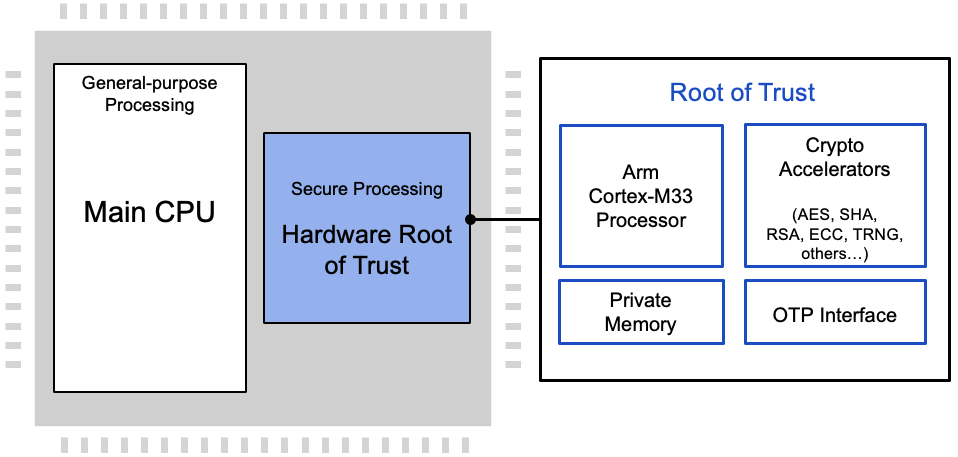
To achieve end‑to‑end security, data must be secured throughout its entire lifecycle: when it is stored, when it is actively processed, and when it is transmitted between devices. Hardware root of trust anchored in silicon provides foundation for securing data at rest, while inline memory encryption protects data in use. For data in motion, however, security must be enforced at the point where information first leaves the device, before it traverses a network that may not be fully trusted.
This is where MACsec plays a critical role. By anchoring security in hardware at the Ethernet layer, MACsec ensures that all network traffic is encrypted and authenticated the moment it goes on the wire. This approach protects against eavesdropping, tampering, and impersonation without relying on higher‑layer software or application changes.
In this blog, we’ll explore what MACsec is, how it works, how it compares to higher-layer security approaches, and why it is essential for modern Ethernet-based systems.
The OSI model explains how MACsec, IPsec, and TLS secure data at different layers of the network communication.
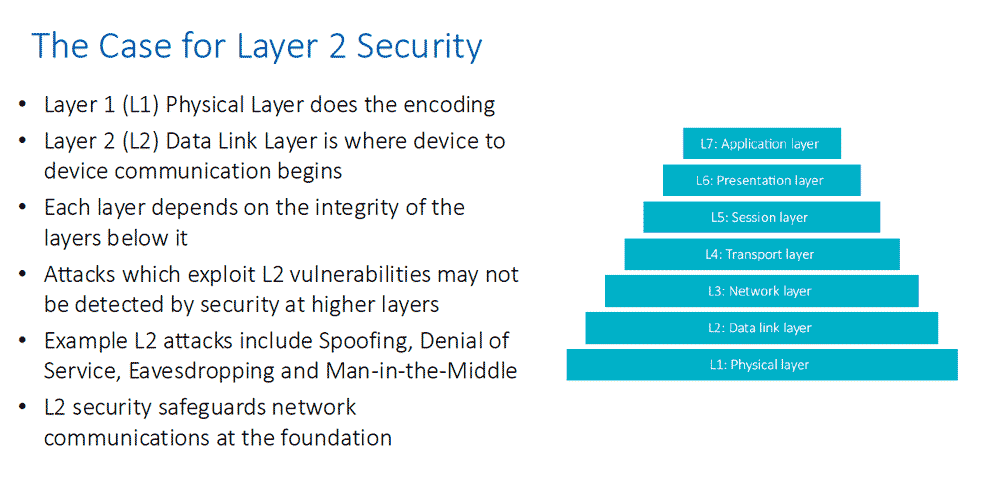
The OSI model is a seven‑layer framework for network communications, with each layer describing how data moves through a network. Each layer can also introduce its own form of security. In this section, we focus on three of those layers and the technologies commonly used to protect data in motion at each one: MACsec, IPsec, and TLS.
At Layer 2 of the OSI model, MACsec protects data as it travels between devices on the same local network, such as switch‑to‑switch, switch‑to‑host, or host‑to‑host connections. A simple way to think about MACsec is that it protects the cable itself. If someone gains access to the physical network, MACsec ensures the data on the wire is encrypted and cannot be read or altered. Because Layer 2 is the last point where data exists in clear form before leaving a device, securing traffic here stops attacks like sniffing, spoofing, and unauthorized monitoring early, without relying on higher‑level software behaving correctly. Layer 2 security provides a strong foundation for network protection.
Internet Protocol Security (IPsec) operates at Layer 3, the network layer. Rather than securing a single physical link, IPsec protects data as it moves between networks, including traffic that traverses the public internet. This makes IPsec well suited for use cases such as site‑to‑site and remote access VPNs, where data must be protected across longer distances and multiple network hops.
Transport Layer Security (TLS) sits near the top of the stack, typically at Layer 4 and above, and focuses on securing individual application communications. A familiar example is the “https” prefix in a web browser. TLS encrypts specific conversations, such as a browser accessing a website or an application calling an API, ensuring the data remains confidential, the server is authenticated, and the communication cannot be tampered with.
Together, these technologies demonstrate how security can be applied at different layers of the network stack, with MACsec protecting the link, IPsec protecting network paths, and TLS protecting application‑level communication.
Defined by the IEEE 802.1AE standard, MACsec provides encryption and authentication for Ethernet traffic at the data link layer of the OSI model. Its purpose is to protect data as it travels across local and metropolitan area networks by ensuring that Ethernet frames can only be read and modified by authorized devices.
Under IEEE 802.1AE, Ethernet frames are encrypted and integrity-checked before they are transmitted over a physical link, which prevents eavesdropping, data tampering, and replay attacks. Because this protection happens at the MAC layer, it is independent of higher-layer protocols such as IP, TCP, or application-level encryption, and it works transparently without requiring changes to applications or network configurations. This makes MACsec especially valuable for environments where physical access to network links cannot be fully trusted, such as shared data centers, campus networks, and inter-rack connections.
In short, MACsec is a Layer 2 security standard that encrypts and authenticates Ethernet frames, ensuring that only trusted devices can access data in transit on local and metropolitan networks.
MACsec works by securing Ethernet frames themselves, before they ever become IP packets or application data. To understand how it operates, it helps to think about what normally happens at the Ethernet layer and how MACsec modifies that process.
Under normal Ethernet operation, a device (like a server or switch) builds an Ethernet frame containing a destination MAC address, a source MAC address, payload data, and a frame check sequence. That frame is then put directly onto the wire, where any device with access to the physical network could potentially observe or copy it.
With MACsec, an additional security step is inserted inside the Ethernet layer, between frame creation and transmission on the physical link. Before the frame is sent, MACsec treats it as protected data that must be authenticated and optionally encrypted.
When two MACsec-capable devices are connected, they first establish trust. This is usually done using IEEE 802.1X for authentication and key agreement, although pre-shared keys can also be used. During this process, the devices agree on cryptographic keys known as Secure Association Keys (SAKs). These keys are unique to the link and can be rotated periodically to limit exposure.
Once keys are established, each Ethernet frame is processed by the MACsec engine. The original Ethernet payload is encrypted using symmetric cryptography (typically AES). MACsec also calculates an integrity check value for the frame, ensuring that the data cannot be altered in transit without detection. A small MACsec header and security tag are added to the frame to indicate that it is protected and to carry information such as packet numbers used to prevent replay attacks.
Importantly, MACsec does not encrypt everything in the Ethernet frame. The source and destination MAC addresses remain visible so switches can still forward traffic correctly. What is protected is the Ethernet payload, along with integrity and authenticity information. From the perspective of higher layers like IP, TCP, and applications, nothing changes; they see the same data as if MACsec were not present.
When the encrypted frame reaches the receiving device, the MACsec engine verifies the integrity check and packet number to confirm the frame has not been tampered with or replayed. If the frame passes validation, it is decrypted and handed up to the normal Ethernet processing path. If validation fails, the frame is silently dropped.
All of this happens at line rate, often using dedicated hardware in network interface cards, switches, or routers. Because the work is done at Layer 2, latency is extremely low, and applications do not need to be modified or even be aware that encryption is occurring.
Conceptually, MACsec turns each Ethernet link into a private, secure tunnel. Instead of assuming the local network is trusted, it assumes the wire itself could be hostile and protects traffic the moment it leaves a device. This makes MACsec especially valuable for securing data center links, campus networks, and any environment where physical or internal network access cannot be fully trusted.
By encrypting Ethernet payloads at line rate before they leave the device, MACsec turns each physical or logical link into a secure, trusted communication channel.
MACsec itself is responsible for encrypting and authenticating Ethernet frames, but it does not decide who is allowed to communicate or which keys should be used. That responsibility is handled by IEEE 802.1X and a companion protocol called MACsec Key Agreement, commonly referred to as MKA.
The process begins with IEEE 802.1X authentication, which answers a fundamental question at the Ethernet layer: is this device trusted enough to participate in secure communication? When two devices are connected by an Ethernet link, such as a switch and a server, each device must prove its identity before any protected traffic is allowed to flow.
IEEE 802.1X uses a familiar identity model with three roles: the supplicant, which is the device requesting access; the authenticator, which controls the port and enforces access; and an authentication server, typically a RADIUS server. Using Extensible Authentication Protocol, or EAP, the supplicant and authentication server exchange credentials such as certificates or usernames and passwords. If authentication succeeds, the link is considered authorized.
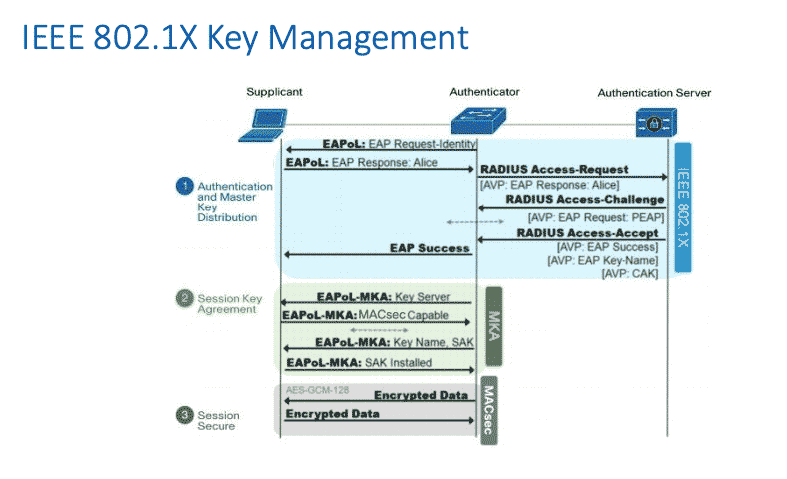
Once authentication is complete, IEEE 802.1X does more than simply open the port. It also establishes a shared secret known as a Master Session Key. This key is cryptographically strong and unique to the authenticated session. At this point, the devices trust each other, but they still do not have the specific encryption keys required for MACsec traffic protection.
This is where MACsec Key Agreement (MKA) comes into play. MKA is defined as part of IEEE 802.1AE and runs directly at the Ethernet layer between authenticated peers. Using the Master Session Key as its foundation, MKA derives one or more Secure Association Keys, or SAKs. These SAKs are the actual keys used by MACsec to encrypt and authenticate Ethernet frames.
MKA serves several important purposes beyond simple key derivation. It securely distributes SAKs to all participants on a protected link or, in the case of point‑to‑multipoint scenarios, to multiple authorized devices. It also assigns each device a role, such as key server or participant, to coordinate key generation and updates. MKA includes mechanisms for key rotation, allowing SAKs to be periodically replaced without interrupting traffic. This limits the amount of data protected by any single key and reduces the impact of potential compromise.
As encrypted traffic begins to flow, each MACsec‑protected frame includes a packet number that is checked by the receiver. MKA ensures both sides agree on packet number handling and anti‑replay rules. If a frame arrives with an unexpected or reused packet number, it is rejected. This prevents attackers from capturing and replaying old Ethernet frames.
Importantly, MKA continues running in the background for the lifetime of the connection. If a device disconnects, fails authentication checks, or violates policy, MKA signals MACsec to stop accepting traffic from that device. If a new device joins, it must complete its own 802.1X authentication before receiving any MACsec keys. This tight coupling ensures that encryption keys are always tied to authenticated identities, not just physical access to a cable or switch port.
From an operational perspective, the combination of IEEE 802.1X and MKA allows MACsec to behave like a zero‑trust system at Layer 2. Every device must authenticate, keys are unique to each link or group, keys are refreshed automatically, and encrypted communication starts immediately at the edge of the network. All of this happens transparently to IP, TCP, and applications, which remain unaware that encryption and identity enforcement are taking place underneath.
IEEE 802.1X and MACsec Key Agreement work together to authenticate devices, derive encryption keys, and continuously manage trust for secure Ethernet communication.
MACsec, IPsec, and TLS are all technologies used to protect data in motion, but they operate at different layers of the network stack and address different security needs. Rather than competing with one another, they are complementary and are often deployed together as part of a layered security strategy.
The simplest way to distinguish them is by where encryption is applied. MACsec operates at Layer 2, securing Ethernet frames as they move across a physical or logical link. IPsec operates at Layer 3, protecting IP packets as they travel between hosts or networks, including across the public internet. TLS operates at the application level, typically above Layer 4, securing individual sessions such as web traffic, APIs, and application‑to‑application communications.
Because of where each technology sits in the stack, each one protects a different portion of the data path. MACsec encrypts the Ethernet payload on a hop‑by‑hop basis while leaving MAC addresses visible so switching can function normally. IPsec encrypts IP packets end to end or between security gateways, depending on deployment mode. TLS encrypts only the application data itself, leaving lower‑layer headers exposed to the network.
These differences also shape how trust is established. MACsec relies on IEEE 802.1X authentication and MACsec Key Agreement to ensure only authorized devices receive encryption keys at the network edge. IPsec uses Internet Key Exchange with certificates or pre‑shared keys to establish trust between endpoints or gateways. TLS depends on public key infrastructure to authenticate servers and sometimes clients directly at the application layer.
From a performance standpoint, MACsec is optimized for line‑rate, low‑latency operation, often using dedicated hardware in NICs and switches, and is largely invisible to applications. IPsec introduces more overhead due to encapsulation and policy processing, though it may also be hardware accelerated. TLS adds encryption and handshake overhead at the application layer but benefits from widespread CPU optimizations and broad software support.
In practice, each technology is best suited to a specific role. MACsec is ideal for securing internal or local Ethernet links without modifying applications. IPsec is commonly used to protect traffic between sites or across untrusted networks, such as VPN connections. TLS is the dominant choice for securing application‑level communication, especially over the public internet.
| Aspect | MACsec | IPsec | TLS |
|---|---|---|---|
| Primary purpose | Secure Ethernet links | Secure IP traffic | Secure application sessions |
| OSI layer | Layer 2 (Data Link) | Layer 3 (Network) | Layers 4–7 (Application) |
| What is encrypted | Ethernet payload | IP packets | Application data |
| Scope of protection | Hop by hop, link local | End to end or tunnel based | End to end per application |
| Typical authentication | IEEE 802.1X, MKA | IKE with certificates or PSKs | Certificates and PKI |
| Visibility to applications | Transparent | Transparent | Application aware |
| Performance characteristics | Line rate, very low latency | Moderate overhead | Session setup and crypto overhead |
| Common implementations | NICs, switches, routers | Hosts, gateways, VPN devices | Web servers, apps, APIs |
| Best suited for | Internal Ethernet security | Inter network security | Application level security |
In summary, MACsec protects the link, IPsec protects the route, and TLS protects the application. Used together, they form a layered approach that secures data in motion from the wire to the workload.
MACsec is designed to secure Ethernet traffic with minimal impact on performance, especially when implemented in hardware. Modern switches, routers, and NICs typically include dedicated MACsec engines that perform encryption and integrity checks at line rate using symmetric cryptography. In these deployments, MACsec does not reduce throughput, even at high speeds like 25G, 100G, or higher. Performance degradation is mainly a concern with software‑only implementations, where cryptographic processing competes with other workloads and can limit scalability.
From a latency perspective, MACsec adds very little overhead. Because it operates at the Ethernet layer and processes each frame independently, encryption and decryption are done inline as frames enter and exit the interface. In hardware‑accelerated designs, the additional latency is usually measured in tens or hundreds of nanoseconds, far below what applications or even most network monitoring tools can detect. Key rotation events are handled seamlessly by MACsec Key Agreement, allowing keys to change without interrupting traffic or adding noticeable delay.
Power consumption depends heavily on where MACsec is implemented. Hardware MACsec slightly increases silicon area and power use, but the incremental cost per port is typically modest and predictable, making it suitable for large‑scale deployments. In contrast, software‑based MACsec is far less energy‑efficient because general‑purpose CPUs are not optimized for sustained cryptographic workloads, resulting in higher power draw per bit of data protected. At scale, this difference becomes significant.
Overall, MACsec offers a strong security‑to‑cost trade‑off when hardware acceleration is available. It provides near‑zero performance loss, extremely low and deterministic latency, and manageable power overhead, making it well suited for data centers, enterprise networks, and embedded systems. The primary architectural consideration is ensuring MACsec support across network devices, but from a performance, latency, and power standpoint, hardware‑accelerated MACsec is one of the most efficient ways to encrypt data in motion.
When implemented in hardware, MACsec delivers strong security with near‑zero throughput impact, extremely low latency, and predictable power consumption at scale.
MACsec is used today anywhere organizations want to protect data in motion at the Ethernet layer, especially in environments where internal networks can no longer be assumed to be trusted.
Common MACsec deployment environments include:
In data centers and cloud infrastructure, MACsec is commonly deployed to secure east‑west traffic between servers, switches, and storage systems. Hyperscalers and enterprise data centers use MACsec to encrypt traffic on switch‑to‑switch and switch‑to‑server links without adding noticeable latency or CPU overhead. Because MACsec operates transparently below IP and applications, it allows operators to enforce blanket encryption for all workloads, including legacy protocols that lack native security.
In enterprise campus and corporate networks, MACsec is used to secure access links at the network edge. Switch‑to‑endpoint, switch‑to‑access‑point, and inter‑building fiber links are frequent use cases. When combined with IEEE 802.1X authentication, MACsec ensures that only authenticated devices can send or receive traffic and that all Ethernet frames are encrypted once they leave the device. This is especially valuable for protecting traffic across shared wiring, campus backbones, and leased lines.
MACsec is also widely adopted in telecommunications and service provider networks. Mobile backhaul, fronthaul, and metro Ethernet links use MACsec to protect traffic between radios, aggregation nodes, and core infrastructure. These environments benefit from MACsec’s low latency and deterministic performance, which are critical for 5G and timing‑sensitive workloads.
Finally, MACsec is increasingly found in embedded, automotive, and industrial Ethernet systems. Automotive Ethernet uses MACsec to protect in‑vehicle networks from spoofing and tampering, while industrial control and operational technology environments use it to secure machine‑to‑machine communication without modifying application protocols. In these contexts, hardware‑based MACsec provides strong security while meeting strict real‑time and power constraints.
In short, MACsec is widely deployed across data centers, enterprise networks, service provider infrastructure, and embedded systems wherever Ethernet security, performance, and transparency are critical.
For organizations looking to implement MACsec at scale, hardware-accelerated solutions are essential. Rambus offers a complete family of silicon-proven MACsec silicon IP solutions for applications ranging from automotive/enterprise SOC/PHY to high-performance optical PHY, switch/router and AI interconnect silicon. All Rambus MACsec IP solutions are IEEE 802.1AE-2018 compliant and come with industry-proven Driver Development Kits (DDK).
Rambus MACsec IP enables standards‑compliant, hardware‑accelerated Ethernet security for high‑performance, scalable systems across data center, networking, automotive, and AI applications.
As Ethernet serves as the backbone of modern computing, securing data in motion is mission critical. MACsec addresses this challenge by delivering line-rate, low-latency, standards-based security directly at the link layer.
By encrypting and authenticating every Ethernet frame, MACsec provides strong protection against eavesdropping, tampering, and unauthorized access without impacting performance or requiring changes to applications and protocols.
For enterprises, data centers, and service providers building next-generation networks, understanding and deploying MACsec is a critical step toward a secure, scalable, and high-performance Ethernet infrastructure.
Is MACsec end‑to‑end encryption?
No. MACsec is hop‑by‑hop encryption at Layer 2, meaning each Ethernet link is secured independently.
Does MACsec encrypt MAC addresses or Ethernet headers?
No. MACsec leaves source and destination MAC addresses visible so that switching and routing can function normally. It encrypts the Ethernet payload and protects it with integrity and replay protection.
Can MACsec be used together with IPsec or TLS?
Yes. MACsec, IPsec, and TLS are complementary and often used together. MACsec secures the underlying Ethernet link, IPsec protects traffic across networks, and TLS secures application‑level communication.
Does MACsec require application or protocol changes?
No. MACsec operates transparently at Layer 2, so applications, operating systems, and higher‑layer protocols do not need to be modified.
Is MACsec suitable for high‑speed networks?
Yes. When implemented in hardware, MACsec supports line‑rate encryption with extremely low latency, even at speeds of 25G, 100G, and higher.
What standards are associated with MACsec?
MACsec is defined by IEEE 802.1AE, and it is commonly used with IEEE 802.1X and MACsec Key Agreement (MKA) for authentication and key management.
Why MACsec?
MACsec protects data at the Ethernet layer before it reaches higher‑layer security controls, reducing exposure to internal threats and protecting traffic that may not be covered by application‑level encryption.
Need more details? Contact us here and request a meeting with one of our dedicated sales specialists.
More on MACsec:
– Ask the Experts: MACsec at Terabit Line Rates
– Network Security at Terabit-per-second Rates with MACsec, IPsec and UEC
– Secure by Design Series: Inline Memory Encryption & MACsec: Protecting Data in Use and in Motion
– MACsec Fundamentals