
Download the product brief to see the features and specifications of the Rambus Registering Clock Driver (RCD) RCD3-G1A.
DDR5 RCD 6400 MT/s Product Brief
Rambus Delivers 6400 MT/s DDR5 Registering Clock Driver to Advance Server Memory Performance
Highlights:
- Boosts data rate and bandwidth by 33% over Gen1 DDR5 devices
- Enables DDR5 RDIMMs for server main memory running at up to 6400 MT/s for future server platforms
- Expands industry-leading DDR5 memory interface chip offering to now include Gen1 4800 MT/s RCD, Gen2 5600 MT/s RCD and Gen3 6400 MT/s RCD
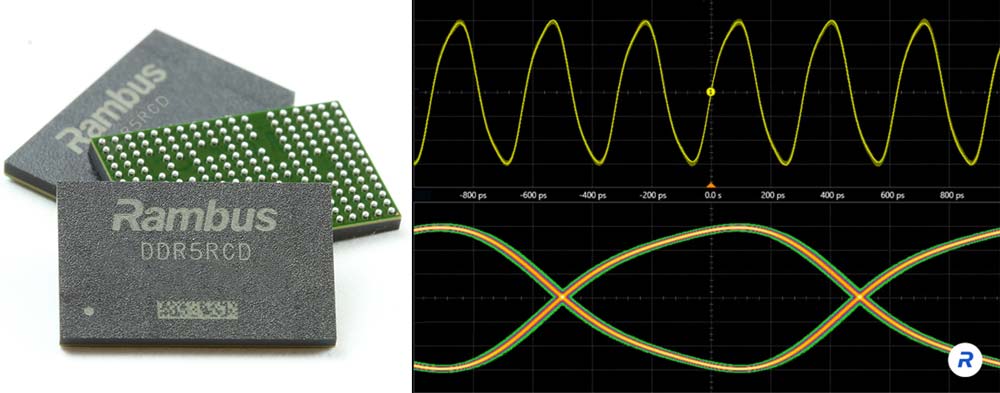
SAN JOSE, Calif. – Feb. 1, 2023 – Rambus Inc. (NASDAQ: RMBS), a premier chip and silicon IP provider making data faster and safer, today announced the availability of its new 6400 MT/s DDR5 Registering Clock Driver (RCD) and sampling to the major DDR5 memory module (RDIMM) manufacturers. With a 33% increase in data rate and bandwidth over Gen1 4800 MT/s solutions, the Rambus Gen3 6400 MT/s DDR5 RCD enables a new level of main memory performance for data center servers. Delivering industry-leading latency and power, it offers optimized timing parameters for improved RDIMM margins.
“Data center workloads have an insatiable thirst for greater memory bandwidth and capacity, and our mission is to advance the performance of server memory solutions that meet this need for each new server platform generation,” said Sean Fan, chief operating officer at Rambus. “We were first in the industry to 5600 MT/s, and now we have raised the bar with our Gen3 DDR5 RCD capable of 6400 MT/s to support a new generation of RDIMMs for server main memory.”
“DDR5 offers tremendous performance enhancements for computing systems,” said Soo-Kyoum Kim, vice president, memory semiconductors at IDC. “As data center applications accelerate demand for more and more memory bandwidth, it is critical that the DDR5 ecosystem extends performance for the fundamental needs of next-generation data centers.”
Rambus DDR5 memory interface chips including the RCD, Serial Presence Detect (SPD) Hub and Temperature Sensors are important in achieving a new level of performance for leading-edge servers. With DDR5 memory, more intelligence is built into the RDIMMs enabling over double the data rate and four times the capacity of DDR4 RDIMMs, while at the same time increasing memory and power efficiency. With over 30 years of high-performance memory experience, Rambus is renowned for its signal integrity (SI) / power integrity (PI) expertise. This expertise helps enable DDR5 memory interface chips delivering superior signal integrity for the command/address and clock signals sent from the host memory controller to the RDIMMs.
More Information:
Learn more about the Rambus DDR5 RCD at https://www.rambus.com/ddr5.
Automotive Security: Meeting the Growing Challenges
Vehicle systems and the semiconductors used within them represent some of today’s most complex electronics. In the drive to autonomous vehicles, increasingly sophisticated electronic systems are being developed for powertrain and vehicle dynamics, advanced driver assistance systems (ADAS), vehicle-to-everything (V2E) connectivity, infotainment, and in-vehicle experience. In addition to achieving higher levels of performance, these systems must meet automotive functional safety requirements as specified by ISO 26262.
Going Beyond the Requirements of a Root of Trust for Measurement with the Silicon-Proven RT-660 Root of Trust
The continuously evolving technology landscape and security requirements for systems present many challenges for device and silicon manufacturers. Nowhere is this truer than in data centers. Rambus has long recognized the need for security designs in data centers, and the Caliptra initiative discussed in this whitepaper is a welcome step towards a widespread adoption of Root of Trust designs in SoCs. The Caliptra specification, released at OCP Global Summit 2022, is defined as a Root of Trust for Measurement (RTM). In this whitepaper, we will present how the Rambus RT-660 Root of Trust (RoT) core can be deployed for Caliptra use case scenarios as well as many other Root of Trust use cases.
Rambus Reports Third Quarter 2022 Financial Results
- Exceeded guidance for Q3 revenue and earnings
- Delivered record quarterly product revenue driven by memory interface chips
- Generated $80 million in cash from operations
- Initiated $100 million accelerated share repurchase program
SAN JOSE, Calif. – October 31, 2022– Rambus Inc. (NASDAQ:RMBS), a provider of industry-leading chips and IP making data faster and safer, today reported financial results for the third quarter ended September 30, 2022. GAAP revenue for the third quarter was $112.2 million, licensing billings were $62.2 million, product revenue was $58.6 million, and contract and other revenue was $23.7 million. The Company also generated $80 million in cash provided by operating activities in the third quarter.
“Rambus had an excellent performance in the third quarter, exceeding guidance and delivering record cash and product revenue,” said Luc Seraphin, chief executive officer of Rambus. “Our strategic focus and strong execution in data center, combined with a diverse portfolio of offerings, drive the company’s long-term profitable growth and enable consistent capital returns to our stockholders.”
| Quarterly Financial Review – GAAP | Three Months Ended September 30, |
|||
| (In millions, except for percentages and per share amounts) | 2022 | 2021 | ||
| Revenue | ||||
| Product revenue | $58.6 | $36.7 | ||
| Royalties | 29.9 | 33.1 | ||
| Contract and other revenue | 23.7 | 11.5 | ||
| Total revenue | 112.2 | 81.3 | ||
| Cost of product revenue | 21.9 | 13.1 | ||
| Cost of contract and other revenue | 1.5 | 1.5 | ||
| Amortization of acquired intangible assets (included in total cost of revenue) | 3.6 | 3.8 | ||
| Total operating expenses (1) | 68.3 | 58.2 | ||
| Operating income | $16.9 | $4.7 | ||
| Operating margin | 15% | 6% | ||
| Net income | $0.9 | $3.7 | ||
| Diluted net income per share | $0.01 | $0.03 | ||
| Net cash provided by operating activities | $80.0 | $46.0 | ||
_________________________________________
(1) Includes amortization of acquired intangible assets of approximately $0.4 million for each of the three months ended September 30, 2022 and 2021.
| Quarterly Financial Review – Supplemental Information(1) | Three Months Ended September 30, |
|||
| (In millions) | 2022 | 2021 | ||
| Licensing billings (operational metric) (2) | $62.2 | $66.1 | ||
| Product revenue (GAAP) | $58.6 | $36.7 | ||
| Contract and other revenue (GAAP) | $23.7 | $11.5 | ||
| Non-GAAP cost of product revenue | $21.8 | $13.1 | ||
| Cost of contract and other revenue (GAAP) | $1.5 | $1.5 | ||
| Non-GAAP total operating expenses | $54.6 | $48.2 | ||
| Non-GAAP interest and other income (expense), net | $1.6 | $(0.2) | ||
| Diluted share count (GAAP) | 112 | 114 | ||
_________________________________________
(1)See “Supplemental Reconciliation of GAAP to Non-GAAP Results” table included below.
(2)Licensing billings is an operational metric that reflects amounts invoiced to our licensing customers during the period, as adjusted for certain differences relating to advanced payments for variable licensing agreements.
GAAP revenue for the quarter was $112.2 million. The Company also had licensing billings of $62.2 million, product revenue of $58.6 million, and contract and other revenue of $23.7 million. The Company had GAAP cost of revenue of $27.0 million and operating expenses of $68.3 million. The Company also had total non-GAAP operating expenses of $77.9 million (including non-GAAP cost of revenue). The Company’s basic share count was 110 million shares and its diluted share count was 112 million shares.
Cash, cash equivalents, and marketable securities as of September 30, 2022 were $264.8 million, a decrease of $86.8 million from June 30, 2022, mainly due to $100 million paid in connection with an accelerated share repurchase program, $58.9 million paid in connection with the repayment of 2023 senior notes, $14.4 million paid in connection with the settlement of warrants, partially offset by $80 million in cash generated by operating activities and proceeds of $19.3 million from the settlement of senior convertible note hedges.
2022 Fourth Quarter Outlook
The Company will discuss its full revenue guidance for the fourth quarter of 2022 during its upcoming conference call. The following table sets forth fourth quarter outlook for other measures.
| (In millions) | GAAP | Non-GAAP (1) | ||
| Licensing billings (operational metric) (2) | $59 – $65 | $59 – $65 | ||
| Product revenue (GAAP) | $63 – $69 | $63 – $69 | ||
| Contract and other revenue (GAAP) | $21 – $27 | $21 – $27 | ||
| Total operating costs and expenses | $100 – $96 | $86 – $82 | ||
| Interest and other income (expense), net | $0 | ($1) | ||
| Diluted share count | 110 | 110 |
_________________________________________
(1) See “Reconciliation of GAAP Forward-Looking Estimates to Non-GAAP Forward-Looking Estimates” table included below.
(2) Licensing billings is an operational metric that reflects amounts invoiced to our licensing customers during the period, as adjusted for certain differences relating to advanced payments for variable licensing agreements.
For the fourth quarter of 2022, the Company expects licensing billings to be between $59 million and $65 million. The Company also expects royalty revenue to be between $29 million and $35 million, product revenue to be between $63 million and $69 million and contract and other revenue to be between $21 million and $27 million. Revenue is not without risk and achieving revenue in this range will require that the Company sign customer agreements for various product sales and solutions licensing, among other matters.
The Company also expects operating costs and expenses to be between $100 million and $96 million. Additionally, the Company expects non-GAAP operating costs and expenses to be between $86 million and $82 million. These expectations also assume non-GAAP interest and other income (expense), net, of ($1 million), tax rate of 24% and diluted share count of 110 million, and exclude stock-based compensation expense ($10 million), amortization expense ($4 million), non-cash interest expense ($0.1 million) and interest income related to the significant financing component from fixed-fee patent and technology licensing arrangements ($1 million).
Conference Call
The Company’s management will discuss the results of the quarter during a conference call scheduled for 2:00 p.m. PT today. The call, audio and slides will be available online at investor.rambus.com and a replay will be available for the next week at the following numbers: (866) 813-9403 (domestic) or (+44) 204-525-0658 (international) with ID# 714912.
Non-GAAP Financial Information
In the commentary set forth above and in the financial statements included in this earnings release, the Company presents the following non-GAAP financial measures: cost of product revenue, operating expenses and interest and other income (expense), net. In computing each of these non-GAAP financial measures, the following items were considered as discussed below: stock-based compensation expense, acquisition-related costs and retention bonus expense, amortization of acquired intangible assets, expense on abandoned operating leases, change in fair value of earn-out liability, loss on extinguishment of debt, loss on fair value adjustment of derivatives, net, realized loss on sale of marketable securities sold for the purpose of notes repurchase, non-cash interest expense and certain other one-time adjustments. The non-GAAP financial measures disclosed by the Company should not be considered a substitute for, or superior to, financial measures calculated in accordance with GAAP, and the financial results calculated in accordance with GAAP and reconciliations from these results should be carefully evaluated. Management believes the non-GAAP financial measures are appropriate for both its own assessment of, and to show investors, how the Company’s performance compares to other periods. The non-GAAP financial measures used by the Company may be calculated differently from, and therefore may not be comparable to, similarly titled measures used by other companies. A reconciliation from GAAP to non-GAAP results is included in the financial statements contained in this release.
The Company’s non-GAAP financial measures reflect adjustments based on the following items:
Stock-based compensation expense. These expenses primarily relate to employee stock options, employee stock purchase plans, and employee non-vested equity stock and non-vested stock units. The Company excludes stock-based compensation expense from its non-GAAP measures primarily because such expenses are non-cash expenses that the Company does not believe are reflective of ongoing operating results. Additionally, given the fact that other companies may grant different amounts and types of equity awards and may use different option valuation assumptions, excluding stock-based compensation expense permits more accurate comparisons of the Company’s results with peer companies.
Acquisition-related costs and retention bonus expense. These expenses include all direct costs of certain acquisitions and the current period’s portion of any retention bonus expense associated with the acquisitions. The Company excludes these expenses in order to provide better comparability between periods as they are related to acquisitions and have no direct correlation to the Company’s operations.
Amortization of acquired intangible assets. The Company incurs expenses for the amortization of intangible assets acquired in acquisitions. The Company excludes these items because these expenses are not reflective of ongoing operating results in the period incurred. These amounts arise from the Company’s prior acquisitions and have no direct correlation to the operation of the Company’s core business.
Expense on abandoned operating leases. Reflects the expense on building leases that were abandoned. The Company excludes these charges because such charges are not directly related to ongoing business results and do not reflect expected future operating expenses.
Change in fair value of earn-out liability. This change is due to adjustments to acquisition purchase consideration. The Company excludes these adjustments because such adjustments are not directly related to ongoing business results and do not reflect expected future operating expenses.
Gain on sale of equity security. The Company has excluded gain on sale of equity security as this is not a reflection of the Company’s ongoing operations.
Loss on extinguishment of debt. The Company has excluded loss on extinguishment of debt as this represents a cost of repurchasing its existing convertible notes and is not a reflection of the Company’s ongoing operations.
Loss on fair value adjustment of derivatives, net. The Company has excluded its loss on fair value adjustment of derivatives, net, as this represents cost and benefits of repurchasing its convertible notes and is not a reflection of the Company’s ongoing operations.
Realized loss on sale of marketable securities sold for the purpose of notes repurchase. The Company has excluded its realized loss on sale of marketable securities sold for the purpose of repurchasing its convertible notes as this is not a reflection of the Company’s ongoing operations.
Non-cash interest expense on convertible notes. The Company incurs non-cash interest expense related to its convertible notes. The Company excludes non-cash interest expense related to its convertible notes to provide more accurate comparisons of the Company’s results with other peer companies and to more accurately reflect the Company’s ongoing operations.
Income tax adjustments. For purposes of internal forecasting, planning and analyzing future periods that assume net income from operations, the Company estimates a fixed, long-term projected tax rate of approximately 24 percent for both 2022 and 2021, which consists of estimated U.S. federal and state tax rates, and excludes tax rates associated with certain items such as withholding tax, tax credits, deferred tax asset valuation allowance and the release of any deferred tax asset valuation allowance. Accordingly, the Company has applied these tax rates to its non-GAAP financial results for all periods in the relevant years to assist the Company’s planning.
On occasion in the future, there may be other items, such as significant gains or losses from contingencies, that the Company may exclude in deriving its non-GAAP financial measures if it believes that doing so is consistent with the goal of providing useful information to investors and management.
Forward-Looking Statements
This release contains forward-looking statements under the Private Securities Litigation Reform Act of 1995, including those relating to Rambus’ expectations regarding business opportunities, the Company’s ability to deliver long-term, profitable growth, product and investment strategies, and the Company’s outlook and financial guidance for the fourth quarter of 2022 and related drivers, and the Company’s ability to effectively manage supply chain shortages. Such forward-looking statements are based on current expectations, estimates and projections, management’s beliefs and certain assumptions made by the Company’s management. Actual results may differ materially. The Company’s business generally is subject to a number of risks which are described more fully in Rambus’ periodic reports filed with the Securities and Exchange Commission, as well as the potential adverse impacts related to, or arising from, the COVID-19 and its variants. The Company undertakes no obligation to update forward-looking statements to reflect events or circumstances after the date hereof.
Rambus Inc.
Condensed Consolidated Balance Sheets
(Unaudited)
| (In thousands) | September 30, 2022 |
December 31, 2021 |
||
| ASSETS | ||||
| Current assets: | ||||
| Cash and cash equivalents | $141,559 | $107,891 | ||
| Marketable securities | 123,289 | 377,718 | ||
| Accounts receivable | 38,547 | 44,065 | ||
| Unbilled receivables | 142,037 | 135,608 | ||
| Inventories | 14,161 | 8,482 | ||
| Prepaids and other current assets | 14,584 | 10,600 | ||
| Total current assets | 474,177 | 684,364 | ||
| Intangible assets, net | 54,856 | 58,420 | ||
| Goodwill | 292,038 | 278,810 | ||
| Property, plant and equipment, net | 78,563 | 56,035 | ||
| Operating lease right-of-use assets | 25,232 | 23,712 | ||
| Deferred tax assets | 2,803 | 4,047 | ||
| Unbilled receivables | 37,914 | 123,018 | ||
| Other assets | 3,473 | 4,240 | ||
| Total assets | $969,056 | $1,232,646 | ||
| LIABILITIES & STOCKHOLDERS’ EQUITY | ||||
| Current liabilities: | ||||
| Accounts payable | $20,405 | $11,279 | ||
| Accrued salaries and benefits | 16,654 | 20,945 | ||
| Convertible notes | 10,368 | 163,687 | ||
| Deferred revenue | 23,460 | 24,755 | ||
| Income taxes payable | 20,024 | 20,607 | ||
| Operating lease liabilities | 5,435 | 5,992 | ||
| Other current liabilities | 20,085 | 20,002 | ||
| Total current liabilities | 116,431 | 267,267 | ||
| Long-term liabilities: | ||||
| Long-term operating lease liabilities | 30,093 | 29,099 | ||
| Long-term income taxes payable | 7,818 | 21,424 | ||
| Deferred tax liabilities | 25,746 | 23,985 | ||
| Other long-term liabilities | 39,084 | 28,475 | ||
| Total long-term liabilities | 102,741 | 102,983 | ||
| Total stockholders’ equity | 749,884 | 862,396 | ||
| Total liabilities and stockholders’ equity | $969,056 | $1,232,646 |
Rambus Inc.
Condensed Consolidated Statements of Operations
(Unaudited)
| Three Months Ended September 30, |
Nine Months Ended September 30, |
|||||||
| (In thousands, except per share amounts) | 2022 | 2021 | 2022 | 2021 | ||||
| Revenue: | ||||||||
| Product revenue | $58,619 | $36,710 | $159,890 | $98,661 | ||||
| Royalties | 29,878 | 33,044 | 108,380 | 103,813 | ||||
| Contract and other revenue | 23,747 | 11,528 | 64,156 | 34,049 | ||||
| Total revenue | 112,244 | 81,282 | 332,426 | 236,523 | ||||
| Cost of revenue: | ||||||||
| Cost of product revenue | 21,953 | 13,157 | 60,767 | 35,989 | ||||
| Cost of contract and other revenue | 1,455 | 1,456 | 3,053 | 4,029 | ||||
| Amortization of acquired intangible assets | 3,576 | 3,813 | 10,375 | 12,638 | ||||
| Total cost of revenue | 26,984 | 18,426 | 74,195 | 52,656 | ||||
| Gross profit | 85,260 | 62,856 | 258,231 | 183,867 | ||||
| Operating expenses: | ||||||||
| Research and development | 39,295 | 35,592 | 118,648 | 99,415 | ||||
| Sales, general and administrative | 26,198 | 22,210 | 79,409 | 67,956 | ||||
| Amortization of acquired intangible assets | 433 | 359 | 1,259 | 817 | ||||
| Restructuring charges | — | — | — | 368 | ||||
| Change in fair value of earn-out liability | 2,411 | — | (1,889) | — | ||||
| Total operating expenses | 68,337 | 58,161 | 197,427 | 168,556 | ||||
| Operating income | 16,923 | 4,695 | 60,804 | 15,311 | ||||
| Interest income and other income (expense), net | 6,385 | 2,726 | 10,483 | 8,088 | ||||
| Loss on extinguishment of debt | (17,129) | — | (83,626) | — | ||||
| Loss on fair value adjustment of derivatives, net | (2,302) | — | (10,585) | — | ||||
| Interest expense | (437) | (2,672) | (1,390) | (7,969) | ||||
| Interest and other income (expense), net | (13,483) | 54 | (85,118) | 119 | ||||
| Income (loss) before income taxes | 3,440 | 4,749 | (24,314) | 15,430 | ||||
| Provision for income taxes | 2,501 | 1,073 | 5,945 | 3,201 | ||||
| Net income (loss) | $939 | $3,676 | $(30,259) | $12,229 | ||||
| Net income (loss) per share: | ||||||||
| Basic | $0.01 | $0.03 | $(0.27) | $0.11 | ||||
| Diluted | $0.01 | $0.03 | $(0.27) | $0.11 | ||||
| Weighted average shares used in per share calculation | ||||||||
| Basic | 109,968 | 108,989 | 110,102 | 111,103 | ||||
| Diluted | 111,962 | 113,661 | 110,102 | 114,954 | ||||
Rambus Inc.
Supplemental Reconciliation of GAAP to Non-GAAP Results
(Unaudited)
| Three Months Ended September 30, |
||||
| (In thousands) | 2022 | 2021 | ||
| Cost of product revenue | $21,953 | $13,157 | ||
| Adjustment: | ||||
| Stock-based compensation expense | (142) | (101) | ||
| Non-GAAP cost of product revenue | $21,811 | $13,056 | ||
| Total operating expenses | $68,337 | $58,161 | ||
| Adjustments: | ||||
| Stock-based compensation expense | (8,730) | (7,381) | ||
| Acquisition-related costs and retention bonus expense | (1,627) | (1,658) | ||
| Amortization of acquired intangible assets | (433) | (359) | ||
| Expense on abandoned operating leases | (520) | (521) | ||
| Change in fair value of earn-out liability | (2,411) | — | ||
| Non-GAAP total operating expenses | $54,616 | $48,242 | ||
| Interest and other income (expense), net | $(13,483) | $54 | ||
| Adjustments: | ||||
| Interest income related to significant financing component from fixed-fee patent and technology licensing arrangements | (1,248) | (2,163) | ||
| Non-cash interest expense on convertible notes | 33 | 1,927 | ||
| Gain on sale of equity security | (3,547) | — | ||
| Loss on extinguishment of debt | 17,129 | — | ||
| Loss on fair value adjustment of derivatives, net | 2,302 | — | ||
| Realized loss on sale of marketable securities sold for the purpose of notes repurchase | 450 | — | ||
| Non-GAAP interest and other income (expense), net | $1,636 | $(182) | ||
Rambus Inc.
Reconciliation of GAAP Forward-Looking Estimates to Non-GAAP Forward-Looking Estimates
(Unaudited)
| 2022 Fourth Quarter Outlook | Three Months Ended December 31, 2022 |
|||
| (In millions) | Low | High | ||
| Forward-looking operating costs and expenses | $100.3 | $96.3 | ||
| Adjustments: | ||||
| Stock-based compensation expense | (10.3) | (10.3) | ||
| Amortization of acquired intangible assets | (4.0) | (4.0) | ||
| Forward-looking Non-GAAP operating costs and expenses | $86.0 | $82.0 | ||
| Forward-looking interest and other income (expense), net | $0.4 | $0.4 | ||
| Adjustments: | ||||
| Interest income related to significant financing component from fixed-fee patent and technology licensing arrangements | (1.0) | (1.0) | ||
| Non-cash interest expense | 0.1 | 0.1 | ||
| Forward-looking Non-GAAP interest and other income (expense), net | $(0.5) | $(0.5) | ||
Rambus and Samsung Electronics Extend Comprehensive Agreement
Ten-year agreement enables deep collaboration on products and broad access to Rambus innovations
SAN JOSE, Calif. – Oct. 31, 2022 – Rambus Inc. (NASDAQ: RMBS), a premier chip and silicon IP provider making data faster and safer, today announced it has extended its comprehensive patent license agreement with Samsung Electronics, a world leader in advanced semiconductor technology, for an additional ten years. The extension substantially maintains the existing financial terms and provides Samsung with broad access to the full Rambus patent portfolio through late 2033. Other terms and details are confidential.
“Samsung has been a trusted partner for many years, and we are very pleased to extend our strategic relationship,” said Luc Seraphin, president and chief executive officer of Rambus. “This extension enables deeper collaboration to deliver even greater value to the industry, and we are excited to continue working with such an innovative industry leader.”
Contact:
Nicole Noutsios
Rambus Investor Relations
(510) 315-1003
[email protected]