
The Rambus Root of Trust RT-1660 is a fully programmable, FIPS 140-2 and FIPS 140-3 compliant root-of-security core offering security by design for U.S. Defense mission-critical applications. The RT-1660 protects against a wide range of hardware and software attacks with state-of-the-art anti-tamper security techniques. U.S. Defense hardware requires the highest security protections due to sensitive information being stored and processed. The RT-1660 is a military grade security co-processor, built on a custom-designed 32-bit RISC-V architecture, along with dedicated, cryptographically secure memories.
Root of Trust RT-1660 Product Brief
IME-IP-340 Inline Memory Encryption Engine Product Brief
XpressAGENT™ Add-on Module Product Brief
Rambus XpressAGENT is a chip-level solution designed for simplifying observability and expediting debug of PCI Express® (PCIe®) and Compute Express Link™ (CXL™) based subsystems that utilize Rambus PCIe or CXL controllers with any PCIe or CXL PHY.
Rambus Announces James Mitarotonda to Become Board Advisor
SAN JOSE, Calif., March 11, 2022 —Rambus Inc. (NASDAQ: RMBS), a provider of industry-leading chips and silicon IP making data faster and safer, today announced that James Mitarotonda will not seek re-election to the Company’s Board of Directors and will step down following the Company’s 2022 annual meeting of the stockholders. As part of his transition, Mr. Mitarotonda will continue on as a consulting advisor for the Rambus Board and management team for a term of one year.
“We are grateful for Jim’s contributions and thank him for his service on the Rambus Board of Directors,” said Chuck Kissner, chairman of the Rambus Board of Directors. “Jim has been a valuable member of the team, providing guidance and perspective as we continue to execute and deliver long-term value for our stockholders. We look forward to a continuing relationship with him as an advisor.”
“It has been a privilege and a pleasure to work with the Rambus management team and to serve on the Company’s Board,” said Mr. Mitarotonda. “Rambus is well-positioned to intercept the growing needs of the data center and cloud computing and I look forward to working with the Company as it continues its profitable growth.”
Coincident with the consulting arrangement, the current standstill agreement signed March 12, 2021 with Mr. Mitarotonda and the Barington Capital Group will be extended through Rambus’ 2023 annual meeting of stockholders. The complete agreement will be filed on a Form 8-K with the Securities and Exchange Commission.
Mr. Mitarotonda has been a director since March 2021. He currently serves as chairman, president and chief executive officer of Barington Capital Group, L.P. (“Barington”), an investment firm. He holds a Master of Business Administration degree from New York University’s Stern School of Business and a Bachelor of Arts in economics from Queens College, where he currently serves as a member of the Board of Trustees.
Rambus Accelerates Automotive SoC Design with ASIL-B Certified Embedded Hardware Security Module
Highlights:
- Rambus RT-640 Embedded Hardware Security Module (HSM) provides automotive chip and device makers state-of-the-art digital protection that meets the functional safety standards of ISO 26262 ASIL-B
- Industry-standard certified solution accelerates the process of achieving functional safety for automotive SoCs
- Rambus expands industry-leading security IP portfolio that spans applications from consumer IoT to mission-critical defense electronics
SAN JOSE, Calif. – Mar. 9, 2022 – Rambus Inc. (NASDAQ: RMBS), a premier chip and silicon IP provider making data faster and safer, today announced that the Rambus Root of Trust RT-640 Embedded Hardware Security Module (HSM) has received Automotive Safety Integrity Level B (ASIL-B) certification per the ISO 26262 international standard. Certified ASIL-B compliance is a critical requirement for automotive manufacturers and their suppliers to ensure vehicle systems meet necessary safety levels. As Advanced Driver Assistance Systems (ADAS) become increasingly ubiquitous, it is imperative that vehicle electronic systems and data be protected from cyberattack and system malfunction. By integrating the Rambus RT-640 Embedded HSM, automotive SoC makers are able to accelerate the process of achieving functional safety requirements with proven, certified security IP.
“Increasingly sophisticated automotive systems must be both functionally safe and resilient to cyberattack,” said Neeraj Paliwal, general manager of Security IP at Rambus. “With the Rambus RT-640 Embedded HSM, automotive manufacturers get the best of both worlds: robust cybersecurity anchored in hardware with the assurance of ASIL-B functional safety. We have already achieved multiple design wins for the RT-640 across the globe, and it has tremendous traction in the new centralized automotive architecture across ADAS and sensors such as cameras, lidar and radar.”
Rambus is the leading supplier of security IP with the industry’s broadest portfolio of solutions. With nearly 200 design wins in the past three years, Rambus has proven security IP solutions for every application from consumer IoT to mission-critical defense electronics. With certified solutions such as the RT-640 Embedded HSM, chip and device makers can implement state-of-the-art security, meet industry-specified requirements, and reduce time to market.
Ensuring Functional Safety with ISO 26262 ASIL-B
Specified under ISO 26262, ASIL-B is a risk classification defined for functional safety of road vehicles. ASIL levels are assigned by performing risk analysis of potential hazards by examining various risk parameters such as severity, exposure and controllability of the vehicle operating scenario. In addition to the RT-640 HSM ASIL-B certification, the Rambus hardware and software development organizations have demonstrated to have the qualification, knowledge, and expertise required for the automotive industry and therefore have been certified to operate in accordance with ISO 26262:2018 standard ASIL-B for development and support processes.
While developing ADAS, automotive electronics makers are building complex SoCs, replacing discrete secure processor elements with ISO 26262-certified synthesizable IP and software. The Rambus RT-640 is the first programmable automotive grade Hardware Root of Trust IP solution on the market to reach this certified status. Customers can integrate the RT-640 as-is and focus on their own automotive security application without affecting the RT-640 certificate.
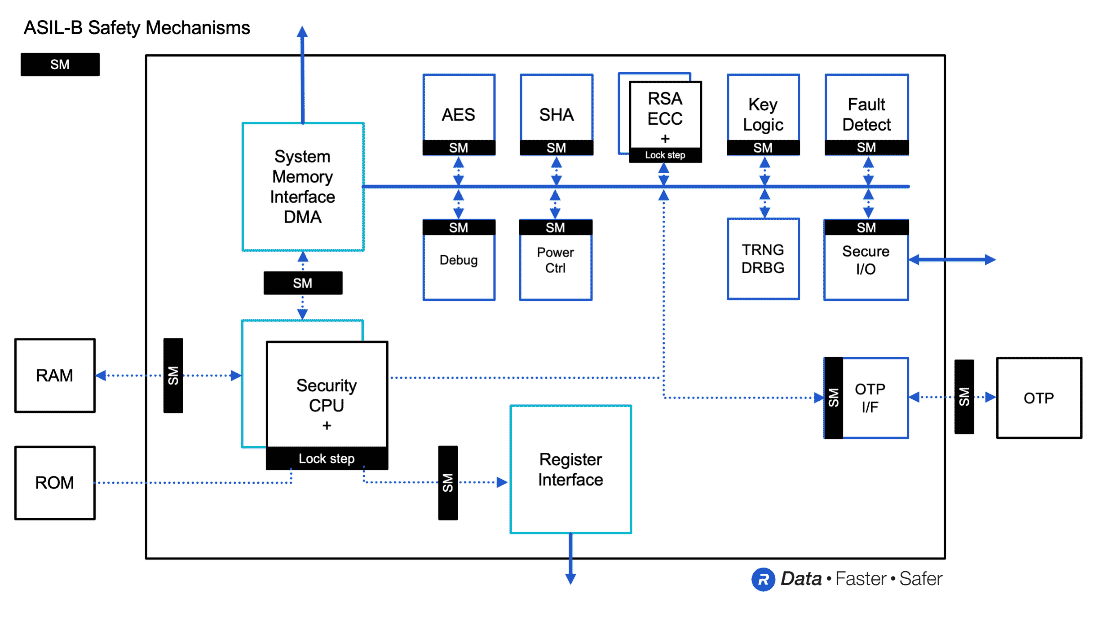
Integrated into an automotive SoC, the ASIL B certified RT-640 silicon IP design provides powerful cryptographic functions, state-of-the-art safety mechanisms and anti-tamper technologies to protect critical automotive electronics and data. This robust cybersecurity solution has been certified by TÜV-SGS 26262 ASIL-B functional safety. The ASIL-B certificate guarantees that all safety mechanisms are implemented and verified correctly, meet and exceed the required safety integrity levels and are supported with the ISO 26262 required evidence.
The certified RT-640 Embedded HSM key features include:
- Fully programmable, purpose-built security processor with hardware enforced security and privilege levels
- High-performance cryptographic accelerators for RSA, ECC, AES, HMAC and SHA-2
- NIST SP 800-90 compliant random bit generator
- Hardware enforced security with state-of-the-art protection from side channel and tampering attacks
- ASIL-B safety mechanisms in the HW and SW implementation
More Information:
For more information on the Rambus RT-640 Embedded HSM, please visit https://www.rambus.com/security/root-of-trust/rt-640/.
Navigating the Intersection of Safety and Security
Vehicle systems and the semiconductors used within them are some of the most complex electronics seen today. In the past, electronics going into vehicle systems implemented flat architectures with isolated functions controlling various components of the power train and vehicle dynamics. However, to support the realization of Level 4 and Level 5 (L4/L5) autonomous driving, a massive restructure is underway. The software-defined vehicle, the automotive Ethernet, vehicle-to-everything (V2X) connectivity, and domain controller units are just some of the new technologies required to realize L4/L5 capabilities. Ensuring all these new systems are both functionally safe and secure from cyberattacks is mission critical.