
When Jann Horn of Google’s Project Zero posted a detailed blog titled “Reading privileged memory with a side-channel,” it set off a firestorm of activity as the post confirmed that secret information inside a computer could be accessed via two different attacks, Meltdown and Spectre. Essentially, both attacks utilize CPU data cache timing to efficiently exploit and leak information from the system. This could lead to – at worst – arbitrary virtual memory read vulnerabilities across local security boundaries in various contexts.
Papers
Full Disk Encryption of Solid State Drives and Root of Trust
File encryption, file system encryption and full disk encryption (FDE) are methods offered by the industry to allow users to protect their data stored on non-volatile storage devices, such as Solid State Disks (SSD). The main feature of FDE is to protect stored system and user date from unauthorized reading, writing, alteration, moving or rolling back. However, extended security features are key to securing FDE implementation.
Architecting a Hardware-Managed Hybrid DIMM Optimized for Cost/Performance
Rapidly evolving workloads and exploding data volumes place great pressure on data-center compute, IO, and memory performance, and especially on memory capacity. Increasing memory capacity requires a commensurate reduction in memory cost per bit. DRAM technology scaling has been steadily delivering affordable capacity increases, but DRAM scaling is rapidly reaching physical limits. Other technologies such as Flash, enhanced Flash, Phase Change Memory, and Spin Torque Transfer Magnetic RAM hold promise for creating high capacity memories at lower cost per bit. However, these technologies have attributes that require careful management.
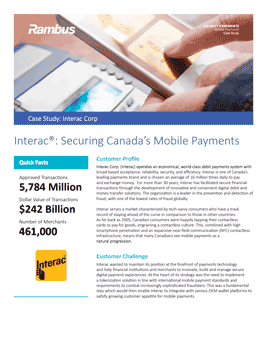
Interac: Securing Canada’s Mobile Payments
The Rising Need for Satellite Security
Satellites today contain highly complex embedded microelectronics systems complete with processing, data storage, and data receiving/transmitting capabilities. Further, they are controlled by ground stations, computers in data centers. They are therefore susceptible to threats prevalent in cloud computing architectures including insider threats, malicious downloads, etc. As such, satellite security must include access control to grant access to system resources only to authorized users, authentication
to verify the identity of a user or device, Availability to assure that a system will be usable when it needs to be, confidentiality to ensure that data is disclosed only to authorized systems or users, data integrity to ensure that data transmitted from a source is not modified, altered, or destroyed, and accountability to ensure that the system actions are logged with the identity of the entity initiating the action and the data and time the action occurred. Rambus security products, deployed in satellites and ground based equipment, are well suited to solve key security problems in each of these required areas of security functionality.
Securing the Connected Ecosystem: Leading Security Solutions and Approaches for IoT
In this Frost & Sullivan analysis, the report describes key requirements in the Internet of Things (IoT) security market and presents details of how Rambus addresses these needs through effective, economical and easy-to-deploy IoT security solutions.