
Thanks to rapid advancements in computing, neural networks are fueling tremendous growth in AI for a broad spectrum of applications. Learn about the memory architectures, and their relative advantages, at the heart of the AI revolution.
Understanding Side-channel Attacks, Their Implications, and How to Test a System’s Resistance
Side-channel attacks are low cost, non-invasive, and can completely subvert an electronic system’s security. Watch this webinar to learn more about the nature of side channel attacks and how testing can reveal a system’s ability to handle this threat.
Rambus Reports Second Quarter 2019 Financial Results
- Second quarter revenue and billings in line with expectations; GAAP revenue of $58.3 million, with royalty revenue of $27.1 million and licensing billings of $64.9 million
- $38.7 million in cash provided by operating activities
- Executing on our strategic semiconductor portfolio refocus with agreement to sell Payments and Ticketing business to Visa, and agreement to acquire digital controller IP provider, Northwest Logic
- Record quarterly revenue for both IP Cores and Server DIMM Chipset businesses
SUNNYVALE, Calif. – July 29, 2019 – Rambus Inc. (NASDAQ:RMBS) today reported financial results for the second quarter ended June 30, 2019. Total revenue for the second quarter was in line with expectations at $58.3 million, with royalty revenue of $27.1 million and licensing billings of $64.9 million. The company also generated $38.7 million in cash provided by operating activities.
“Rambus made great progress toward our strategic vision to refocus on our core strengths in semiconductor, optimize for operational efficiency, and reinvest for growth,” said Luc Seraphin, chief executive officer of Rambus. “Propelled by strong operational execution and gains in market share, we delivered a solid second quarter.”
Business Review
Rambus took several significant steps in support of our strategic vision this quarter. The first was an agreement to sell our Payments and Ticketing business to Visa, simplifying our portfolio and redefining our perimeter to focus on the semiconductor market. Following that, we announced an agreement to acquire Northwest Logic to augment our interface IP offerings with best-in-class digital controllers, amplifying our market and technology position through new investments in our core focus area. In addition to these strategic steps, Rambus business units continued to deliver organic growth with overall product revenue for server DIMM chips and silicon IP, including IP Cores and Cryptography, increasing quarter over quarter.
Revenue was up significantly for our Server DIMM Chipset business, despite declines in the overall memory market, and the business is on track for 50% growth on the year as a whole. This growth continues to be driven by increased OEM and data center qualifications, leading to steady gains in our DDR4 buffer chip market share. In addition to the gains in DDR4, we remain well positioned as the first-mover for next-generation DDR5 server DIMM chips, shipping samples at the top-end speeds for both the RCD and DB chips.
Our high-speed IP Cores business delivered record revenue for the second consecutive quarter and remains on a trajectory of approximately 50% compounded annual growth rate. We announced the addition of our 112G SerDes PHY for 400G and 800G networking, a GDDR6 win at Achronix and continue to close new Tier 1 SoC design wins for data center, networking and artificial intelligence. In line with our strategy of investing in our focus areas, we have signed an agreement to acquire the digital controller company, Northwest Logic, and will be integrating their offerings and design team into our IP Cores business. As a market leader in memory, PCIe and MIPI digital controllers, Northwest Logic will expand our solutions by creating a complementary product portfolio of PHYs and controllers for data center, AI, communications and automotive.
The Cryptography business is delivering on an application-driven product roadmap with the launch of the expanded family of CryptoManager Root of Trust secure processor cores. The family now includes a comprehensive suite of configurations, tailored for artificial intelligence, data center, automotive and government, making the cores readily available to the market and easy to integrate for our customers. Focused on creating the most resilient and deployable embedded security on market, our simplified go-to-market strategy to deliver secure silicon IP and provisioning solutions to our customers is gaining traction with our first security win in artificial intelligence (AI) at a leading provider of AI accelerators.
| Quarterly Financial Review – GAAP |
Three Months Ended |
||||||
| (In millions, except for percentages and per share amounts) | 2019 | 2018 | |||||
| Revenue | |||||||
| Royalties | $ | 27.1 | $ | 30.1 | |||
| Product revenue | 16.0 | 8.1 | |||||
| Contract and other revenue | 15.2 | 18.3 | |||||
| Total revenue | $ | 58.3 | $ | 56.5 | |||
| Total operating costs and expenses | $ | 95.3 | $ | 76.4 | |||
| Operating loss | $ | (37.0) | $ | (19.9) | |||
| Operating margin | (64)% | (35)% | |||||
| Net loss | $ | (37.0) | $ | (15.4) | |||
| Diluted net loss per share | $ | (0.33) | $ | (0.14) | |||
| Licensing billings (1) | $ | 64.9 | $ | 73.2 | |||
| Net cash provided by operating activities | $ | 38.7 | $ | 3.6 | |||
(1) Licensing billings is an operational metric that reflects amounts invoiced to our licensing customers during the period, as adjusted for certain differences.
| Quarterly Financial Review – Non-GAAP (1) |
Three Months Ended |
||||||
| (In millions, except for percentages and per share amounts) | 2019 | 2018 | |||||
| Revenue | |||||||
| Royalties | $ | 27.1 | $ | 30.1 | |||
| Product revenue | 16.0 | 8.1 | |||||
| Contract and other revenue | 15.2 | 18.3 | |||||
| Total revenue | $ | 58.3 | $ | 56.5 | |||
| Total operating costs and expenses | $ | 64.1 | $ | 66.8 | |||
| Operating loss | $ | (5.8) | $ | (10.3) | |||
| Operating margin | (10)% | (18)% | |||||
| Net income (loss) | $ | 0.2 | $ | (3.1) | |||
| Diluted net income (loss) per share | $ | 0.00 | $ | (0.03) | |||
(1) See “Supplemental Reconciliation of GAAP to Non-GAAP Results” and “Reconciliation of Other GAAP to Non-GAAP Items” tables included below. Note that the applicable non-GAAP measures are presented and that revenue is solely presented on a GAAP basis.
Revenue for the quarter was $58.3 million, with royalty revenue of $27.1 million and licensing billings of $64.9 million, in line with expectations. We had GAAP total operating costs and expenses of $95.3 million, above the high end of our expectations, primarily related to charges associated with our agreement to sell our payments and ticketing business. We also had non-GAAP total operating costs and expenses of $64.1 million, below our expectations due to our cost containment actions. We had GAAP and non-GAAP diluted net income (loss) per share of ($0.33) and $0.00, respectively. Our basic share count was 110.9 million shares and our diluted share count would have been 112.5 million shares.
Cash, cash equivalents, and marketable securities as of June 30, 2019 were $337.7 million, an increase of $31.8 million from March 31, 2019, mainly due to $38.7 million in cash provided by operating activities. Cash provided by operating activities for the six months ended June 30, 2019 was $67.5 million, an increase of $47.1 million from the same period in the prior year.
2019 Third Quarter Outlook
The Company will discuss revenue guidance for the third quarter of 2019 during its upcoming conference call. The following table sets forth third quarter outlook for other measures, and excludes our Payments and Ticketing business.
| (In millions) | GAAP | Non-GAAP (1) | |
| Total operating costs and expenses | $70 – $66 | $58 – $54 | |
| Interest and other income (expense), net | $4 | $1 | |
| Diluted share count | 113 | 113 |
(1) See “Reconciliation of GAAP Forward Looking Estimates to Non-GAAP Forward Looking Estimates” tables included below.
For the third quarter of 2019, the Company expects operating costs and expenses to be between $70 million and $66 million. Additionally, the Company expects non-GAAP operating costs and expenses to be between $58 million and $54 million. These expectations also assume non-GAAP interest and other income (expense), net, of $1 million, tax rate of 24% (refer to non-GAAP financial information below – income tax adjustments) and diluted share count of 113 million, and exclude stock-based compensation expense ($7 million), amortization expense ($5 million), non-cash interest expense on convertible notes ($2 million) and interest income related to the significant financing component from fixed-fee patent and technology licensing arrangements ($5 million).
Conference Call:
Rambus management will discuss the results of the quarter during a conference call scheduled for 2:00pm PT today. The call, audio and slides will be available online at investor.rambus.com and a replay will be available for the next week at the following numbers: (855) 859-2056 (domestic) or (404) 537-3406 (international) with ID# 3471916.
Non-GAAP Financial Information:
In the commentary set forth above and in the financial statements included in this earnings release, the Company presents the following non-GAAP financial measures: operating costs and expenses, operating margin, operating income (loss), net income (loss), and diluted net income (loss) per share. In computing each of these non-GAAP financial measures, the following items were considered as discussed below: stock-based compensation expenses, acquisition-related costs and retention bonus expense, amortization expenses, impairment of assets held for sale, non-cash interest expense and certain other one-time adjustments. The non-GAAP financial measures disclosed by the Company should not be considered a substitute for, or superior to, financial measures calculated in accordance with GAAP, and the financial results calculated in accordance with GAAP and reconciliations from these results should be carefully evaluated. Management believes the non-GAAP financial measures are appropriate for both its own assessment of, and to show investors, how the Company’s performance compares to other periods. The non-GAAP financial measures used by the Company may be calculated differently from, and therefore may not be comparable to, similarly titled measures used by other companies. Reconciliation from GAAP to non-GAAP results is included in the financial statements contained in this release.
The Company’s non-GAAP financial measures reflect adjustments based on the following items:
Stock-based compensation expense. These expenses primarily relate to employee stock options, employee stock purchase plans, and employee non-vested equity stock and non-vested stock units. The Company excludes stock-based compensation expense from its non-GAAP measures primarily because such expenses are non-cash expenses that the Company does not believe are reflective of ongoing operating results. Additionally, given the fact that other companies may grant different amounts and types of equity awards and may use different option valuation assumptions, excluding stock-based compensation expense permits more accurate comparisons of the Company’s results with peer companies.
Acquisition-related costs and retention bonus expense. These expenses include all direct costs of certain acquisitions and the current periods’ portion of any retention bonus expense associated with the acquisitions. The Company excludes these expenses in order to provide better comparability between periods as they are related to acquisitions and have no direct correlation to the Company’s operations.
Restructuring charges. These charges may consist of severance, contractual retention payments, exit costs and other charges and are excluded because such charges are not directly related to ongoing business results and do not reflect expected future operating expenses.
Impairment of assets held for sale. These charges consist of non-cash charges to assets held for sale and are excluded because such charges are non-recurring and do not reduce the Company’s liquidity.
Amortization expense. The Company incurs expenses for the amortization of intangible assets acquired in acquisitions. The Company excludes these items because these expenses are not reflective of ongoing operating results in the period incurred. These amounts arise from the Company’s prior acquisitions and have no direct correlation to the operation of the Company’s core business.
Non-cash interest expense on convertible notes. The Company incurs non-cash interest expense related to its convertible notes. The Company excludes non-cash interest expense related to its convertible notes to provide more accurate comparisons of the Company’s results with other peer companies and to more accurately reflect the Company’s ongoing operations.
Income tax adjustments. For purposes of internal forecasting, planning and analyzing future periods that assume net income from operations, the Company estimates a fixed, long-term projected tax rate of approximately 24 percent for both 2019 and 2018, which consists of estimated U.S. federal and state tax rates, and excludes tax rates associated with certain items such as withholding tax, tax credits, deferred tax asset valuation allowance and the release of any deferred tax asset valuation allowance. Accordingly, the Company has applied these tax rates to its non-GAAP financial results for all periods in the relevant years to assist the Company’s planning. The Company has provided below a reconciliation of its GAAP provision for income taxes and GAAP effective tax rate to the assumed non-GAAP provision for income taxes and non-GAAP effective tax rate.
Escrow settlement refund. The Company received a refund from an escrow settlement related to a prior acquisition. The Company excludes these items because these receipts are not reflective of ongoing operating results. These amounts arise from the Company’s prior acquisitions and have no direct correlation to the operation of the Company’s core business.
On occasion in the future, there may be other items, such as significant gains or losses from contingencies that the Company may exclude in deriving its non-GAAP financial measures if it believes that doing so is consistent with the goal of providing useful information to investors and management.
Forward-Looking Statements
This release contains forward-looking statements under the Private Securities Litigation Reform Act of 1995, including those relating to Rambus’ expectations regarding product and service offerings, the expected benefits of our merger, acquisition and divestiture activity, future profit and growth, and financial guidance for the third quarter of 2019, including operating costs and expenses, and estimated, fixed, long-term projected tax rates, both on a GAAP and non-GAAP basis as appropriate. Such forward-looking statements are based on current expectations, estimates and projections, management’s beliefs and certain assumptions made by Rambus’ management. Actual results may differ materially. Rambus’ business generally is subject to a number of risks which are described more fully in Rambus’ periodic reports filed with the Securities and Exchange Commission. Rambus undertakes no obligation to update forward-looking statements to reflect events or circumstances after the date hereof.
Rambus Inc.
Condensed Consolidated Balance Sheets
(In thousands)
(Unaudited)
| June 30, 2019 |
December 31, 2018 |
||||||
| ASSETS | |||||||
| Current assets: | |||||||
| Cash and cash equivalents | $ | 114,186 | $ | 115,924 | |||
| Marketable securities | 223,532 | 161,840 | |||||
| Accounts receivable | 28,225 | 50,863 | |||||
| Unbilled receivables | 177,897 | 176,613 | |||||
| Inventories | 9,326 | 6,772 | |||||
| Assets held for sale | 78,388 | — | |||||
| Prepaids and other current assets | 9,350 | 15,738 | |||||
| Total current assets | 640,904 | 527,750 | |||||
| Intangible assets, net | 29,748 | 59,936 | |||||
| Goodwill | 153,144 | 207,178 | |||||
| Property, plant and equipment, net | 41,590 | 57,028 | |||||
| Operating lease right-of-use assets | 16,081 | — | |||||
| Deferred tax assets | 4,399 | 4,435 | |||||
| Unbilled receivables, long-term | 419,532 | 497,003 | |||||
| Other assets | 6,763 | 7,825 | |||||
| Total assets | $ | 1,312,161 | $ | 1,361,155 | |||
| LIABILITIES & STOCKHOLDERS’ EQUITY | |||||||
| Current liabilities: | |||||||
| Accounts payable | $ | 7,794 | $ | 7,392 | |||
| Accrued salaries and benefits | 13,966 | 16,938 | |||||
| Deferred revenue | 6,448 | 19,374 | |||||
| Income taxes payable, short-term | 17,461 | 16,390 | |||||
| Operating lease liabilities | 8,381 | — | |||||
| Liabilities held for sale | 13,706 | — | |||||
| Other current liabilities | 16,668 | 9,191 | |||||
| Total current liabilities | 84,424 | 69,285 | |||||
| Long-term liabilities: | |||||||
| Convertible notes, long-term | 145,314 | 141,934 | |||||
| Long-term imputed financing obligation | — | 36,297 | |||||
| Long-term operating lease liabilities | 9,548 | — | |||||
| Long-term income taxes payable | 69,359 | 77,280 | |||||
| Other long-term liabilities | 30,290 | 24,247 | |||||
| Total long-term liabilities | 254,511 | 279,758 | |||||
| Total stockholders’ equity | 973,226 | 1,012,112 | |||||
| Total liabilities and stockholders’ equity | $ | 1,312,161 | $ | 1,361,155 | |||
Rambus Inc.
Condensed Consolidated Statements of Operations
(In thousands, except per share amounts)
(Unaudited)
|
Three Months Ended |
Six Months Ended |
||||||||||||||
| 2019 | 2018 | 2019 | 2018 | ||||||||||||
| Revenue: | |||||||||||||||
| Royalties | $ | 27,050 | $ | 30,049 | $ | 51,903 | $ | 51,423 | |||||||
| Product revenue | 16,031 | 8,087 | 24,995 | 15,400 | |||||||||||
| Contract and other revenue | 15,216 | 18,322 | 29,783 | 36,061 | |||||||||||
| Total revenue | 58,297 | 56,458 | 106,681 | 102,884 | |||||||||||
| Operating costs and expenses: | |||||||||||||||
| Cost of product revenue (1) | 6,310 | 4,199 | 10,737 | 8,556 | |||||||||||
| Cost of contract and other revenue | 6,717 | 11,089 | 13,488 | 23,211 | |||||||||||
| Research and development (1) | 37,890 | 37,696 | 78,509 | 77,813 | |||||||||||
| Sales, general and administrative (1) | 24,908 | 24,483 | 52,553 | 54,681 | |||||||||||
| Restructuring charges (recoveries) | 2,528 | (1,022) | 2,859 | 2,223 | |||||||||||
| Impairment of assets held for sale | 16,990 | — | 16,990 | — | |||||||||||
| Total operating costs and expenses | 95,343 | 76,445 | 175,136 | 166,484 | |||||||||||
| Operating loss | (37,046) | (19,987) | (68,455) | (63,600) | |||||||||||
| Interest income and other income (expense), net | 6,972 | 8,249 | 14,385 | 17,365 | |||||||||||
| Interest expense | (2,534) | (4,634) | (4,805) | (9,055) | |||||||||||
| Interest and other income (expense), net | 4,438 | 3,615 | 9,580 | 8,310 | |||||||||||
| Loss before income taxes | (32,608) | (16,372) | (58,875) | (55,290) | |||||||||||
| Provision for (benefit from) income taxes | 4,372 | (1,015) | 4,681 | (4,244) | |||||||||||
| Net loss | $ | (36,980) | $ | (15,357) | $ | (63,556) | $ | (51,046) | |||||||
| Net loss per share: | |||||||||||||||
| Basic | $ | (0.33) | $ | (0.14) | $ | (0.58) | $ | (0.47) | |||||||
| Diluted | $ | (0.33) | $ | (0.14) | $ | (0.58) | $ | (0.47) | |||||||
| Weighted average shares used in per share calculation | |||||||||||||||
| Basic | 110,875 | 107,737 | 110,287 | 108,542 | |||||||||||
| Diluted | 110,875 | 107,737 | 110,287 | 108,542 | |||||||||||
_________
(1) Total stock-based compensation expense for the three and six months ended June 30, 2019 and 2018 is presented as follows:
| Three Months Ended June 30, |
Six Months Ended June 30, |
|||||||||||||||
| 2019 | 2018 | 2019 | 2018 | |||||||||||||
| Cost of product revenue | $ | 1 | $ | 2 | $ | 2 | $ | 5 | ||||||||
| Research and development | $ | 3,058 | $ | 3,286 | $ | 6,268 | $ | 6,478 | ||||||||
| Sales, general and administrative | $ | 4,021 | $ | (1,400) | $ | 7,999 | $ | 2,919 | ||||||||
Rambus Inc.
Supplemental Reconciliation of GAAP to Non-GAAP Results
(In thousands)
(Unaudited)
|
Three Months Ended |
|||||||
| 2019 | 2018 | ||||||
| Operating costs and expenses | $ | 95,343 | $ | 76,445 | |||
| Adjustments: | |||||||
| Stock-based compensation expense | (7,080) | (1,888) | |||||
| Acquisition-related costs and retention bonus expense | — | (30) | |||||
| Amortization expense | (4,921) | (8,738) | |||||
| Restructuring charges (recoveries) | (2,528) | 1,022 | |||||
| Impairment of assets held for sale | (16,990) | — | |||||
| Escrow settlement refund | 296 | — | |||||
| Non-GAAP operating costs and expenses | $ | 64,120 | $ | 66,811 | |||
| Operating loss | $ | (37,046) | $ | (19,987) | |||
| Adjustments: | |||||||
| Stock-based compensation expense | 7,080 | 1,888 | |||||
| Acquisition-related costs and retention bonus expense | — | 30 | |||||
| Amortization expense | 4,921 | 8,738 | |||||
| Restructuring charges (recoveries) | 2,528 | (1,022) | |||||
| Impairment of assets held for sale | 16,990 | — | |||||
| Escrow settlement refund | (296) | — | |||||
| Non-GAAP operating loss | $ | (5,823) | $ | (10,353) | |||
| Loss before income taxes | $ | (32,608) | $ | (16,372) | |||
| Adjustments: | |||||||
| Stock-based compensation expense | 7,080 | 1,888 | |||||
| Acquisition-related costs and retention bonus expense | — | 30 | |||||
| Amortization expense | 4,921 | 8,738 | |||||
| Restructuring charges (recoveries) | 2,528 | (1,022) | |||||
| Impairment of assets held for sale | 16,990 | — | |||||
| Escrow settlement refund | (296) | — | |||||
| Non-cash interest expense on convertible notes | 1,702 | 2,717 | |||||
| Non-GAAP income (loss) before income taxes | $ | 317 | $ | (4,021) | |||
| GAAP provision for (benefit from) income taxes | 4,372 | (1,015) | |||||
| Adjustment to GAAP provision for (benefit from) income taxes | (4,296) | 50 | |||||
| Non-GAAP provision for (benefit from) income taxes | 76 | (965) | |||||
| Non-GAAP net income (loss) | $ | 241 | $ | (3,056) | |||
| Non-GAAP basic net income (loss) per share | $ | 0.00 | $ | (0.03) | |||
| Non-GAAP diluted net income (loss) per share | $ | 0.00 | $ | (0.03) | |||
| Weighted average shares used in non-GAAP per share calculation: | |||||||
| Basic | 110,875 | 107,737 | |||||
| Diluted | 112,522 | 107,737 | |||||
Supplemental Reconciliation of GAAP to Non-GAAP Effective Tax Rate (1)
|
Three Months Ended |
|||||
| 2019 | 2018 | ||||
| GAAP effective tax rate | (13)% | 6% | |||
| Adjustment to GAAP effective tax rate | 37% | 18% | |||
| Non-GAAP effective tax rate | 24% | 24% | |||
- For purposes of internal forecasting, planning and analyzing future periods that assume net income from operations, the Company estimates a fixed, long-term projected tax rate of approximately 24 percent for both 2019 and 2018, which consists of estimated U.S. federal and state tax rates, and excludes tax rates associated with certain items such as withholding tax, tax credits, deferred tax asset valuation allowance and the release of any deferred tax asset valuation allowance. Accordingly, the Company has applied these tax rates to its non-GAAP financial results for all periods in the relevant year to assist the Company’s planning for future periods.
Rambus Inc.
Reconciliation of Other GAAP to Non-GAAP Items
(In thousands, except percentages)
(Unaudited)
| GAAP | Non-GAAP | ||||||||||||||
| Three Months Ended June 30, |
Three Months Ended June 30, |
||||||||||||||
| 2019 | 2018 | 2019 | 2018 | ||||||||||||
| Revenue (i) | $ | 58,297 | $ | 56,458 | $ | 58,297 | $ | 56,458 | |||||||
| Operating loss (ii) | (37,046) | (19,987) | (5,823) | (10,353) | |||||||||||
| Operating margin (ii/i) | (64)% | (35)% | (10)% | (18)% | |||||||||||
Rambus Inc.
Reconciliation of GAAP Forward Looking Estimates to Non-GAAP Forward Looking Estimates
(In millions)
(Unaudited)
| 2019 Third Quarter Outlook |
Three Months Ended |
||||||
| Low | High | ||||||
| Forward-looking operating costs and expenses | $ | 69.8 | $ | 65.8 | |||
| Adjustments: | |||||||
| Stock-based compensation expense | (7.1) | (7.1) | |||||
| Amortization expense | (4.9) | (4.9) | |||||
| Forward-looking Non-GAAP operating costs and expenses | $ | 57.8 | $ | 53.8 | |||
| Forward-looking interest and other income (expense), net | $ | 4.4 | $ | 4.4 | |||
| Adjustments: | |||||||
| Interest income related to significant financing component from fixed-fee patent and technology licensing arrangements | (5.3) | (5.3) | |||||
| Non-cash interest expense on convertible notes | 1.7 | 1.7 | |||||
| Forward-looking Non-GAAP interest and other income (expense), net | $ | 0.8 | $ | 0.8 | |||
Rambus to Acquire Northwest Logic, Extending Leadership in Interface IP
Highlights:
- Complementary product portfolio of PHYs and controllers further accelerates Rambus growth
- Expands solutions for data center, artificial intelligence (AI), machine learning (ML), communications and automotive applications
- Combined offerings, including HBM2, GDDR6, DDR4 and PCI Express (PCIe), create one-stop-shop for SoC designers
SUNNYVALE, Calif. and HILLSBORO, Ore. – July 29, 2019 – Rambus Inc. (NASDAQ: RMBS), a premier silicon IP and chip provider making data faster and safer, today announced it has signed a definitive agreement to acquire Northwest Logic, a market leader in memory, PCIe and MIPI digital controllers. Northwest Logic’s high-performance, high-quality and silicon-proven digital IP controller cores are optimized for use in both ASICs and FPGAs. Interface IP solutions consisting of a physical interface (PHY) and companion digital controller make it possible to optimize the transfer of data between chips and electronic devices. Every SoC design that uses a Memory or a PCIe or a MIPI PHY also needs to use a controller associated with it. The combination of complementary digital and physical IP portfolios from Northwest Logic and Rambus will create a one-stop-shop for customers.
“With this acquisition, we expand our leading product portfolio for high-performance markets such as data center, networking, artificial intelligence, machine learning and automotive,” said Hemant Dhulla, vice president and general manager of IP Cores at Rambus. “Northwest Logic’s innovative, best-in-class digital controllers complement Rambus’ proven strength in high-speed physical IP cores. Together, we will offer one of the most comprehensive high-performance interface IP solutions in the industry, leveraging our core strength in semiconductors, strong go-to-market advantage and global reach.”
Brian Daellenbach, president and CEO, Northwest Logic said: “Northwest Logic’s category-leading digital controllers fit perfectly with Rambus’ leadership portfolio of high-speed PHY solutions. This deal creates a one-stop-shop for SoC designers working on state-of-the-art applications across a broad range of high-performance markets. We look forward to continue serving our existing customers and working with our PHY partners.”
Critical to enabling the high performance of data center, networking, AI, ML and automotive applications, this acquisition will bring together the physical and digital IP core families from renowned market leaders to offer comprehensive memory and SerDes IP solutions for chip designers.
The transaction is expected to close in the current calendar quarter of 2019. Although this transaction will not materially impact 2019 results due to the expected timing of close and acquisition accounting, Rambus expects this acquisition to be accretive in 2020.
Forward-looking statements
Information set forth in this press release, including statements as to Rambus’ outlook and financial estimates and statements as to the expected timing, completion and effects of the proposed acquisition of Northwest Logic, constitute forward-looking statements within the meaning of the safe harbor provisions of the Private Securities Litigation Reform Act of 1995.
These statements are based on various assumptions and the current expectations of the management of Rambus and may not be accurate because of risks and uncertainties surrounding these assumptions and expectations. Factors listed below, as well as other factors, may cause actual results to differ significantly from these forward-looking statements. There is no guarantee that any of the events anticipated by these forward-looking statements will occur, or what effect they will have on the operations or financial condition of Rambus or Northwest Logic. Forward-looking statements included herein are made as of the date hereof, and Rambus undertakes no obligation to publicly update or revise any forward-looking statement unless required to do so by federal securities laws.
Major risks, uncertainties and assumptions include, but are not limited to: the expected benefits and costs of the transaction; management plans relating to the transaction; the expected timing of the completion of the transaction; the satisfaction of all closing conditions to the transaction; statements of the plans, strategies and objectives of Rambus for future operations; any statements regarding anticipated operational and financial results; any statements of expectation or belief; the risk that disruptions from the transaction will harm Rambus’ business; other factors described under “Risk Factors” in Rambus’ Annual Report on Form 10-K and Quarterly Reports on Form 10-Q; and any statements of assumptions underlying any of the foregoing. It is not possible to predict or identify all such factors. Consequently, while the list of factors presented here is considered representative, no such list should be considered to be a complete statement of all potential risks and uncertainties.
Hidden Signals: Memory and Interconnect Decisions for AI, IoT and 5G
Watch this webinar to learn about the components that move, accelerate, and store the data that enable the applications of the future including artificial intelligence (AI), Internet of Things (IoT) and 5G.
Rambus Expands Family of CryptoManager Root of Trust Secure Silicon IP Cores
Highlights:
- Offers tailored configurations addressing the security needs of Internet of things (IoT), artificial intelligence (AI), machine learning (ML), cloud, government, military and automotive applications
- Employs fully programmable hardware-level security co-processor with the ability to adapt to a dynamic threat environment
- Purpose-built, complete security solution offers ease of integration into SoC designs
- Features FIPS 140-2 ready crypto module and accelerators and DPA resistant crypto cores; designed for automotive-specific configuration ISO-26262-2018 ASIL-D
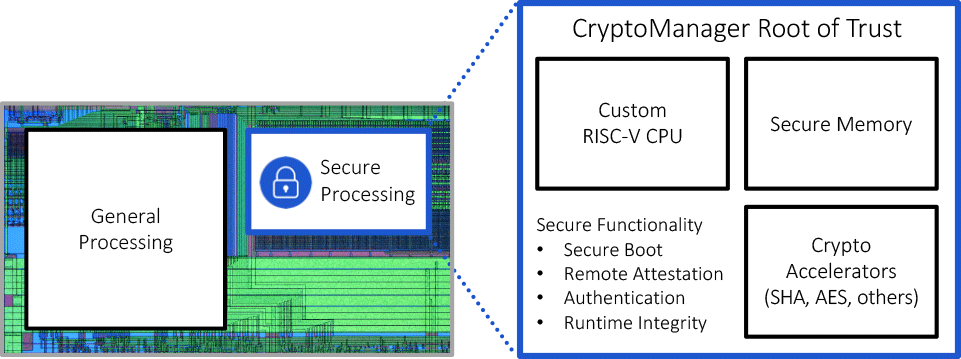
SUNNYVALE, Calif. – June 26, 2019 – Rambus Inc. (NASDAQ: RMBS) today announced the expansion of the CryptoManager Root of Trust family of products, a series of fully programmable, hardware-level secure silicon IP cores to address the security needs of applications including IoT, AI, ML, cloud, government, military and automotive. CryptoManager cores employ a siloed architecture. They isolate and secure sensitive code, processes, and algorithms from the main processor cores. This mitigates the risk of critical vulnerabilities like the Meltdown and Spectre security flaws. The CryptoManager Root of Trust is purpose-built for security — it features tailored configurations that allow chip designers to optimize main processors for high performance, while relying on the root of trust to perform security processes.
“Security is a mission critical imperative for SoC designs serving virtually every application space,” said Neeraj Paliwal, vice president of products, cryptography at Rambus. “The Rambus CryptoManager Root of Trust family offers tailored secure silicon IP solutions which chip architects can incorporate to meet the specific security needs of their designs.”
Offering a full array of security services, the CryptoManager Root of Trust enables secure boot and runtime integrity checking, remote authentication and attestation, and hardware acceleration for symmetric and asymmetric cryptographic algorithms. Featuring a layered security model, Federal Information Processing Standards (FIPS) 140-2 certified crypto accelerators, and multiple roots of trust to support independent privilege levels, the CryptoManager Root of Trust serves a wide range of applications.
The CryptoManager Root of Trust creates a foundation for Rambus’ comprehensive CryptoManager suite of solutions, including the CryptoManager Infrastructure for secure provisioning. For more information on the Rambus CryptoManager Root of Trust family of cores, visit rambus.com/security/cryptomanager-platform/root-of-trust/.
CryptoManager Root of Trust Technical Details
Within the product family, seven standard configurations address the specific security requirements and certification standards of different end markets. The RT-730 automotive design offers an ISO-26262-2018 ASIL-D-ready implementation, targeting vehicle-to-vehicle and vehicle-to-infrastructure (V2X), advanced driver-assistance systems (ADAS), and infotainment uses. For cloud, AI and ML accelerator chips, the RT-630 helps secure valuable training models, and training and inference data. For government-focused chip designs, the RT-650 offers a design that targets FIPS 140-2 Cryptographic Module Validation Program (CMVP) certification with Suite B accelerators. The RT-660 extends the functionality of RT-650 with the addition of Differential Power Analysis resistant cryptographic cores.
The CryptoManager Root of Trust family of products offers an end-to-end security implementation, comprised of a fully synthesizable IP core that anchors trust in silicon. It includes state-of-the-art crypto accelerators, security firewalls, an entropy source, secure key generation and derivation, secure one-time programmable (OTP) memory management, and a complete secure embedded firmware stack. The secure firmware stack offers secure boot for the root of trust as well as the SoC CPU(s), communicating securely with the SoC stack and running signed secure applications on the root of trust’s CPU. A reference SDK allows integrators to build secure boot, secure firmware updates and secure applications, with provided examples and references. Available evaluation boards and QEMU allow chip designers to easily evaluate the CryptoManager Root of Trust and secure applications.