800G Multi-Channel MACsec Engine with TDM Interface
Home > You searched for security > Page 97
The MACsec-IP-164 is a MACsec/IPsec engine developed specifically for high-speed, multi-rate and multi-port Ethernet devices. Its architecture provides an optimal multi-protocol solution for aggregate throughput ranging from 100G to 800G and beyond. The MACsec-IP-164 is ideal for deployment in data center, enterprise and carrier network applications, as well as network-attached high-performance computing.
Cloud computing and data center throughput requirements have driven Ethernet and OTN standards to 100G, 400G and now to 800G. These standards deploy multiple SerDes lanes with various rates, which require support for flexible bandwidth allocation for a varying number of channels (ports), depending on the target silicon.
 Contact
 Product Brief
All IEEE MACsec standards supported (including IEEE802.1AE-2018). Optional inclusion of Cisco extensions, IPsec ESP tunnel and transport mode with AES-GCM cipher
How the MACsec-IP-164 works
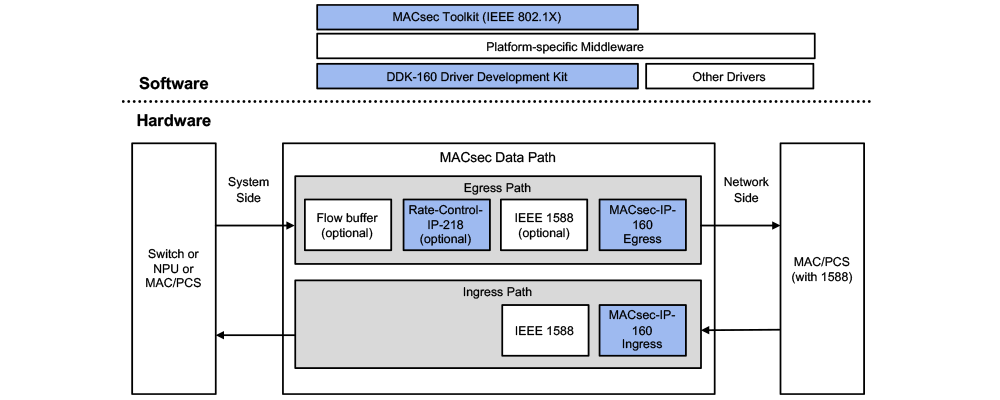
The MACsec-IP-164 engine provides complete MACsec SecY frame processing for multiple channels (port). It supports multiple SecY (virtual ports) to realize protection for each individual virtual network running over the same physical port. Its pooled classification and transformation resources allow optimal implementation of multi-port designs. The fat-pipe design allows aggregating multiple port to use the same MACsec SecY.
The MACsec-IP-164 engine provides a cost-effective option for line-rate IPsec ESP packet processing for transport and tunnel modes with AES-GCM cipher. A port can work in either MACsec or IPsec mode. In IPsec mode, at egress, it receives classification results from the system side. At ingress, it can match the decrypting SA. Like in MACsec, it supports pooled SA and classification resources. Implementation supports IPsec topologies with sharing the same group key.
The MACsec-IP-163 is a virtual port matching classifier that works with the MACsec- IP-164 to form an autonomous MACsec processing data path. Alternatively, the MACsec-IP-164 can be used in combination with an external classifier or stand alone, depending on the use case.
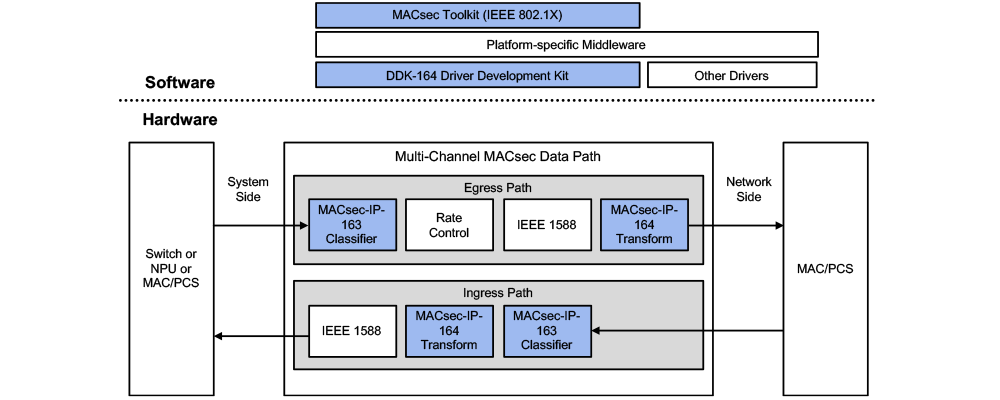
The MACsec-IP-164 engine is delivered together with a widely adopted Driver Development Kit (DDK-164). To build a system-level solution, Rambus offers the MACsec Toolkit product that implements a complete IEEE 802.1X specification and has multiple features that facilitate development and testing of the MACsec compliant processing.
The MACsec-164 engine has been used by leading silicon and system vendors over multiple generations thanks to the engine’s software compatibility and proven history of API scalability.
Ask the Experts: MACsec at Terabit Line Rates
In this episode of Ask the Experts, we chat with Maxim Demchenko about MACsec at Terabit Line Rates. Learn why MACsec was developed, how it has evolved from point-to-point layer 2 security, applications for MACsec, and the Rambus MACsec-IP-164.
MACsec Fundamentals
For end-to-end security of data, it must be secured both when at rest (stored on a connected device) and when in motion (communicated between connected devices). For data at rest, a hardware root of trust anchored in silicon provides that foundation upon which all device security is built. Similarly, MACsec security anchored in hardware at the foundational communication layer (Layer 2) provides that basis of trust for data in motion over Ethernet-based networks.
Solution Offerings
Packet Interface
- 800G in 7nm technology
- 400G/600G in 16nm technology
- 100G/200G in reduced area configurations
- Cut-through TDM interface
- Up to 64 channels (ports)
- Flexible bandwidth allocation
- FlexE ready
SA and Classification Scaling
- Pooled SA (from few to many K entries)
- TCAM internal/external
Control Interface
- AMBA APB3
- Interrupts (global and per-channel)
Default Protocol Support
- Full IEEE 802.1AE-2018 compliance
- IEEE 802.1AE
- IEEE 802.1AEbn
- IEEE 802.1AEbw
- IEEE 802.1AEcg
- MACsec with VLAN-in-clear
Optional Features
- Cisco MACsec extensions
- IPsec ESP with AEC-GCM
- Other customer classifications
NIST CAVP Compliance for FIPS 140-3 Validation
- Support for basic AES and AEC-GCM transformations
Packages
- Silicon IP
- Driver Development Kit
Complete Documentation
- Hardware integration guide
- Hardware and software reference manuals
- Programming guides
- IP-XACT Register description
Integration Support
- Complete verification test bench
- Comprehensive set of test vectors
- World-class support from MACsec experts
Secure Networking Basics: MACsec, IPsec, and SSL/TLS/DTLS
The MACsec, IPsec and SSL/TLS/DTLS protocols are the primary means of securing data in motion (communicated between connected devices). These protocols can be anchored in hardware or implemented in software as part of an end-to-end security architecture. This white paper provides fundamental information on each of these protocols including their interrelationships and use cases.