
Moor Insights & Strategy senior analyst John Fruehe says more focus should be placed on the “what” of the IoT rather than the “how.”
Search Results for: IoT
Why the IoT is all about data
Moor Insights & Strategy senior analyst John Fruehe says more focus should be placed on the “what” of the IoT rather than the “how.”
“All of the strategy and shiny objects in the world won’t help if the data isn’t accurate, secure and actionable,” Fruehe wrote in a recent Forbes article. “The data should always drive the strategy; the implementation tail should not be wagging the data dog. This strategy needs to start at the business level based on identifiable business needs and then filter down to the products.”
However, emphasizes Fruehe, data is only as accurate as the system, sensor and the ability to separate the signal from the noise. Plus, data must be securely collected, with integrity maintained as it moves throughout the system.
“Data is collected, brought through a gateway and then moved through a series of servers and applications before it finally comes to rest in the middle of the datacenter, where it can be analyzed and acted upon,” he said. “Each step along the way requires security and consistency to ensure data integrity is maintained.”
More specifically, says Fruehe, there is plenty of focus on security and maintaining systems within the datacenter – although data is often more vulnerable at the sensor/collector level or initial gateway.
“One cannot truly ensure the accuracy of the data unless it can be secured through the whole process,” he noted. “This is often a challenge as security embedded at the sensor level is often the most difficult to implement and maintain; especially, as in the case of vehicles, if the manufacturer loses physical custody of the product to the end user.”
In addition, says Fruehe, there is little point in capturing, structuring and processing data if it will just be filed away without action.
“IoT data should be used as a real-time feed to help hone decisions and accelerate action, driving agility in the company,” he added.
Indeed, Intel VP and General Manager Ron Kasabian recently described the extraction of meaningful information from raw data as a “key enabler” of the new digital service economy.
“In this new era, an organization’s competitive edge increasingly hinges on its ability to turn an avalanche of data into actionable insights that improve operations and guide the creation of essential new products and services,” he wrote in an official Intel blog post.
According to Kasabian, Big Data analytics isn’t limited to Web 2.0 businesses or high-tech powerhouses. Rather, the opportunity for pervasive analytics and insights spans virtually all industries—from healthcare to transportation, from banking to manufacturing.
“With powerful analytics solutions, physicians can diagnose illnesses faster and create personalized treatment plans,” Kasabian explained. “Retailers can better understand buying behaviors to stock up on the products people are most likely to need. Car manufacturers can use predictive failure analysis to make repairs proactively—before customers find themselves stuck on the side of the road.”
Interested in learning more about Big Data and the IoT? You can check out our article archive here.
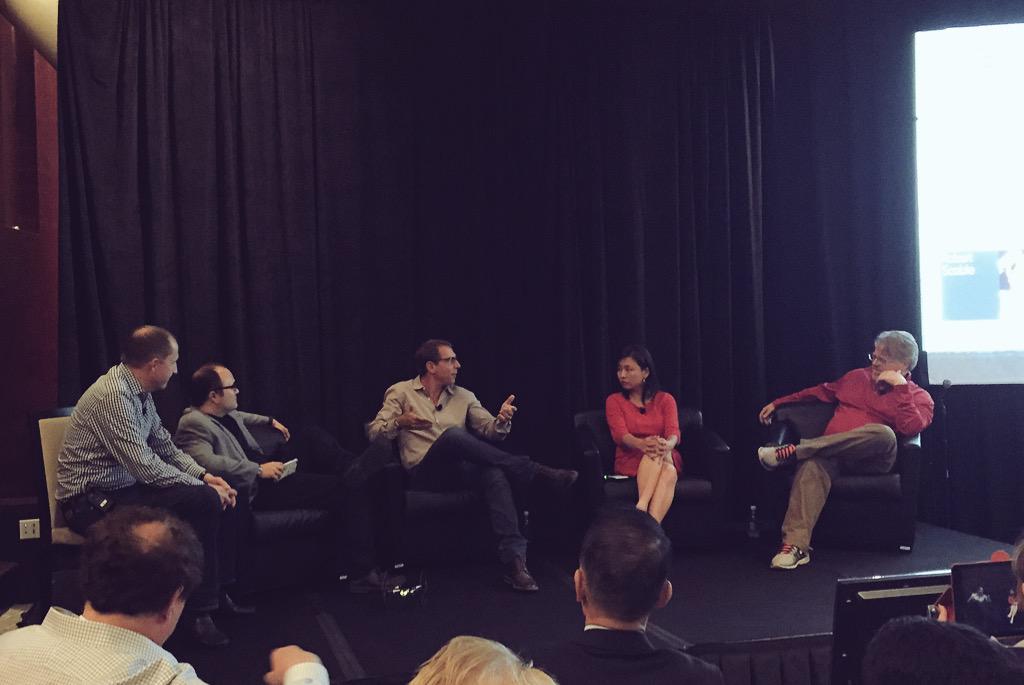
IoT postcards from the digital edge
Along with Robert Scoble and Ben Parr, Rambus CMO Jerome Nadel recently took part in a keynote discussion at the IoT Influencers Summit. The closing session – which also featured AKQA Chairman Tom Bedecarre and Edith Yeung of 500 Mobile Collective – explored how consumers will interact with their IoT devices and applications in a world where everything is connected.
According to Nadel, the IoT represents a natural evolution of distributed computing, with advanced sensors enabling a “smart” future characterized by ubiquitous connectivity (hardware) and apps (software) that are contextually aware.

Image Credit: Frederik Hermann (via Twitter)
“The mobile devices we are familiar with today, such as the smartphone, won’t necessarily be around in the future,” said Nadel. “One really has to question if we need to be forever tethered to a display-based handset. Perhaps we can – one day – get rid of the phone and create a virtual environment that provides a more immersive user experience.”
Smart nodes, says Nadel will be an integral part of enabling such a future.
“Installed throughout smart cities, these ubiquitous endpoints can be tasked with instantly diagnosing and correcting a wide variety of issues, including failing power grids, malfunctioning streetlights and even providing possible solutions for heavy traffic,” he explained.
“However, beyond the hardware, I think the true value of smart infrastructure will be driven by predictive analytics and software that extracts real meaning from the complex relationship between seemingly disparate Big Data sets. This will require a new approach to data centers and servers as demand for bandwidth and capacity continues to scale upwards.”
Perhaps most importantly, emphasizes Nadel, is how the IoT can potentially help the consumer master complex tech with a minimal amount of effort.
“Instagram is a perfect example,” he said. “Individuals without extensive Photoshop experience can take pictures, run them through a digital filter, easily add effects and send the images to friends and family.”
Robert Scoble expressed similar sentiments, noting that the consumer may never know what truly lies behind the term IoT. To highlight his point, Scoble brought up the example of Internet-connected vending machines.
“Maybe a consumer can use his or her watch to pay for a snack, but they won’t necessarily think of the vending machine as part of the Internet of Things,” he opined.
Scoble also discussed the ways in which sensors and Big Data were on track to revolutionize agriculture, as smart farms could very well boast up to 50 sensors per acre to help increase crop yields within a 10-year timeframe.
Weighing in on the future of the IoT, AKQA Chairman Tom Bedecarre agreed that the average consumer might not be aware of the IoT from a technical perspective. However, consumers will almost certainly use technology and devices connected to the Internet of Things. Like Nadel, Bedecarre also believes it will be critical for companies to extract real value from IoT-generated Big Data.
“Like so many other things, retail as we know it will be changed by the IoT, as the physical and digital worlds come together,” he added.
IoT postcards from the digital edge
Along with Robert Scoble and Ben Parr, Rambus CMO Jerome Nadel recently took part in a keynote discussion at the IoT Influencers Summit. The closing session – which also featured AKQA Chairman Tom Bedecarre and Edith Yeung of 500 Mobile Collective – explored how consumers will interact with their IoT devices and applications in a world where everything is connected.
Building the IoT with solar-powered smart sensors
As MIT’s Larry Hardesty notes, the rapidly evolving Internet of Things (IoT) is expected to boast extremely low-power sensors capable of running for months on a single charge using various energy harvesting techniques. Indeed, MIT researchers have designed a power converter chip designed to both power a device and charge a battery that’s more than 80 percent efficient, even at the extremely low and variable power levels characteristic of tiny solar cells. Previous iterations, says Hardesty, had efficiencies of only 40 or 50 percent.
Building the IoT with solar-powered smart sensors
As MIT’s Larry Hardesty notes, the rapidly evolving Internet of Things (IoT) is expected to boast extremely low-power sensors capable of running for months on a single charge using various energy harvesting techniques.
Indeed, MIT researchers have designed a power converter chip designed to both power a device and charge a battery that’s more than 80 percent efficient, even at the extremely low and variable power levels characteristic of tiny solar cells. Previous iterations, says Hardesty, had efficiencies of only 40 or 50 percent.
Image Credit: MIT
The new MIT chip also offers additional features, including the ability to directly charge both a battery and a device. All operations share a single inductor, effectively saving on circuit board space.
“We still want to have battery-charging capability, and we still want to provide a regulated output voltage,” explained Dina Reda El-Damak, an MIT graduate student in electrical engineering and computer science and first author on a new paper describing the chip. “We need to regulate the input to extract the maximum power, and we really want to do all these tasks with inductor sharing and see which operational mode is the best. And we want to do it without compromising the performance, at very limited input power levels – 10 nanowatts to 1 microwatt – for the Internet of Things.”
Brett Miwa, who leads a power conversion development project as a fellow at Maxim Integrated, says the current trend is to lower efficiency as the power drops due to a fixed amount of energy.
“[However, El-Damak’s] design is unusually efficient for how low a power level she’s at. One of the things that are most notable about it is that it’s really a fairly complete system. It’s really kind of a full system-on-a chip for power management,” said Miwa. “And that makes it a little more complicated, a little bit larger, and a little bit more comprehensive than some of the other designs that might be reported in the literature. So for her to still achieve these high-performance specs in a much more sophisticated system is also noteworthy.”
Commenting on this, Patrick Gill, a Principal Research Scientist at Rambus, noted that recent advances in energy harvesting technology would help accelerate the development and deployment of next-gen smart sensors.
“Many IoT devices will have a tiny sensor, a tiny battery, and be charged by a photovoltaic with intermittent access to light. El-Damak’s techniques nearly double the efficiency of photovoltaic power harvesting systems, and could make energy-harvesting more practical,” added Gill. “What’s particularly interesting is that as energy management innovations deliver increasing power, the energy needed for sensing, computation and wireless transmission continues to decrease. Since it’s the product of power available times power efficiency that dictates the capability of an autonomous sensing node, we can expect to see a quickly-expanding range of digital interactions in IoT widgets that do not need to be plugged in.”