Search Results for: cryptomedia
CryptoMedia Content Security Platform
Home > You searched for cryptomedia > Page 4
Security
CryptoMedia Content Security Platform

Designed to protect the delivery and storage high-value content, including 4K UHD and High Dynamic Range (HDR) programming, CryptoMedia Content Security Platform is a comprehensive suite of components that enables consumers to securely and easily access, stream, store, copy and share premium content across multiple devices.
| Solutions | Product Brief | Applications |
|---|---|---|
| Player Core | Digital Entertainment, Media Storage/Ownership | |

| Player Agent | Digital Entertainment, Media Storage/Ownership | |
| DPA Resistant Solutions | Digital Entertainment | |
| Content Protection Core | Digital Entertainment, Media Storage/Ownership | |
| Content Protection Services | Digital Entertainment, Media Storage/Ownership |
Superior Protection
Provides robust hardware root-of-trust for highest level of security and side channel attack resistance
Proven expertise and experience in secure key issuance and management
Supports MovieLabs ECP security requirements
Reduces Cost
Embedded cores reduce cost by eliminating the need for a smart card
Enables in-field subscription and service upgrades with no change in hardware
Broad ecosystem compatibility enables greater diversity of partners in deploying solutions
Improves time-to-market
Improves time-to-market with a comprehensive suite of ready-to-use components
Reduces development costs with integrated solutions
Simplifies certification with pre-validated IP
CryptoMedia Solutions
The CryptoMedia Security Platform provides comprehensive media protection solutions for storage, ownership, broadcast and streaming applications. Utilizing our expertise in embedded security systems hardware root of trust, side channel attack resistance, in-field key provisioning, and secure infrastructure, our suite of products enables dramatic cost savings, flexibility and ease of use while still providing robust security for protecting content. The CryptoMedia platform is designed to work with ecosystem partners, such as multimedia chipset manufacturers and DRM/CAS providers for flexibility in system design and implementation.Broadcast & Streaming
Storage & Ownership
Broadcast & Streaming
Storage & Ownership
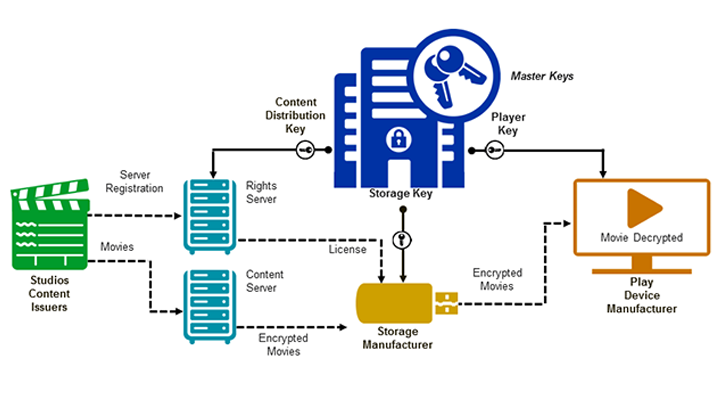
The CryptoMedia Security Platform is a complete content storage solution and includes a hardware root-of-trust, player software and trusted key provisioning services to meet the growing demand for high-quality digital movie watching experiences of 4K Ultra-high Definition (UHD) and High Dynamic Range (HDR) content. CryptoMedia solutions deliver a secure digital ownership experience for premium content across multiple devices, including smartphones, tablets, smartTVs and home storage devices.
- The Player Core that provides protection for stored media while still providing ease of use for the consumer in accessing their content through VIDITY-compliant player devices;
- The Player Agent that is available standalone or integrated with the Key Derivation Core for secure acquisition and playback of VIDITY content; and
- The Key Issuance Center (KIC) that provides keys to player and storage device manufacturers, as well as content providers in the VIDITY ecosystem.
- DPA Resistant Solutions, including cryptographic hardware cores and software libraries, that provide protection against side channel attacks
Smarter than a Smart Card
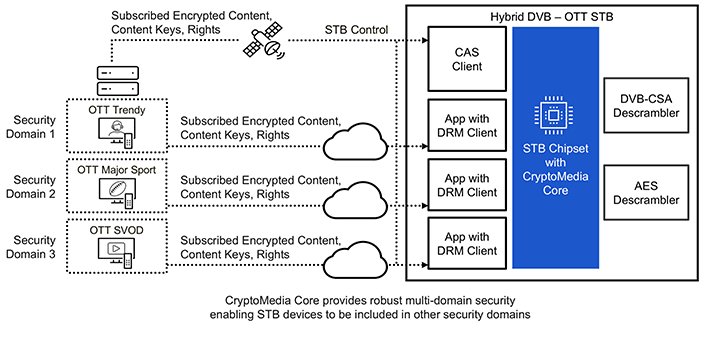
Set-top boxes (STBs) were initially secured by Conditional Access System (CAS) smart cards. However, this approach is no longer effective. Smart cards cannot prevent unauthorized access to premium 4K and UHD content, as they are not designed to protect the interface between the card and box, or the STB SoC itself. This is one of the reasons why cardless CAS set-top boxes, equipped with a hardware-based root-of-trust, are increasing in popularity amongst major operators. A hardware root-of-trust, provided by platforms such as Rambus’ CryptoMedia, offers operators robust security protection with an integrated security core that acts to effectively decrease potential attack vectors.Resources
Related Markets & Applications
CryptoMedia Content Protection Core Product Brief
Designed to meet the growing demand for secure content delivery to a range of devices, such as Set Top Boxes (STBs) and smart TVs, our CryptoMedia Content Protection Core provides Operators and over-the-top (OTT) services with robust protection combined with ability to save costs by replacing the smart card with a hardware root-of-trust embedded within the chipset. The core and associated services are compatible with a variety of conditional access systems (CAS) and digital rights management (DRM) providers to provide robust security against piracy while driving down design, operational and manufacturing costs.
Rambus Tech Days
Rambus Tech Days are three afternoons of deep dive technical presentations covering topics from MACsec to MIPI.
Join security and interface technology leaders from Rambus and its partners as they discuss the latest solutions for safeguarding and accelerating data in applications spanning AI/ML, data center, 5G, automotive/ADAS, IoT and government. Each presentation will be followed by a Q&A session where you can tap into our technologists’ knowledge base live. Presentation slides will be available for download during every session.
Featured Speakers
Justin Endo
Sales and Marketing Manager, Mixel
Frank Ferro
Sr. Director, Product Marketing, Rambus
Joe Gow
Sr. Director, Product Management, Rambus
Thierry Kouthon
Principal Engineer, Product Management, Rambus
Joe Rodriguez
Product Marketing Manager, Rambus
Alain Legault
VP IP Products, Hardent
Bart Stevens
Sr. Director of Product Management, Rambus
Gijs Willemse
Sr. Director of Product Management, Rambus
Schedule
Monday, April 19th, 2021
3:00pm – 4:00pm IDT – Securing Data Center AI/ML Workloads Beyond Secure Boot and Authentication
Speaker: Bart Stevens
With the rising value of AI/ML spanning training and inference models and data, as well as the AI hardware itself, the threats from adversaries are greater than ever. As such, a security strategy for AI/ML workloads and hardware needs to offer far more than secure boot and authentication. Rambus security expert, Bart Stevens will discuss how a hardware root of trust can be the foundation for AI/ML security through defense in depth, partitioning of secure operations, and state-of-the-art protections from side channel attacks. Incorporating a purpose-built secure co-processor, a hardware root of trust can offer a broad range of security services to safeguard AI/ML workloads and data.
4:00pm – 5:00pm IDT – Securing High-Speed Data in Motion Using MACSec and Encryption Cores
Speaker: Gijs Willemse
Providing Layer 2 security, MACsec is becoming the predominant solution for safeguarding network traffic. While network security is increasingly a de facto requirement, there is a growing trend of protecting the SoC interfaces as well, including short distance ones such as PCI Express (PCIe) and those to off-chip memory. In this webinar, Rambus security expert, Gijs Willemse, will discuss the design and implementation of hardware-based MACsec security and trends for high-performance inline encryption. Security IP solutions from 100 Gbps to 1 Tbps will be covered, including the 800 Gbps MACsec protocol engines.
Tuesday, April 20th, 2021
3:00pm – 4:00pm IDT – Securing Automotive Semiconductors in the New Centralized Car Architecture
Speaker: Thierry Kouthon
Modern automobiles contain between 50 and 100 Electronic Control Units (ECUs). Particularly with the increasing adoption of Advanced Driver Assistance Systems (ADAS), cars are data centers on wheels. Cybersecurity is an increasing imperative given widely publicized spectacular exploits and threats to both life and property. The automotive industry has identified Hardware Security Modules (HSM) embedded in ECUs as a viable and effective way to address automotive cybersecurity. Thierry Kouthon will discuss how ASIL-B/D and FIPS-certified root of trust solutions can be used to implement automotive HSMs.
4:00pm – 5:00pm IDT – Securing the Semiconductor Supply Chain with Silicon Provisioning and Cloud Key Management
Speaker: Joseph Gow
The semiconductor industry is the lifeblood of the digital economy. The design, manufacturing and consumption of semiconductors is a global ecosystem, and competition is fierce as scaling and cost reductions based on Moore’s law are diminishing. Counterfeit and other unauthorized chips create real risks in areas of reliability, functionality, performance, and safety. Joseph Gow will discuss how semiconductor companies can protect their IP and their business by securely provisioning silicon, and can provide the ecosystem-wide capabilities needed to verify the identity and provenance of semiconductor devices.
Wednesday, April 21, 2021
3:00pm – 4:00pm IDT – Selecting the Right High Bandwidth Memory
Speaker: Frank Ferro
An exponentially rising tide of data has led to the development of application-specific silicon to tackle the requirements of demanding workloads such as AI/ML training, Advanced Driver Assistance Systems (ADAS) for automotive, network graphics and HPC. To keep these processors and accelerators fed requires state-of-the-art memory solutions that deliver extremely high bandwidth. Frank Ferro will discuss design and implementation considerations of HBM2E and GDDR6 memory subsystems to address the bandwidth needs of next-generation computing applications.
4:00pm – 5:00pm IDT – Next-Generation Displays: An Integrated IP Solution from Mixel, Rambus and Hardent
Speakers: Justin Endo, Joseph Rodriguez, Alain Legault
Displays for next-generation smartphones, AR/VR devices, and automotive systems all require more bandwidth than ever before. Using a combination of VESA Display Stream Compression (DSC) with the MIPI Display Serial Interface (DSI-2) technology, designers can achieve display resolutions up to 8K without compromise to video quality, battery life or cost. This presentation will showcase a fully integrated off-the-shelf display IP solution consisting of Mixel (C-PHY/D-PHY Combo), Rambus (DSI-2 Controller), and Hardent (VESA DSC) IP that delivers state-of-the-art performance.
Don’t miss out on the Rambus Tech Days!
Thank You
Home > You searched for cryptomedia > Page 4
Thank you for contacting us.
A representative will reach out and respond to your request soon. In the meantime, here are some helpful links:
Resource Library
Memory PHYs
SerDes PHYs
Server DIMM Chipsets
Northwest Logic Controllers
Root of Trust Solutions
Provisioning and Key Management
Protocol Engines
Crypto Accelerator Cores
Software Protocols
DPA Countermeasures
Anti-Counterfeiting
CryptoMedia
Corporate Headquarters
4453 North First Street, Suite 100
San Jose, CA 95134
Phone: +1 408-462-8000
Fax: + 1 408-462-8001
Media Contacts
Cori Pasinetti
Director, Corporate Communications
+1 650 309 6226
[email protected]
For US-related Inquiries
Justin Gillespie
+1 925-719-1097
[email protected]
For Asia-related Inquiries
Frank Zhang
+1 3817955961
[email protected]
Hybrid Memory Solutions
Home > You searched for cryptomedia > Page 4
Emerging Solutions
Hybrid Memory Research
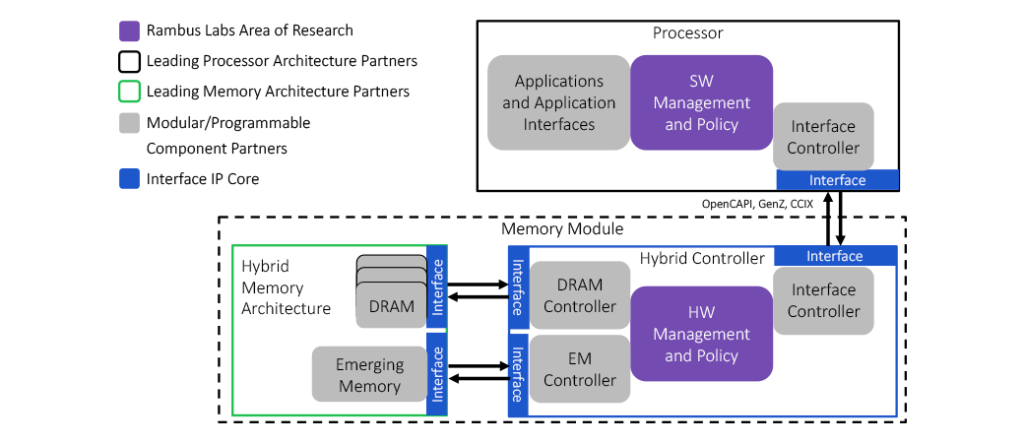
A research program, in partnership with IBM, to explore the use of DRAM with emerging memories (EM) to create a high-capacity memory subsystem that delivers comparable performance to DRAM.
Flexible Interface
Memory and processor agnostic by using advanced interfaces like OpenCAPI, GenZ, and CCIX
Low Latency
Researching options for hybrid architectures that perform at the same or similar speeds as current DRAM solutions
Increased Capacity
Exploring emerging memory technology options to offer significantly higher capacities
A Growing Requirement for Increased Memory Capacities
Leading-edge technologies, such as big data analytics and deep learning (a specific subset of artificial intelligence), are creating an increasing demand for memory capacity and performance inside the data center. For example, deep learning techniques that leverage neural networks are being used in autonomous driving applications for voice or facial recognition and are required to analyze and compute large data sets at incredible speeds. Due to this, the memory bandwidth and capacity in the system directly define the run time of a learning algorithm and are often the limiting factor for the system’s performance.
In addition to these emerging technologies, there are also many current applications that could benefit from a cost-effective way to significantly increase memory capacity. Examples include in-memory databases (IMDB) for faster decision making, media streaming services that could load full movies into memory, large graphic rendering projects (animated movie or game creation) that constantly require terabytes of data to be loaded into memory at a time, and more. Credit card fraud detection is a great example use case that could benefit from large-capacity IMBDs. The bank behind a credit card is required to approve or reject a transaction from any user at any given moment in time, which requires them to quickly access large amounts of information every transaction. Having decision making information directly available in-memory (versus disk storage) will allow the bank to make quicker, more accurate decisions and could help prevent fraud from occurring.
As seen in the examples above, technology continues advancing and data generation from edge devices is exponentially increasing. Therefore, the requirement for instantaneous calculations is higher than ever, and projects like our hybrid memory research are solving key limitations that will continue advancing hardware and reduce bottlenecks in the data center.
The CryptoMedia Security Platform is a complete content storage solution and includes a hardware root-of-trust, player software and trusted key provisioning services to meet the growing demand for high-quality digital movie watching experiences of 4K Ultra-high Definition (UHD) and High Dynamic Range (HDR) content. CryptoMedia solutions deliver a secure digital ownership experience for premium content across multiple devices, including smartphones, tablets, smartTVs and home storage devices.
- The Player Core that provides protection for stored media while still providing ease of use for the consumer in accessing their content through VIDITY-compliant player devices;
- The Player Agent that is available standalone or integrated with the Key Derivation Core for secure acquisition and playback of VIDITY content; and
- The Key Issuance Center (KIC) that provides keys to player and storage device manufacturers, as well as content providers in the VIDITY ecosystem.
- DPA Resistant Solutions, including cryptographic hardware cores and software libraries, that provide protection against side channel attacks
Architecting a Hardware-Managed Hybrid DIMM Optimized for Cost/Performance
Rapidly evolving workloads and exploding data volumes place great pressure on data-center compute, IO, and memory performance, and especially on memory capacity. Increasing memory capacity requires a commensurate reduction in memory cost per bit. DRAM technology scaling has been steadily delivering affordable capacity increases, but DRAM scaling is rapidly reaching physical limits. Other technologies such as Flash, enhanced Flash, Phase Change Memory, and Spin Torque Transfer Magnetic RAM hold promise for creating high capacity memories at lower cost per bit. However, these technologies have attributes that require careful management.
Feed the Starving CPUs
Moore’s Law has allowed computing gains through clock speeds, increasing the number of cores, and supplemental computing through the use of accelerators, but DRAM has not kept pace and memory is the growing bottleneck in the data center. Although DRAM is currently the memory of choice for low latencies, its capacity limitations are creating a surplus of computing power. The standard way to increase capacity is through increased memory modules or increased memory channels, but this comes at a cost through dollars, area, and power. Rambus is continuously working to feed the point of computing through products like our Server DIMM Chipsets for registered and load-reduced memory modules (RDIMMs and LRDIMMs), which enable increased DRAM capacities while maintaining maximum performance. Although RDIMM and LRDIMM options are a much needed stop-gap, we understand that the divergence between processing power and memory is growing and other ideas or architectures must be considered. Rambus, as a leader in memory interface and architecture design, continues to research and innovate in this field looking for possible ways to feed data starved CPUs by reducing the latency gap between DRAM and other, higher capacity, technologies.